📝 Paper Summary
Spatial reasoning
Embodied AI agent
Path planning
S2RCQL improves LLM maze navigation by converting raw coordinates into explicit entity relations to fix spatial hallucinations and using curriculum Q-learning to address long-term reasoning inconsistencies.
Core Problem
LLMs struggle with spatial reasoning and long-term path planning in maze environments due to spatial hallucinations (misunderstanding coordinates) and context inconsistency hallucinations (losing track during long reasoning chains).
Why it matters:
- Standard prompt engineering (CoT) and even memory-augmented methods (Rememberer) often fail in simple mazes because LLMs intuitively favor shortest straight-line paths, ignoring obstacles.
- Spatial reasoning is foundational for embodied intelligence, yet current LLMs perform poorly on these tasks compared to humans.
Concrete Example:
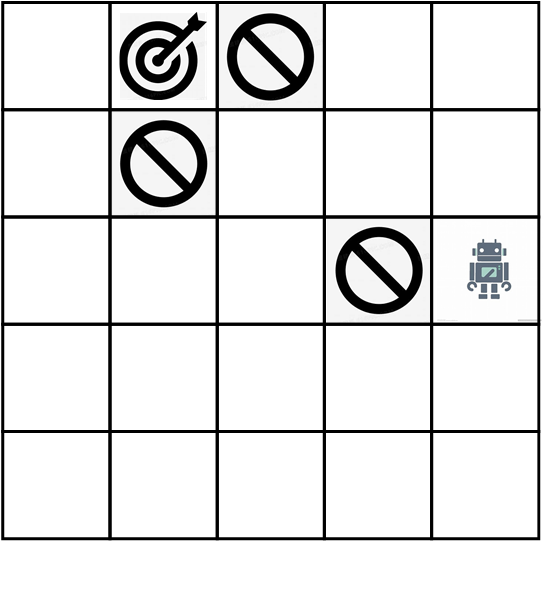
In a maze with obstacles, an LLM might try to move from (1,0) to (1,1) because the coordinates look similar or geometrically close, even if a wall exists between them. Standard CoT agents often get stuck in forbidden zones or lose direction after a few steps.
Key Novelty
Spatial-to-Relational Transformation and Curriculum Q-Learning (S2RCQL)
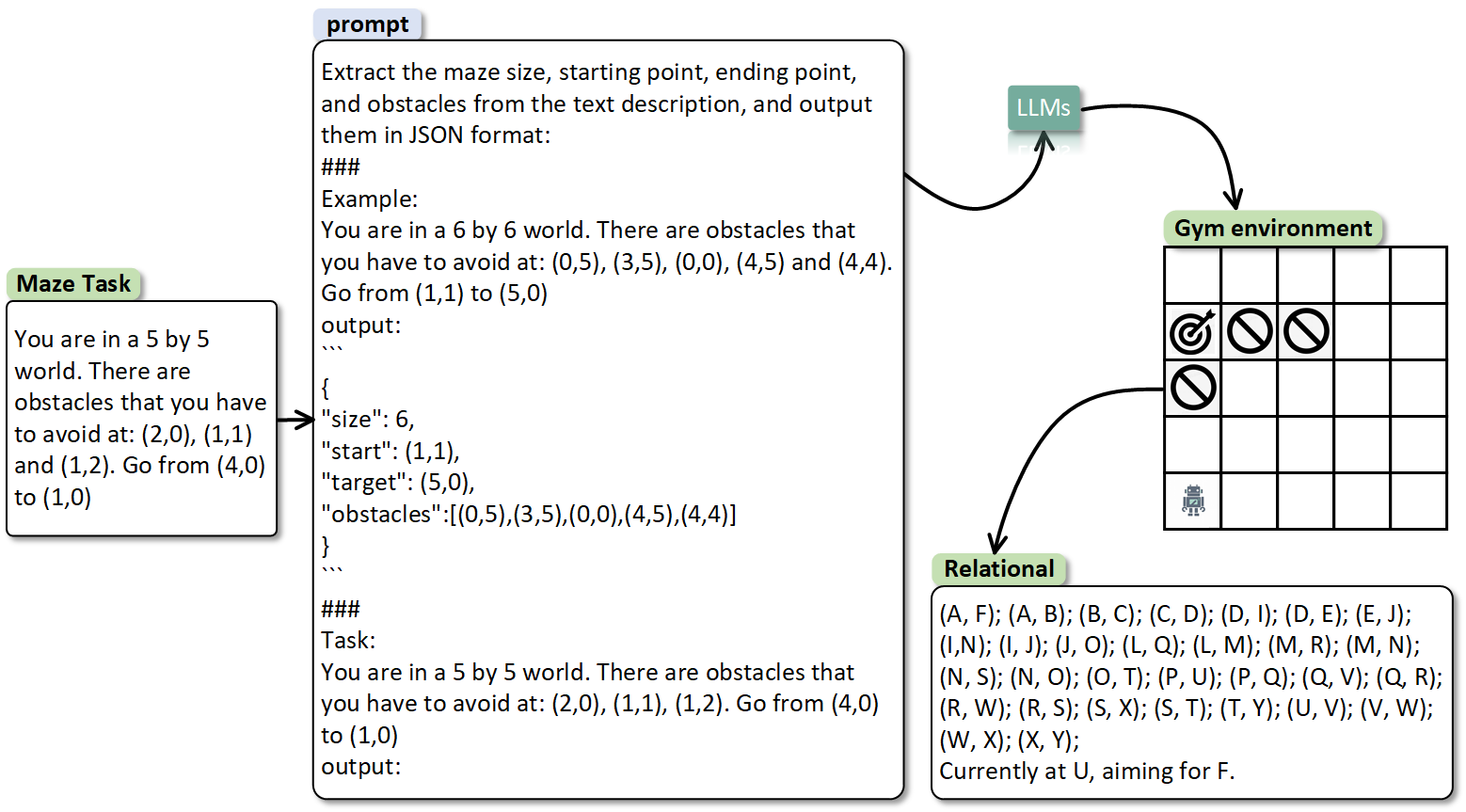
- Transforms implicit spatial coordinates (e.g., '(0,0) to (1,0)') into explicit entity relations (e.g., 'Node A connected to Node F') to prevent LLMs from hallucinating based on coordinate similarity.
- Integrates Q-learning directly into the prompt context: the agent retrieves Q-values for state-action pairs to guide decision-making, replacing random exploration with LLM prior knowledge.
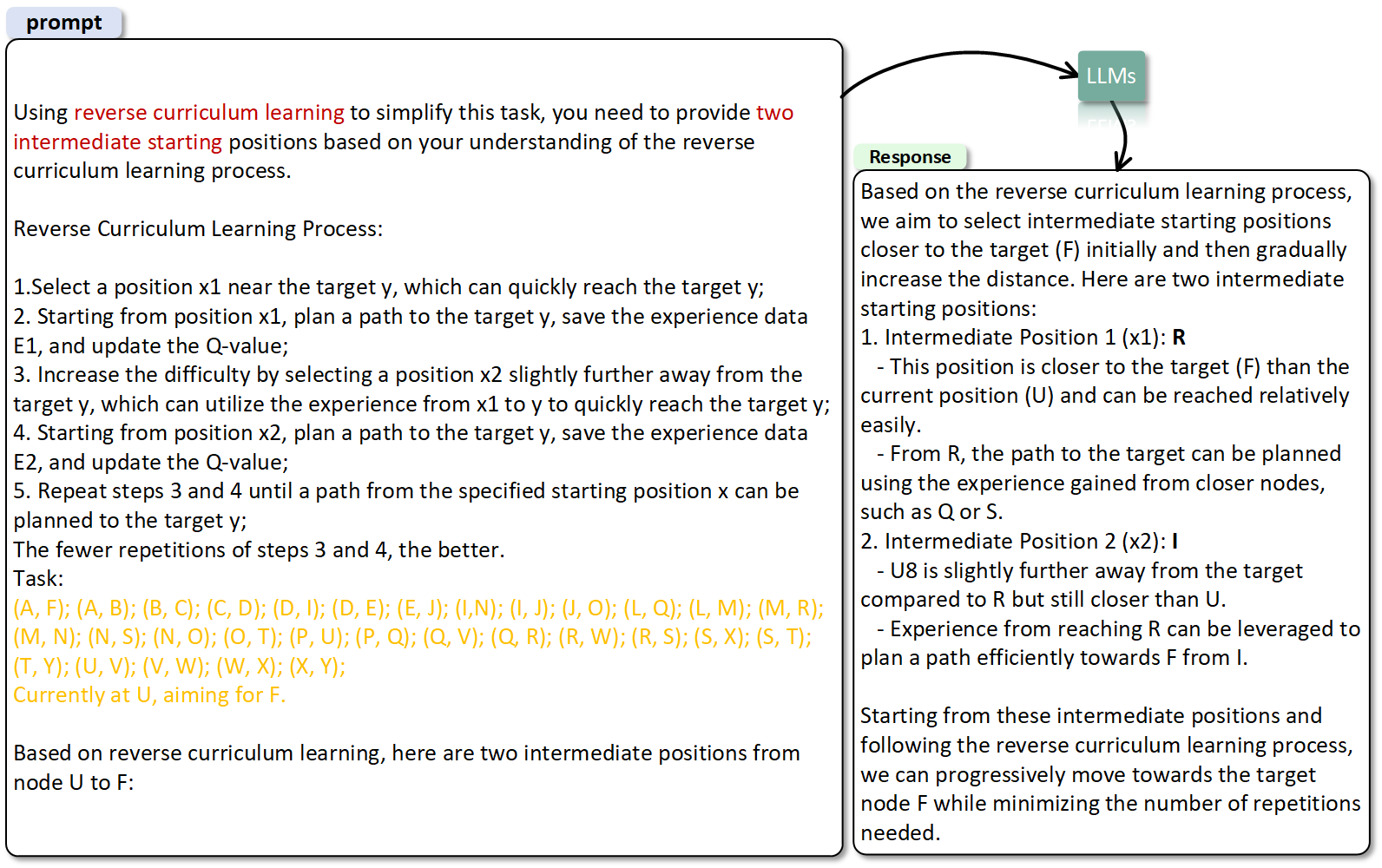
- Uses Reverse Curriculum Learning (RCL) to generate simplified intermediate starting points, allowing the LLM to learn from easy-to-hard tasks and reduce reasoning chain length.
Architecture
The S2RCQL framework overview, showing the interaction between Environment, Agent, and Course Module.
Evaluation Highlights
- Outperforms the 'Rememberer' baseline by 25%–40% in Success Rate across 5x5, 7x7, and 10x10 mazes.
- Achieves 23%–30% higher Optimality Rate (finding shortest paths) compared to Rememberer.
- Removing the Spatial-to-Relational (S2R) module causes a ~15% drop in success rates, validating its role in mitigating spatial hallucination.
Breakthrough Assessment
7/10
Novel combination of symbolic transformation (spatial-to-relational) and RL-guided prompting. Significant empirical gains on maze tasks, though tested on a specific proprietary LLM (ERNIE-Bot) rather than open models.