📝 Paper Summary
Hallucination suppression
Factuality in data-to-text generation
SymGen prompts LLMs to generate text interleaved with symbolic references to input data fields, enabling precise provenance tracking and easier human verification without sacrificing fluency.
Core Problem
LLM outputs are vulnerable to hallucinations and require laborious human verification, especially in high-stakes applications involving structured data.
Why it matters:
- Newspapers generating sports summaries and search engines grounding output in results need guarantees that text faithfully reflects the source data
- Current approaches either rely on rigid, robotic templates or fully neural generation that is fluent but prone to hallucinations
- Manual verification of standard LLM output is time-consuming because users must hunt for the source of every claim
Concrete Example:
When summarizing a basketball game, a standard LLM might write 'The Celtics won by 10 points.' If the score was actually different, the user must manually check the box score. SymGen generates 'The {{visitor.city}} won by {{win_margin}} points,' where clicking '10' explicitly links to the exact cell in the source JSON.
Key Novelty
Symbolically Grounded Generation (SymGen)
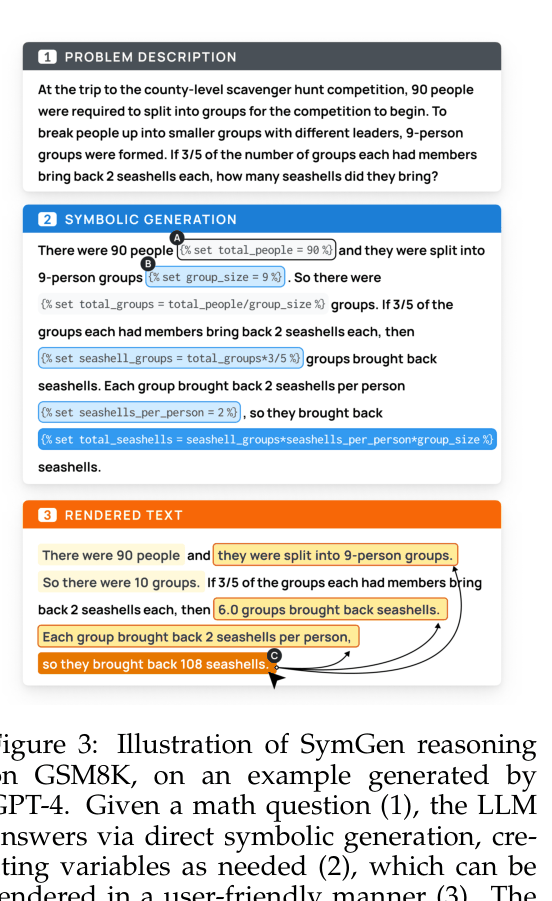
- Prompt the LLM to act as a template engine: instead of generating plain text, it generates text containing symbolic variables (e.g., {{ data.field }})
- A separate parser renders these variables into the final values, ensuring that the displayed numbers/facts come directly from the trusted source data
- The system can be prompted directly (generate symbols immediately) or indirectly (generate text first, then convert to symbols) to handle complex reasoning
Architecture
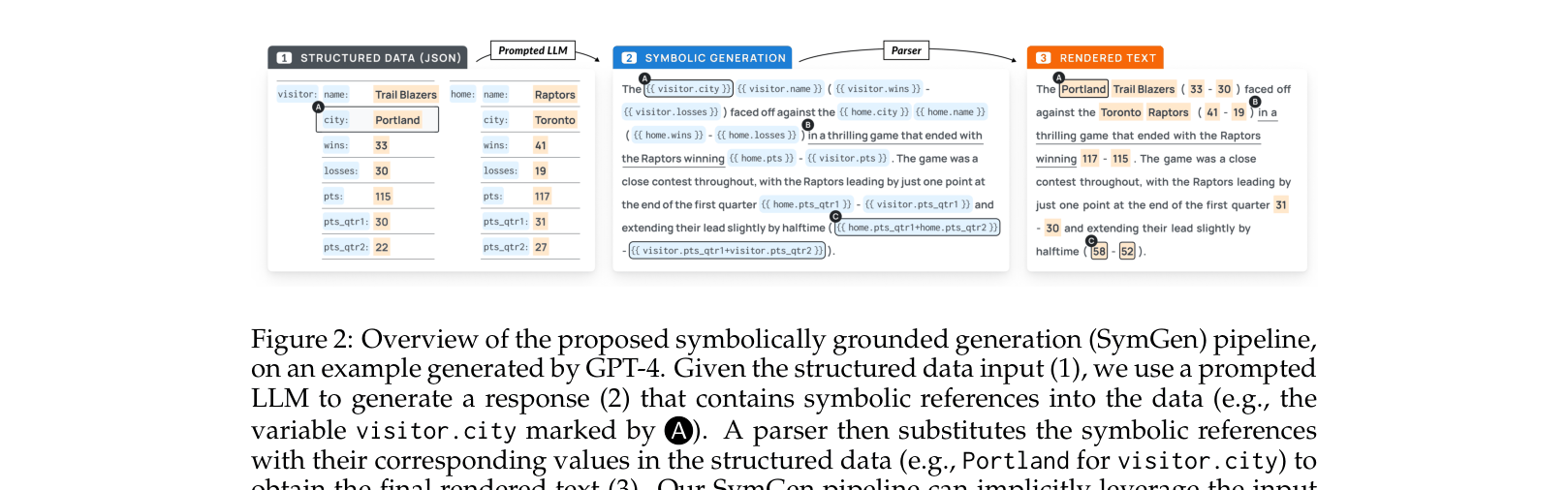
Overview of the SymGen pipeline processing a basketball game summary
Evaluation Highlights
- SymGen annotations reduce human verification time by ~20% compared to unannotated text on the Rotowire dataset
- Annotators perceive the verification task as 14% easier when using SymGen annotations
- Symbolic reference accuracy (linking text to correct data fields) is >99.5% for SymGen compared to <47% for a regex-based baseline
Breakthrough Assessment
7/10
Simple yet highly effective method for verifiability. While not a new model architecture, it cleverly bridges neural fluency with symbolic rigidity for high-stakes data-to-text tasks.