📝 Paper Summary
Knowledge Editing
Model Editing
MOSE replaces traditional additive parameter updates with multiplicative orthogonal transformations to preserve numerical stability and model performance during sequential knowledge editing.
Core Problem
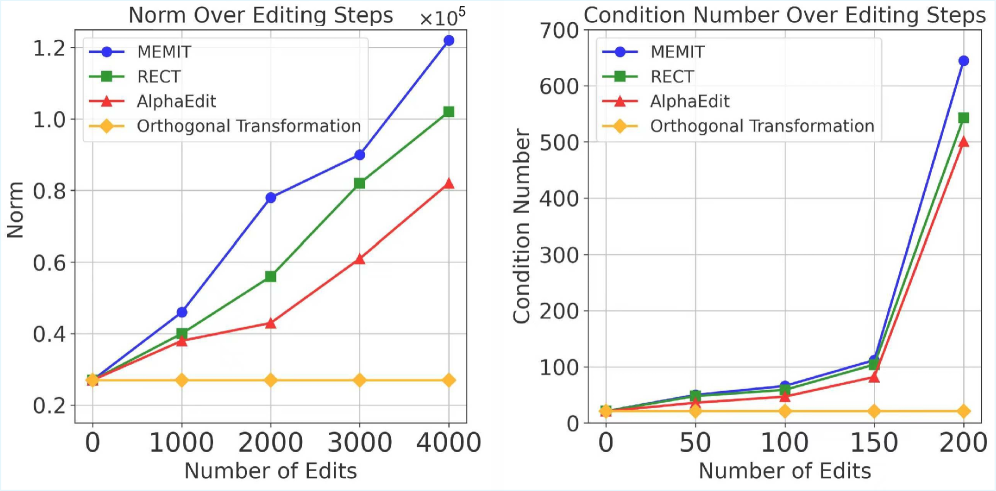
Existing sequential editing methods use additive updates that progressively degrade the numerical stability (norm and condition number) of parameter matrices, damaging the model's general abilities.
Why it matters:
- Sequential editing is essential for keeping LLMs up-to-date without expensive retraining, but current methods degrade rapidly after multiple updates
- Loss of numerical stability leads to 'catastrophic forgetting' where the model loses general capabilities and reasoning skills while learning new facts
Concrete Example:
After 4000 sequential edits on LLaMA3-8B using additive methods like ROME, the matrix condition number spikes, causing the model to fail on both retained knowledge and downstream tasks like summarization.
Key Novelty
Multiplicative Orthogonal Sequential Editing (MOSE)
- Instead of adding a delta matrix (W + ΔW), MOSE left-multiplies the original weights by an orthogonal matrix (R * W), which mathematically preserves vector lengths and angles
- Solves the update as an 'Orthogonal Procrustes Problem' to find the optimal rotation that aligns new knowledge while keeping old knowledge stable
Architecture
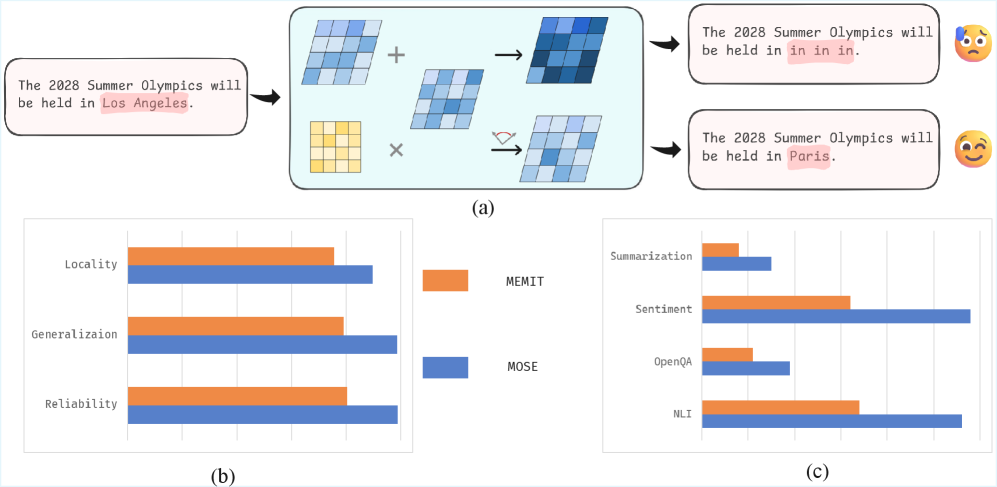
Comparison of Additive vs. Multiplicative editing paradigms.
Evaluation Highlights
- +12.08% improvement in sequential editing performance compared to state-of-the-art baselines across LLaMA3-8B and Qwen2.5-7B
- Retains 95.73% of general abilities on downstream tasks (like NLI and summarization) after extensive editing, significantly outperforming additive methods
- Strictly maintains the Frobenius norm and condition number of parameter matrices even after 4000 sequential edits
Breakthrough Assessment
8/10
Offers a mathematically grounded departure from the dominant additive editing paradigm. effectively solving the stability issues that plague continuous model updating.