📝 Paper Summary
Latent Knowledge Estimation (LKE)
Hallucination suppression
ZP-LKE (Zero-Prompt Latent Knowledge Estimator) estimates an LLM's factual knowledge by using lists of example facts to implicitly communicate the relationship, avoiding the reliability issues of prompt engineering.
Core Problem
Existing methods for estimating whether an LLM knows a fact rely on prompt templates (e.g., 'X was born in...'), which conflate the model's actual knowledge with its ability to understand specific instructions (meta-linguistic judgment) and are vulnerable to prompt hacking.
Why it matters:
- Reliable estimation is crucial to prevent hallucinations; models should not assert facts they do not actually 'know'
- Current prompt-based methods introduce side-channels (giving hints) and over-fitting, making estimates unreliable
- Model-specific prompt engineering prevents fair large-scale comparisons across different LLM families
Concrete Example:
For the relation 'position held', a prompt like 'X is elected Y' performs better than 'X has the position of Y', but the former introduces a side-channel by implicitly ruling out non-elected positions, inflating the knowledge estimate artificially.
Key Novelty
Zero-Prompt Latent Knowledge Estimator (ZP-LKE)
- Eliminates explicit instructions entirely; instead of asking 'When was Einstein born?', it provides a sequence like 'Feynman 1918 Heisenberg 1901 Einstein' and checks the completion
- Leverages 'task learning' (inferring the relationship from examples) rather than just 'task recognition' (using examples to format an answer), requiring many-shot examples to work effectively
Architecture
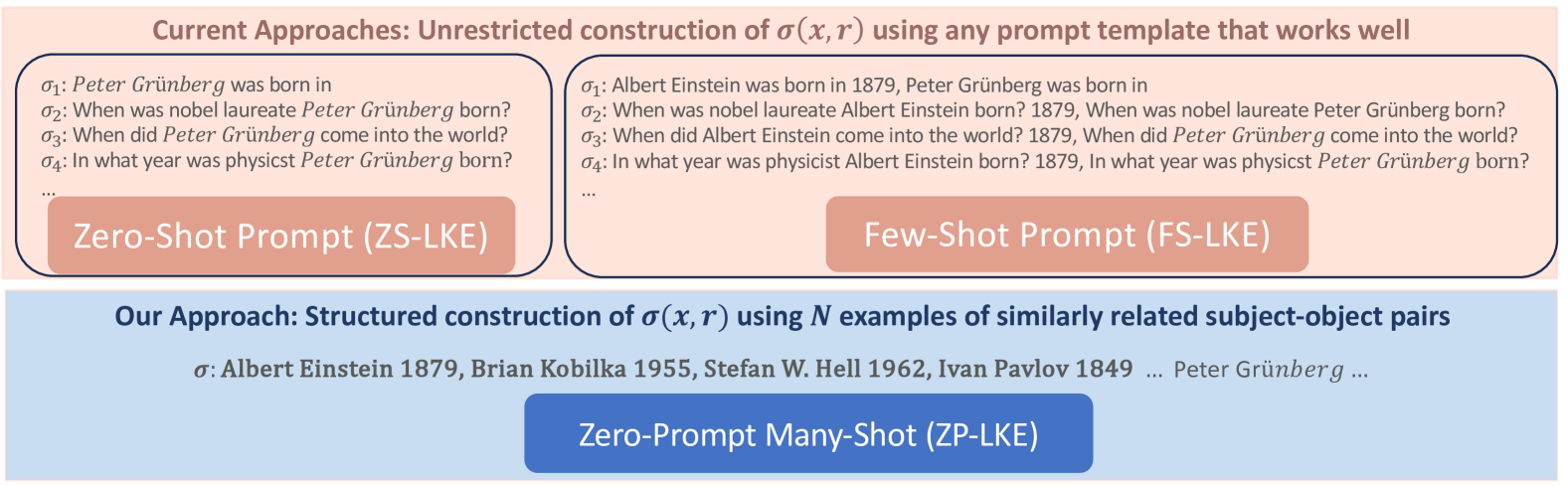
Contrast between Prompt-based LKE (Zero-shot and Few-shot) and the proposed Zero-Prompt LKE (ZP-LKE).
Evaluation Highlights
- ZP-LKE improves accuracy of extracted facts by +35% over Human-Generated Prompts (0.45 to 0.61) and +90% over Machine-Mined Prompts (0.32 to 0.61) on T-Rex dataset using response testing
- In multiple-choice testing, ZP-LKE outperforms baselines by 9.4% for Human-Generated Prompts (0.71 to 0.78) and 57% for Machine-Mined Prompts (0.50 to 0.78)
- For complex relations like 'position played on team', ZP-LKE improves extraction by 152% (0.17 to 0.43) over human prompts
Breakthrough Assessment
8/10
Significantly improves reliability of knowledge probing by removing prompt engineering artifacts. Offers a standardized, model-agnostic way to benchmark latent knowledge across diverse LLMs.