📝 Paper Summary
Factuality Evaluation
Hallucination Suppression
Model Calibration
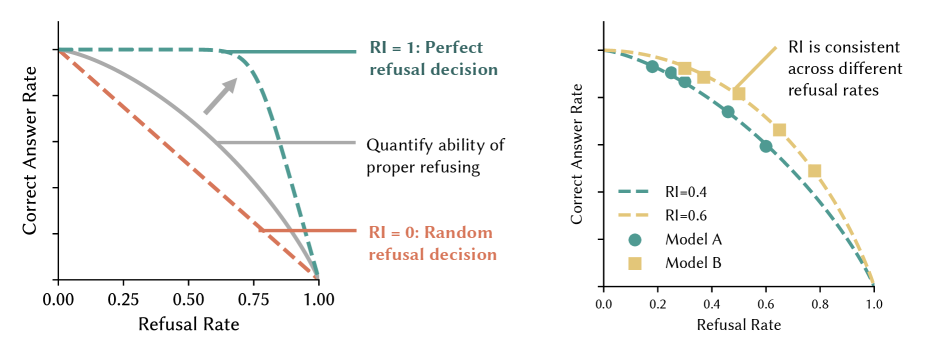
The Refusal Index measures an LLM's ability to refuse unknown questions by calculating the rank correlation between its refusal probability and its error probability using a two-pass evaluation.
Core Problem
Existing factuality metrics fail to accurately measure whether models refuse questions based on actual knowledge gaps; simple refusal rates are biased by model tendencies, while calibration metrics measure proxy processes rather than the model's intrinsic refusal behavior.
Why it matters:
- LLMs frequently hallucinate answers with high confidence, necessitating reliable refusal mechanisms for safe deployment
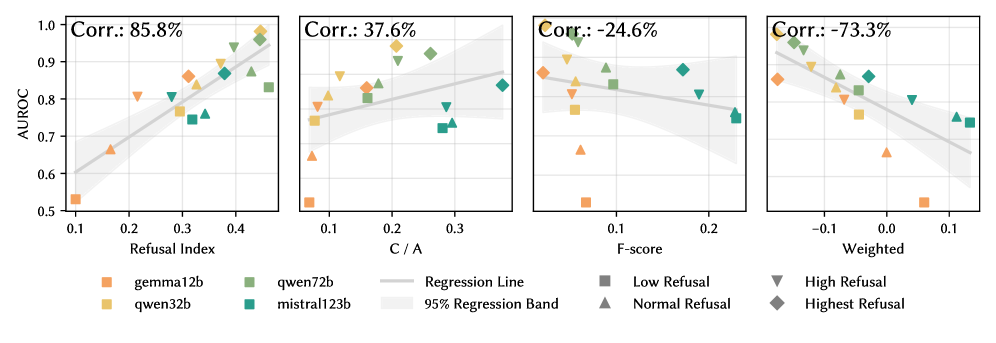
- Current metrics like F-score or Weighted Score are inconsistent, fluctuating wildly based on a model's arbitrary refusal threshold rather than its actual knowledge boundary
- Standard calibration metrics (ECE) rely on verbalized confidence or auxiliary models, which often misalign with the model's actual generation behavior
Concrete Example:
A model instructed to be conservative might achieve a high score simply by refusing everything (high refusal rate), even if it knows the answers. Conversely, a model might refuse random questions rather than difficult ones. Existing metrics struggle to distinguish a model that refuses *because* it doesn't know from a model that refuses due to a conservative prompt.
Key Novelty
Refusal Index (RI) via Two-Pass Evaluation
- Defines knowledge-aware refusal as the Spearman rank correlation between a model's likelihood to refuse and its likelihood to be wrong, independent of the absolute refusal rate
- Uses a lightweight two-pass process: Pass 1 allows refusal to observe behavior; Pass 2 forces an answer to check correctness. These binary signals are then fitted to a Gaussian copula to estimate the underlying correlation
Architecture
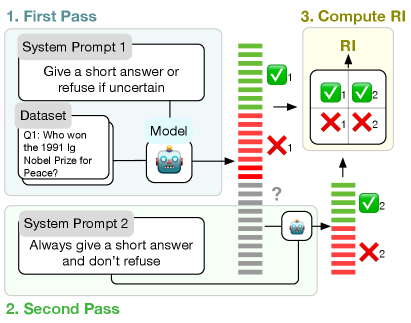
The Two-Pass Evaluation process used to compute the Refusal Index.
Evaluation Highlights
- RI demonstrates ~70% lower variability than heuristic metrics (F-score, Weighted Score) when tested on the same model across different refusal-inducing prompts
- RI achieves 85% correlation with computationally expensive sampling-based calibration methods (AUROC on P(Answering)), validating it as a faithful calibration proxy
- Model family is the strongest predictor of RI performance, with consistent rankings independent of model scale or instruction tuning
Breakthrough Assessment
8/10
Provides a mathematically grounded, robust metric for a critical safety capability (refusal). Solves the long-standing issue of metric instability caused by varying refusal rates.