📝 Paper Summary
Graph-based RAG pipeline
Knowledge Graph Construction
HyperGraphRAG models complex knowledge as a hypergraph where edges connect multiple entities simultaneously, enabling the retrieval of complete n-ary facts rather than fragmented binary triples found in standard graph RAG.
Core Problem
Existing graph-based RAG methods rely on ordinary graphs where edges connect only two entities (binary relations), causing information loss when modeling complex real-world facts involving three or more entities.
Why it matters:
- Real-world knowledge (especially in medicine and law) often involves n-ary relations (e.g., Patient + Symptom + Test Result -> Diagnosis) that cannot be naturally represented by simple binary links.
- Decomposing complex facts into binary triples leads to representation sparsity and fragmentation, forcing the retrieval system to hop multiple times to reconstruct a single coherent fact.
- Standard chunk-based RAG misses structural connections entirely, while current GraphRAG approaches over-simplify these connections.
Concrete Example:
A medical fact like 'Male hypertensive patients with serum creatinine 115–133µmol/L are diagnosed with mild elevation' involves 4 entities. A binary graph splits this into separate triples like (Patient, Male) and (Patient, Mild elevation), losing the specific condition that links all four.
Key Novelty
Hypergraph-structured Knowledge Representation for RAG
- Utilizes hyperedges that connect $n$ entities ($n \ge 2$) simultaneously, preserving the integrity of complex facts instead of breaking them into binary triples.
- Stores the hypergraph in a bipartite graph database (connecting hyperedge nodes to entity nodes) to allow efficient retrieval while maintaining higher-order structural information.
- Employes a 'hyperedge retrieval' strategy that matches queries directly to these complex n-ary facts, fused with standard text chunks for generation.
Architecture
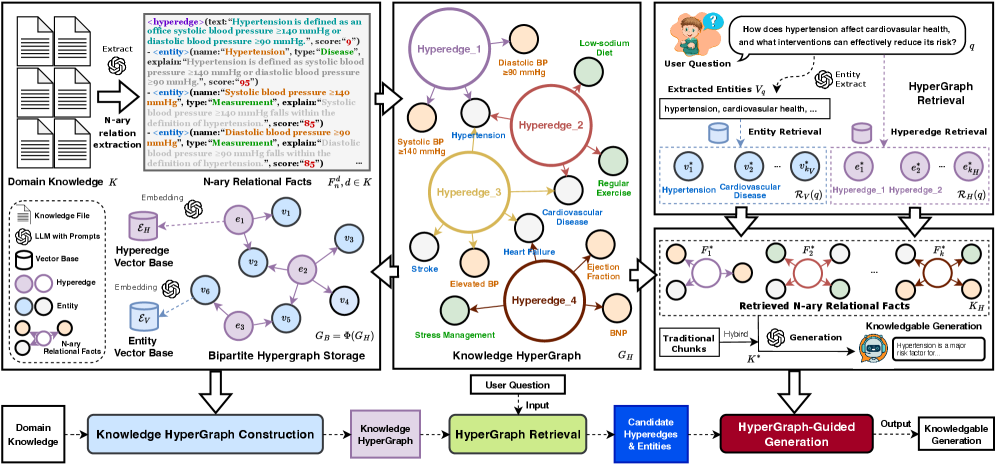
The HyperGraphRAG pipeline: Construction, Retrieval, and Generation.
Evaluation Highlights
- +7.45 F1 improvement over StandardRAG across five domains (Medicine, Agriculture, CS, Legal, Mixed).
- Outperforms GraphRAG (binary graph baseline) by +5.9 F1 score on average across domains.
- Achieves highest Correctness score (64.8) in LLM-as-a-judge evaluation, surpassing both LightRAG (60.9) and GraphRAG (59.6).
Breakthrough Assessment
8/10
Addresses a fundamental limitation of graph RAG (binary constraint) with a mathematically sound hypergraph approach. Strong empirical gains across diverse domains validate the method's effectiveness.