📝 Paper Summary
Tree/graph-based memory
Layered memory
Synapse is a brain-inspired agentic memory system that retrieves information by propagating activation energy through a unified graph of interaction logs and abstract concepts, rather than relying solely on vector similarity search.
Core Problem
Standard RAG systems treat memory as a static library indexed by semantic similarity, leading to 'Contextual Isolation' where structurally linked but semantically distinct memories (like a schedule conflict causing anxiety) are missed.
Why it matters:
- Autonomous agents fail at long-horizon tasks requiring causal or transitive reasoning because vector search cannot bridge gaps between lexically distinct events
- Existing graph approaches either optimize for global dataset summaries (too expensive) or lack the granularity and time-decay mechanisms needed for specific episodic recall
- Current systems struggle to distinguish between 'not remembering' and 'not existing,' leading to hallucinations when queried about non-existent entities
Concrete Example:
If a user asks 'Why am I feeling anxious today?', a standard vector system retrieves recent mentions of 'anxiety' but misses a 'schedule conflict' logged weeks prior because the conflict shares no words with the query. Synapse retrieves the conflict by propagating activation from the user node to the conflict node via temporal edges.
Key Novelty
Unified Episodic-Semantic Graph with Cognitive Dynamics
- Constructs a dual-layer graph where raw interaction logs (episodic) are linked to abstract concepts (semantic), bridging the gap between specific events and general knowledge
- Retrieves memories using 'Spreading Activation' (inspired by ACT-R), where energy flows from query anchors through graph edges, prioritizing structurally relevant nodes even without direct vector similarity
- Implements 'Lateral Inhibition' to suppress irrelevant but highly active nodes, preventing common concepts (hubs) from flooding the retrieval results
Architecture
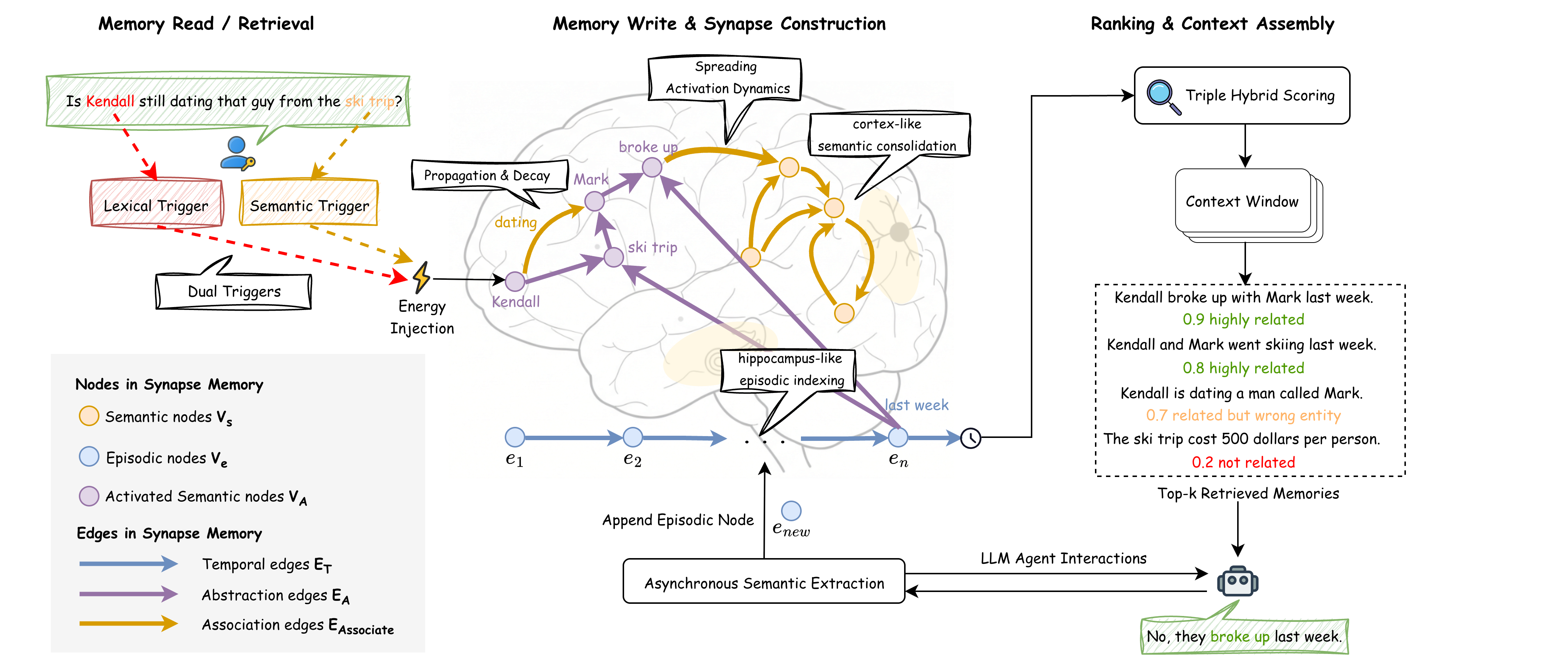
The overall framework of Synapse, illustrating the Unified Episodic-Semantic Graph and the retrieval process
Evaluation Highlights
- Achieves 40.5 Weighted F1 on the LoCoMo benchmark, surpassing state-of-the-art A-Mem (33.3) and Zep (39.7) by significant margins
- Reduces token consumption by 95% compared to full-context methods (814 tokens vs. ~16,910) while improving multi-hop reasoning accuracy
- Attains 96.6 F1 on Adversarial tasks via uncertainty gating, effectively rejecting hallucinations where baselines like LoCoMo fail (69.2 F1)
Breakthrough Assessment
8/10
Strong methodological contribution introducing cognitive science principles (Spreading Activation) to agentic memory. Resolves a critical failure mode of RAG (Contextual Isolation) with convincing efficiency and SOTA results.