📝 Paper Summary
Graph-based RAG pipeline
Modularized RAG pipeline
CommunityKG-RAG enhances zero-shot fact-checking by constructing a knowledge graph from articles, detecting community structures to identify relevant subgraphs, and converting these communities into textual context for LLMs.
Core Problem
Existing RAG systems often struggle with multi-hop reasoning and context integration because they retrieve fragmented text chunks that lack structural relationships, while direct KG-based methods (feeding triples) confuse LLMs trained on sequential text.
Why it matters:
- LLMs suffer from hallucinations and outdated training data, jeopardizing fact-checking accuracy.
- Standard RAG struggles when crucial information is buried in long texts or when retrieved contexts contain noise/contradictions.
- Directly feeding Knowledge Graph triples (subject, relation, object) to LLMs is suboptimal because models are not trained to leverage such structured formats effectively.
Concrete Example:
When verifying a claim requiring multi-hop reasoning, a standard RAG system might retrieve disparate sentences that don't explicitly link entities. CommunityKG-RAG instead retrieves a 'community' of interconnected entities (e.g., a subgraph of related political figures and events) and converts this structural context into natural language, enabling the LLM to see the full picture.
Key Novelty
Community-Centric Knowledge Graph Retrieval
- Constructs a Knowledge Graph from fact-checking articles and uses the Louvain algorithm to detect 'communities' (clusters of densely connected entities).
- Retrieves entire communities based on semantic similarity to the claim, rather than just individual sentences or triples.
- Converts the retrieved graph communities back into natural language sentences before feeding them to the LLM, bridging the gap between structured knowledge and sequential language processing.
Architecture
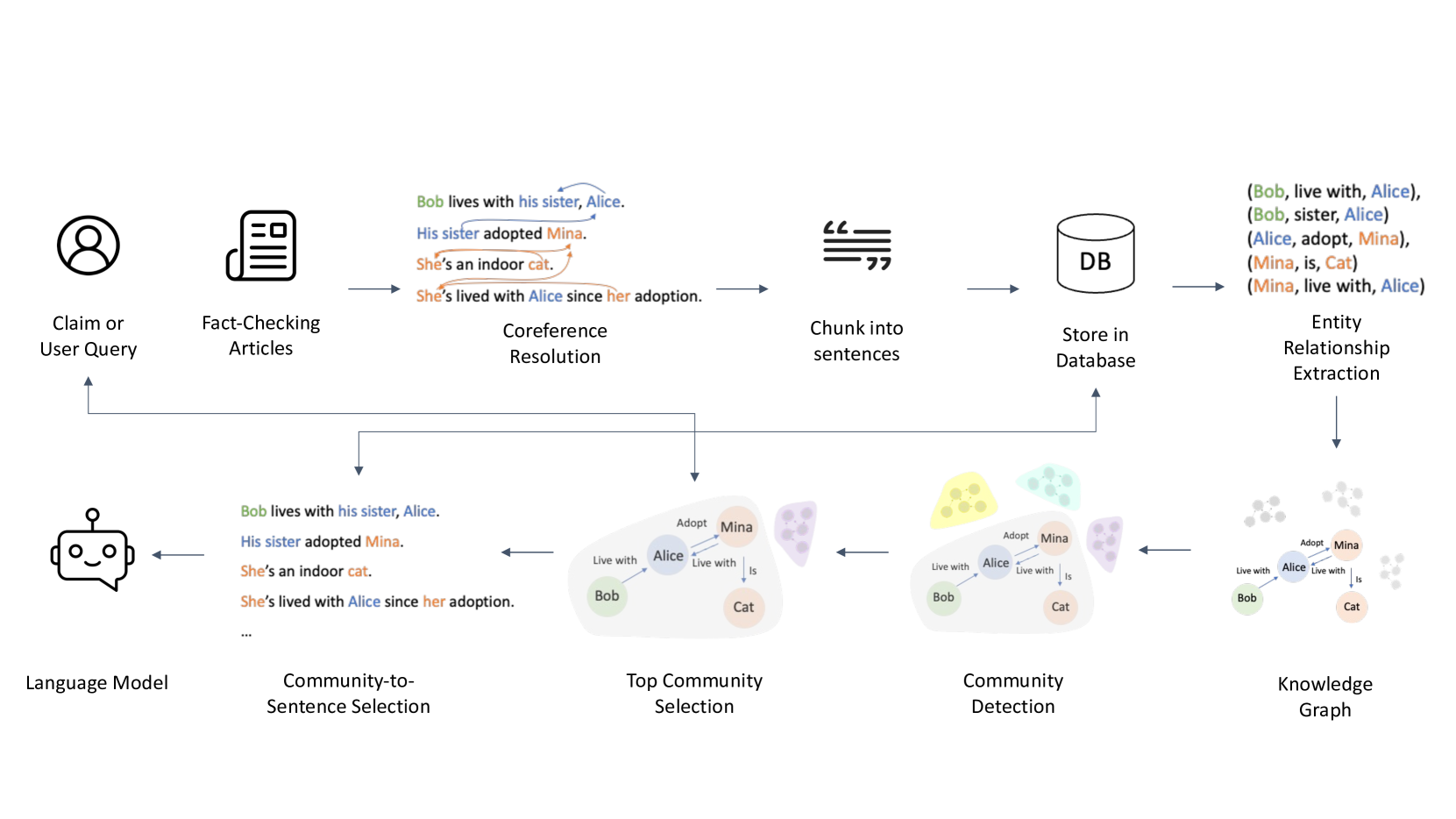
Overview of the CommunityKG-RAG framework pipeline.
Evaluation Highlights
- Outperforms the KAPING baseline by +3.45% in Accuracy on the MOCHEG dataset using Llama-2-7b.
- Achieves higher accuracy (63.02%) compared to Semantic Retrieval (56.09%) and No Retrieval (51.13%) baselines.
- Demonstrates that converting KG communities to sentences is superior to using raw triples, improving results significantly over triple-based methods.
Breakthrough Assessment
7/10
Novel integration of community detection in KGs for RAG. Effectively addresses the structure-vs-text gap in LLMs. Strong zero-shot performance, though evaluated on a single dataset type.