📝 Paper Summary
Medical Recommendation Systems
Modularized RAG pipeline
Hierarchical Reasoning
HiRMed improves medical test recommendations by using a tree-structured RAG system that progressively refines diagnostic decisions from general symptoms to specific departments and finally to individual test items.
Core Problem
Traditional medical test recommendation systems (rule-based or flat similarity matching) fail to capture the hierarchical reasoning process of doctors and often miss complex symptom-disease relationships.
Why it matters:
- Direct vector matching lacks the nuanced, multi-stage reasoning required for accurate medical diagnosis, often overlooking the context of resource constraints and diagnostic uncertainty
- Existing LLM/RAG approaches lack a structural hierarchy, leading to insufficient integration of specialized domain knowledge at different diagnostic stages
- Poor recommendations increase miss rates for critical tests and reduce diagnostic accuracy in outpatient settings
Concrete Example:
A standard RAG system might directly map 'chest pain' to a generic set of tests without first determining if the context suggests a cardiac issue versus a gastrointestinal one, potentially missing specialized cardiac markers.
Key Novelty
Hierarchical RAG-enhanced Medical Test Recommendation (HiRMed)
- Implements a tree-structured architecture (Root → Department → Item) where each node performs a specialized RAG process to narrow down the diagnostic path progressively
- Uses a dual-layer knowledge base (general department-level vs. specific item-level) to provide context-appropriate medical knowledge at each reasoning stage
- Incorporates a memory mechanism to pass reasoning history between layers, ensuring consistency as the system moves from broad symptom assessment to specific test selection
Architecture
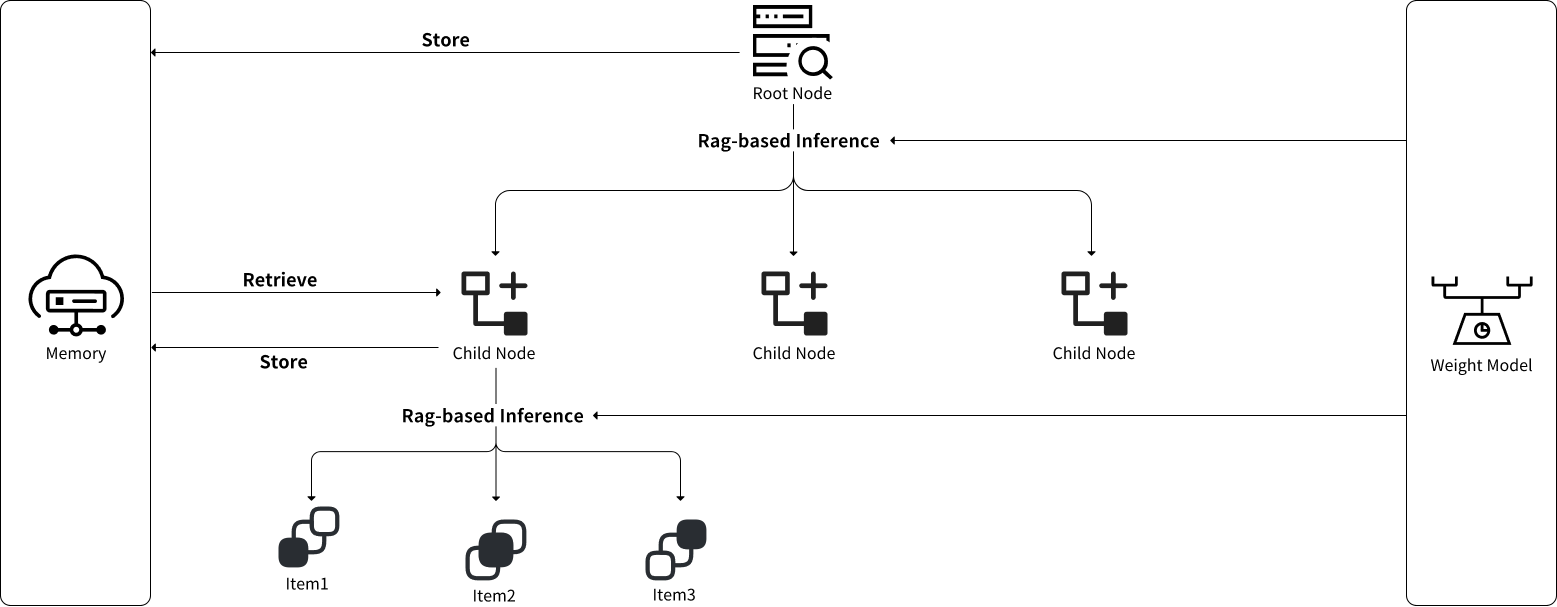
The three-layer hierarchical architecture of HiRMed (Root Layer → Department Layer → Item Layer), showing how patient queries are processed through progressive reasoning steps.
Evaluation Highlights
- Achieves 92.3% coverage rate of relevant diagnostic tests, outperforming traditional vector similarity (72.8%) and flat RAG (84.7%)
- Reduces miss rate for critical tests to 2.1%, compared to 5.8% for flat RAG and 10.6% for vector similarity
- Attains a clinical relevance score of 4.3/5.0 in expert physician review, verifying the medical appropriateness of recommendations
Breakthrough Assessment
7/10
Strong practical application of hierarchical RAG to the medical domain with significant performance gains over flat baselines. While the components (RAG, trees) are known, the specific integration for medical reasoning is well-executed and validated.