📝 Paper Summary
Memory recall
Modularized RAG pipeline
Emotional RAG mimics human cognition by retrieving memories based on both semantic relevance and emotional congruence, enabling role-playing agents to generate more character-consistent responses.
Core Problem
Existing RAG methods for role-playing agents rely solely on semantic similarity to retrieve memories, ignoring the psychological influence of emotions on memory recall.
Why it matters:
- Role-playing agents (e.g., in customer service or games) need to maintain consistent personalities, but purely semantic retrieval often misses the emotional context required for human-like responses
- Current approaches fail to leverage Mood-Dependent Memory theory, which suggests memories are better recalled when current mood matches the mood at encoding
Concrete Example:
If a character is currently angry, standard RAG might retrieve a semantically relevant but emotionally neutral memory (e.g., a fact about their job), whereas Emotional RAG would prioritize retrieving memories of past anger or conflict, leading to a more consistent angry response.
Key Novelty
Mood-Congruent Memory Retrieval
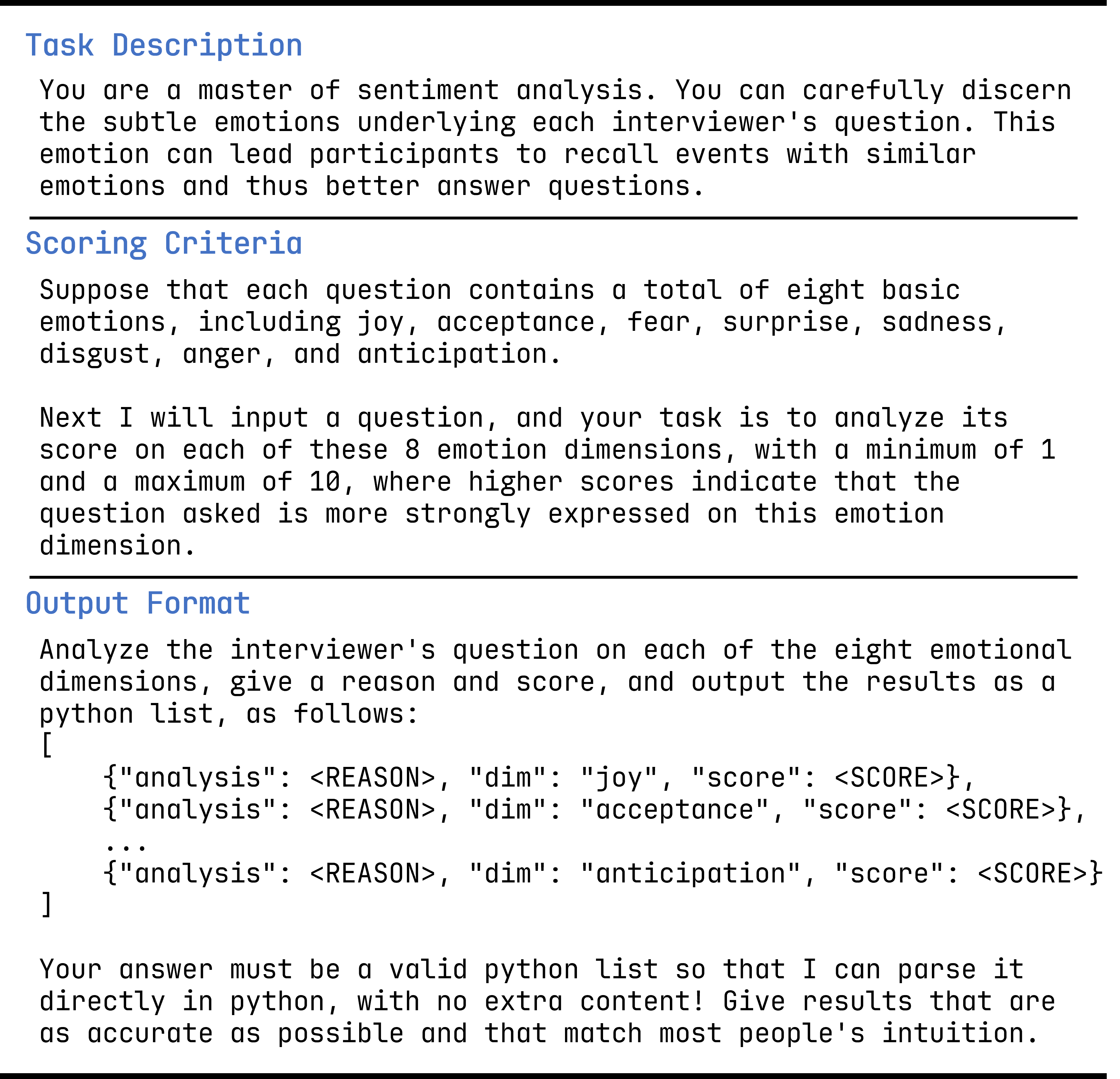
- Encodes both the semantic meaning and the emotional state (across 8 dimensions like joy, fear, anger) for every user query and stored memory fragment
- Calculates retrieval scores using a dual metric: semantic distance (Euclidean) combined with emotional distance (Cosine similarity of emotion vectors)
- Applies flexible strategies (Combination or Sequential) to weight or re-rank memories, prioritizing those that match the character's current emotional state
Architecture
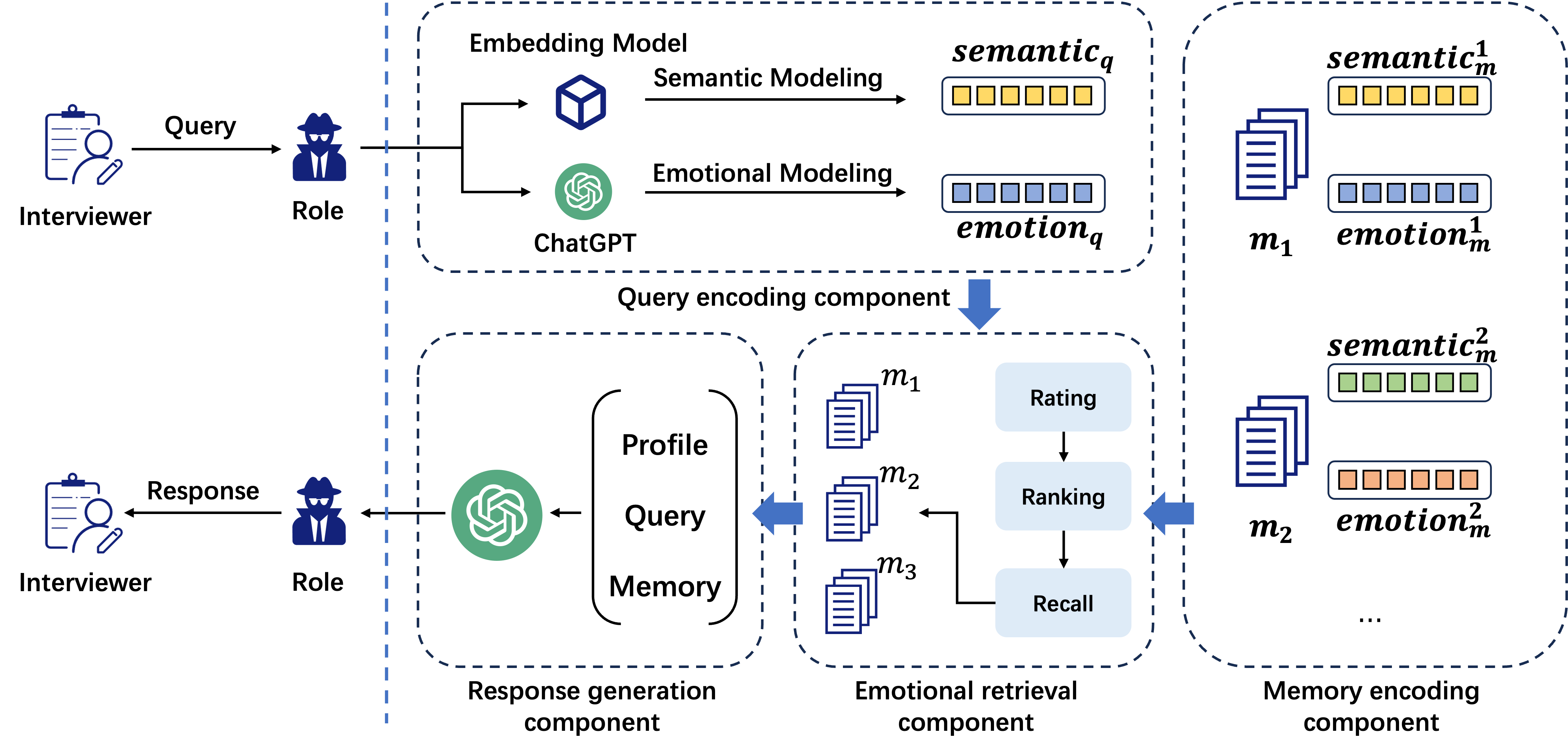
Overview of the Emotional RAG framework, illustrating the parallel processing of queries and memories for both semantic and emotional content.
Evaluation Highlights
- Outperforms Ordinary RAG (semantic-only) on InCharacter dataset using ChatGLM-6B: +0.027 MSE improvement on BFI personality consistency
- Achieves higher MBTI accuracy on CharacterEval dataset with Qwen-72B: 67.53% Acc (Full) vs 59.74% for Ordinary RAG
- Consistent gains across three datasets (InCharacter, CharacterEval, Character-LLM) verify that emotional context aids personality maintenance
Breakthrough Assessment
7/10
Novel application of psychological memory theory to RAG. While the architectural changes are straightforward (dual encoding), the consistent empirical gains across personality benchmarks demonstrate the value of emotional context.