📝 Paper Summary
Graph-based RAG pipeline
Benchmark
A unified framework that decomposes existing graph-based RAG methods into modular operators, enabling systematic comparison and the discovery of a new, more effective operator combination (VGraphRAG).
Core Problem
Numerous graph-based RAG methods have been proposed, but they lack a systematic comparison under identical settings and a unified framework to understand their core components.
Why it matters:
- Without a unified view, it is difficult to isolate which specific components (e.g., retrieval operators, graph types) drive performance improvements
- Existing evaluations often focus on overall system performance rather than individual module contributions, obscuring the trade-offs between accuracy and efficiency
- The lack of standardized comparison hampers the development of new methods that could combine the best features of existing approaches
Concrete Example:
On the Quality dataset, RAPTOR improves accuracy by 53.80% over ZeroShot, while G-retriever decreases it by 14.17%, yet without a framework, it's unclear whether this is due to the graph structure (Tree vs. KG) or the retrieval operator (vector search vs. subgraph retrieval).
Key Novelty
Unified 4-Stage Graph-RAG Framework & Operator Pool
- Abstracts all graph-based RAG methods into four stages: Graph Building, Index Construction, Operator Configuration, and Retrieval & Generation
- Decouples the retrieval stage into a pool of 19 distinct operators (e.g., vector search, personalized PageRank, Steiner tree) that can be mixed and matched
- Identifies a new State-of-the-Art method (VGraphRAG) by combining entity-relationship retrieval with vector-based community/chunk search, outperforming existing complex QA baselines
Architecture
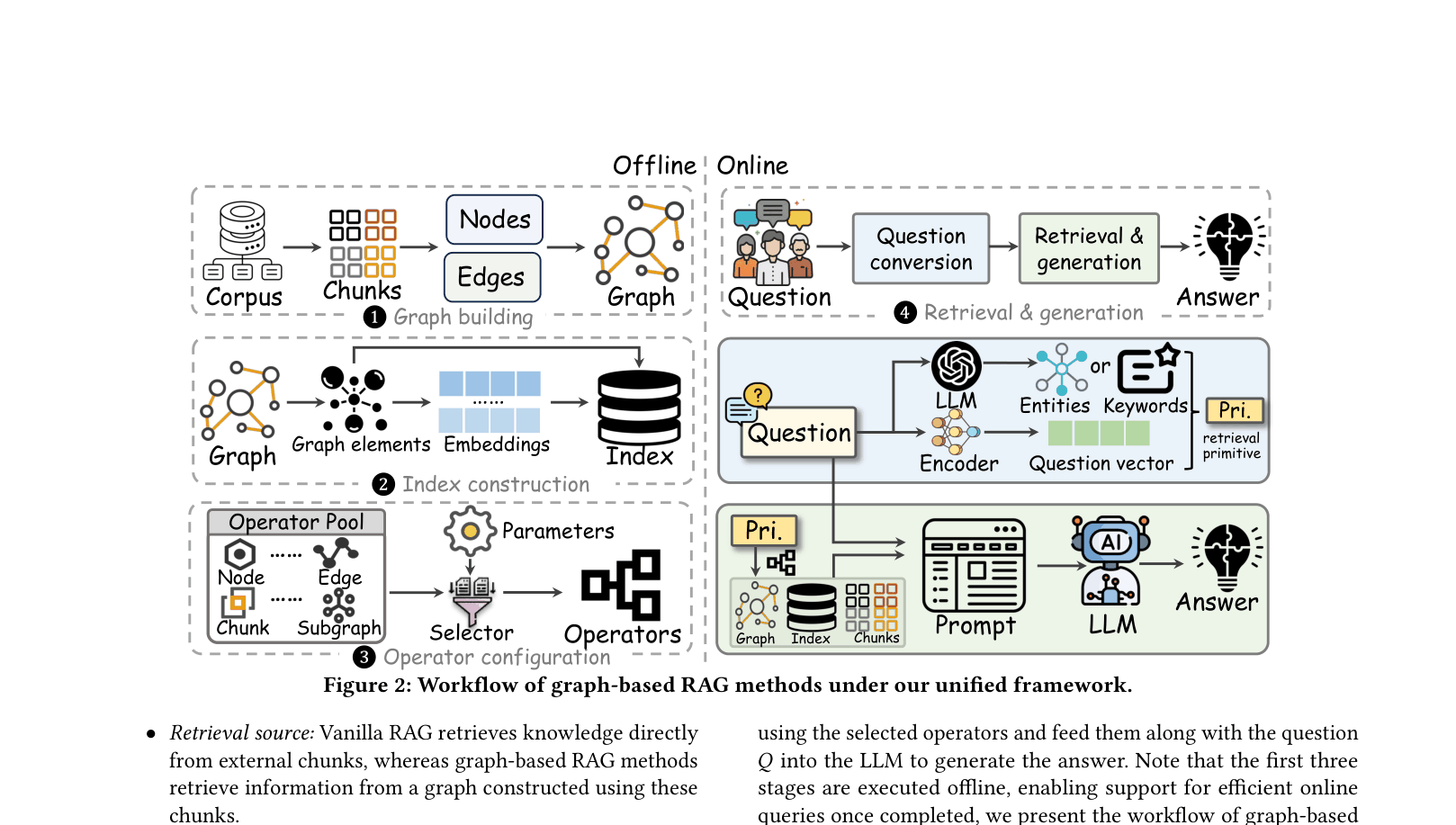
The unified framework workflow showing the four stages: Graph building, Index construction, Operator configuration, and Retrieval & generation.
Evaluation Highlights
- +6.42% accuracy improvement by the proposed VGraphRAG over the state-of-the-art RAPTOR on the MultihopQA dataset
- +13.18% String Exact Match (STREM) improvement by VGraphRAG over VGraphRAG-CC on the ALCE dataset
- GGraphRAG consistently achieves the highest head-to-head win rates (e.g., 78% vs RAPTOR on MultihopSum) for abstract QA tasks due to its community report summaries
Breakthrough Assessment
8/10
Provides the first comprehensive benchmark and modular framework for graph RAG, successfully identifying optimal component combinations that outperform existing SOTA.
