📝 Paper Summary
Multimodal Large Language Models (MLLMs)
Hallucination Mitigation
Creative Generation
FlexAC is a training-free framework that modulates MLLM associative reasoning by extracting steering vectors from hallucinated responses and injecting them into middle layers during inference.
Core Problem
Current MLLMs face a trade-off where methods to reduce hallucination (improving faithfulness) inadvertently suppress associative reasoning (harming creativity), lacking flexible control.
Why it matters:
- Existing hallucination mitigation techniques like VCD and DPO often degrade performance on creative tasks (e.g., storytelling, event planning)
- MLLMs need to adaptively switch between convergent thinking (factual) and divergent thinking (creative) based on task demands, similar to human cognition
- Enhancing creativity in a controllable, task-specific manner remains underexplored compared to faithfulness
Concrete Example:
Existing hallucination mitigation techniques improve faithfulness (lowering CHAIR scores by 14.0) but reduce associative reasoning strength (lowering VDAT scores by 1.78), causing poor performance on creative tasks like event planning.
Key Novelty
Flexible Association Control (FlexAC)
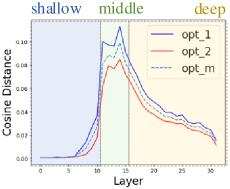
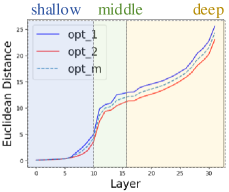
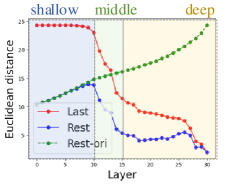
- Identifies that middle layers are the primary locus of associative behavior and that hallucinated responses encode strong associative directions useful for steering
- Constructs steering vectors by contrasting hidden states of hallucinated (high-association) vs. grounded (low-association) responses
- Applies these vectors at inference time with intensity calibration to dynamically amplify or suppress associative reasoning based on input alignment
Architecture
The FlexAC framework pipeline, illustrating both Offline Control Vector Construction and Inference-Time Control phases.
Evaluation Highlights
- Achieves up to 5.8× improvement in creativity on Creation-MMBench compared to baselines
- Reduces hallucination rate by 29% on CHAIR benchmark while maintaining general capabilities
- Outperforms VCD and Ha-DPO on both faithfulness (CHAIR) and creativity (VDAT) metrics by flexibly adjusting the steering coefficient
Breakthrough Assessment
8/10
Strong mechanistic insight linking hallucination and creativity to specific layer representations. The method effectively solves the trade-off between faithfulness and creativity without retraining.