📝 Paper Summary
LLM-enhanced Recommendation
Graph-based Recommendation
CORONA improves graph-based recommendation by using LLMs to reason about user preferences and intents, progressively filtering the candidate graph before final GNN scoring.
Core Problem
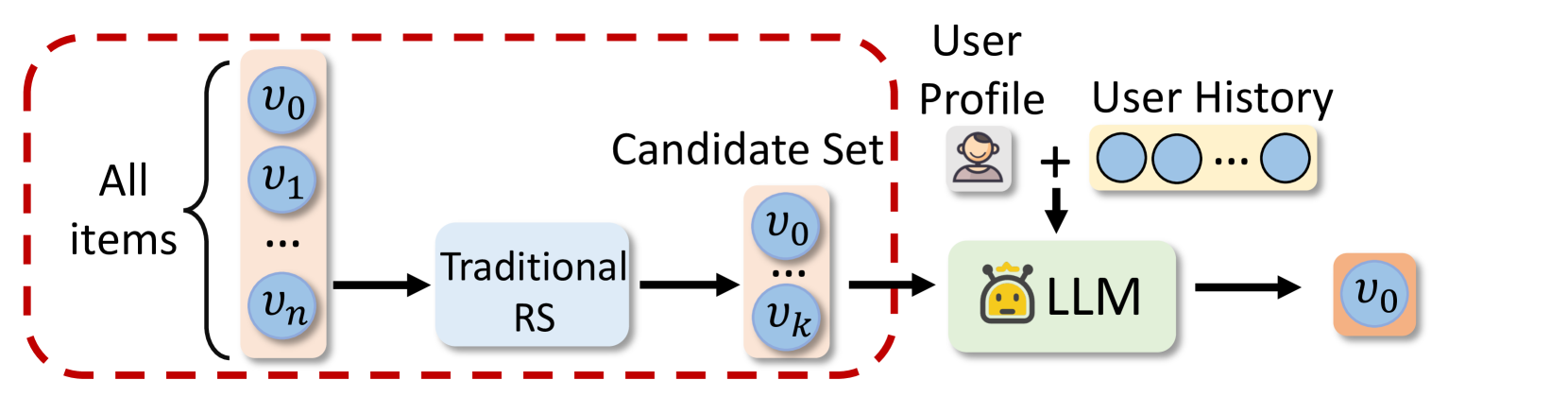
Existing methods limit LLMs to either re-ranking small candidate sets or static data augmentation, failing to utilize LLM reasoning capabilities during the critical candidate filtering process.
Why it matters:
- Re-ranking methods are constrained by the quality of the initial candidate set generated by traditional models
- Data augmentation methods cannot adapt to dynamically changing user intents during inference
- Traditional GNNs struggle to capture semantic reasoning behind user choices, while LLMs struggle with large-scale collaborative filtering signals
Concrete Example:
In current pipelines, if a traditional retriever misses 'French movies' for a user because of sparse interaction history, the LLM re-ranker never sees them. CORONA's LLM infers this preference from the profile ('User is from France') and actively retrieves relevant French movie subgraphs for the GNN to score.
Key Novelty
Coarse-to-Fine Retrieval Chain on Graphs
- Decomposes retrieval into three progressive stages: Preference-Assisted (profile-based), Intent-Assisted (history-based), and GNN-Enhanced (collaborative signal-based)
- Transforms LLM textual reasoning (about preferences/intents) into dense query embeddings to dynamically slice the interaction graph into relevant subgraphs
- Summarizes retrieved subgraph information into natural language to guide the LLM's subsequent intent reasoning step
Architecture
The three-stage CORONA framework: Preference-assisted retrieval, Intent-assisted retrieval, and GNN-enhanced retrieval.
Evaluation Highlights
- +18.6% relative improvement in Recall on average across three datasets compared to state-of-the-art baselines
- +18.4% relative improvement in NDCG on average across three datasets
- Significantly outperforms both traditional GNNs (LightGCN) and recent LLM-enhanced methods (LLMRec, RLMRec)
Breakthrough Assessment
7/10
Strong integration of LLM reasoning directly into the retrieval loop (subgraph construction) rather than just re-ranking. Significant metric gains, though the core components (LLMs, GNNs) are standard.