📝 Paper Summary
Agentic RAG pipeline
Complex question answering
Reasoning-Enhanced RAG
This survey unifies disjoint research into a taxonomy of RAG-Reasoning systems, charting the evolution from one-way enhancements to synergized, agentic frameworks where retrieval and reasoning iteratively refine each other.
Core Problem
Standard RAG lacks the depth for complex multi-step problems, while pure reasoning models often hallucinate; existing methods treat them separately or only as one-way enhancements.
Why it matters:
- Static Retrieval-Then-Reasoning frameworks fail when pre-retrieved knowledge is insufficient or irrelevant for subsequent reasoning steps
- Complex real-world tasks like scientific discovery require dynamic, iterative information seeking that current static pipelines cannot support
- Current literature is fragmented between improving RAG with reasoning and improving reasoning with RAG, missing the potential of their tight synergy
Concrete Example:
In a complex task, a standard RAG system might retrieve a pilot's biography when asked about his specific flight path, overwhelming the reasoner with irrelevant facts. Conversely, a Synergized system would first reason about what flight data is needed, retrieve specifically for that, and then refine its reasoning based on the new data.
Key Novelty
Unified RAG-Reasoning Taxonomy
- Categorizes systems into three stages: Reasoning-Enhanced RAG (Reasoning → RAG), RAG-Enhanced Reasoning (RAG → Reasoning), and Synergized RAG-Reasoning (RAG ⇔ Reasoning)
- Identifies the shift towards 'Deep Research' agentic systems where reasoning actively guides retrieval planning and retrieval dynamically grounds reasoning steps
- Proposes a framework for Synergized systems based on Reasoning Workflow (chain, tree, graph) and Agent Orchestration (single vs. multi-agent)
Architecture
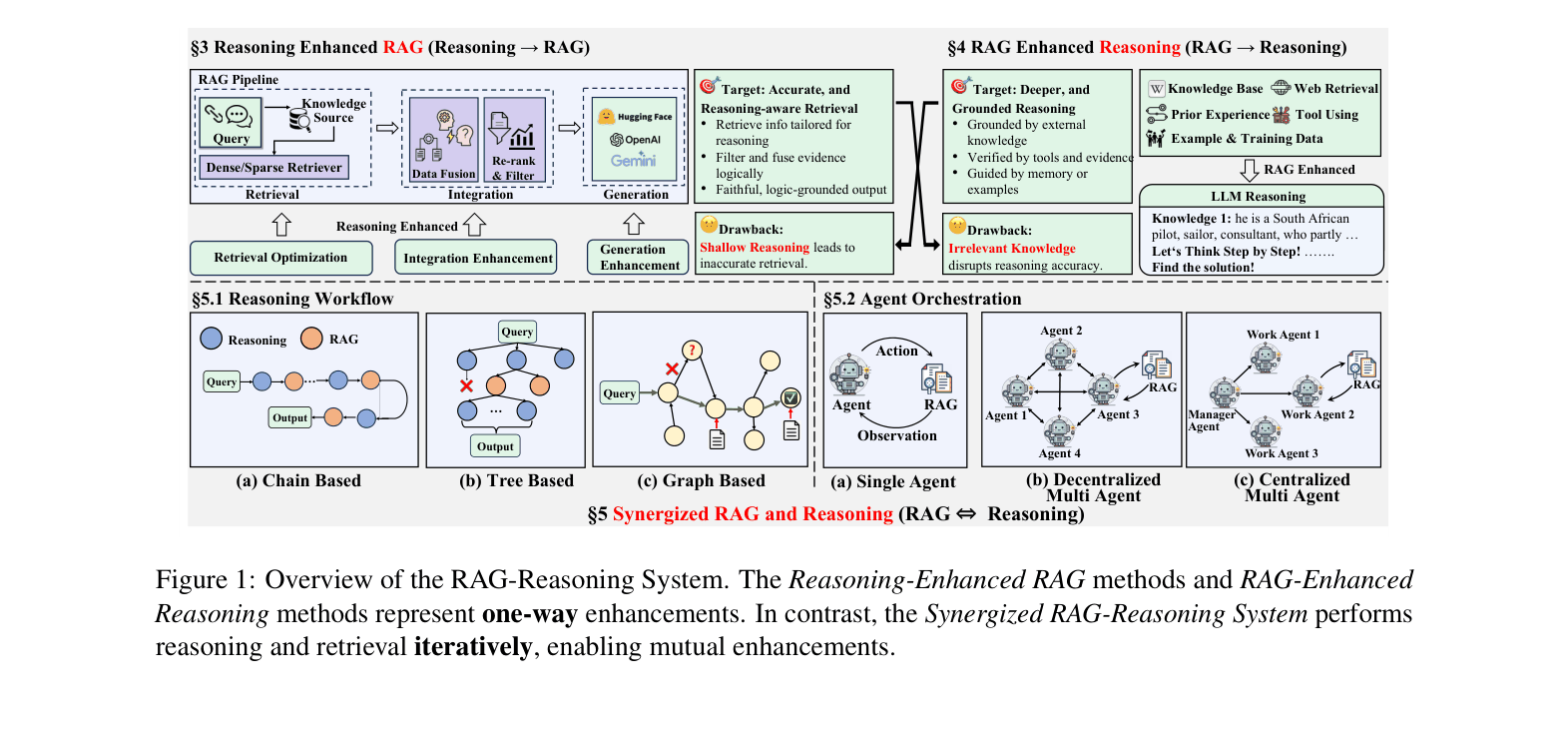
Overview of the RAG-Reasoning System taxonomy, illustrating the progression from one-way enhancements to synergized iterative systems
Evaluation Highlights
- Synthesizes over 200 research papers to construct a comprehensive taxonomy of the RAG-Reasoning landscape
- Identifies 6 key open challenges, including reasoning efficiency, retrieval trustworthiness, and human-agent collaboration
- Categorizes benchmarks across 7 domains, highlighting the shift from simple QA (TriviaQA) to agentic web browsing (BrowseComp) and code reasoning (LiveCodeBench)
Breakthrough Assessment
9/10
Timely and comprehensive survey that defines the emerging paradigm of agentic RAG-reasoning. It effectively bridges the gap between static RAG and autonomous agents.