📝 Paper Summary
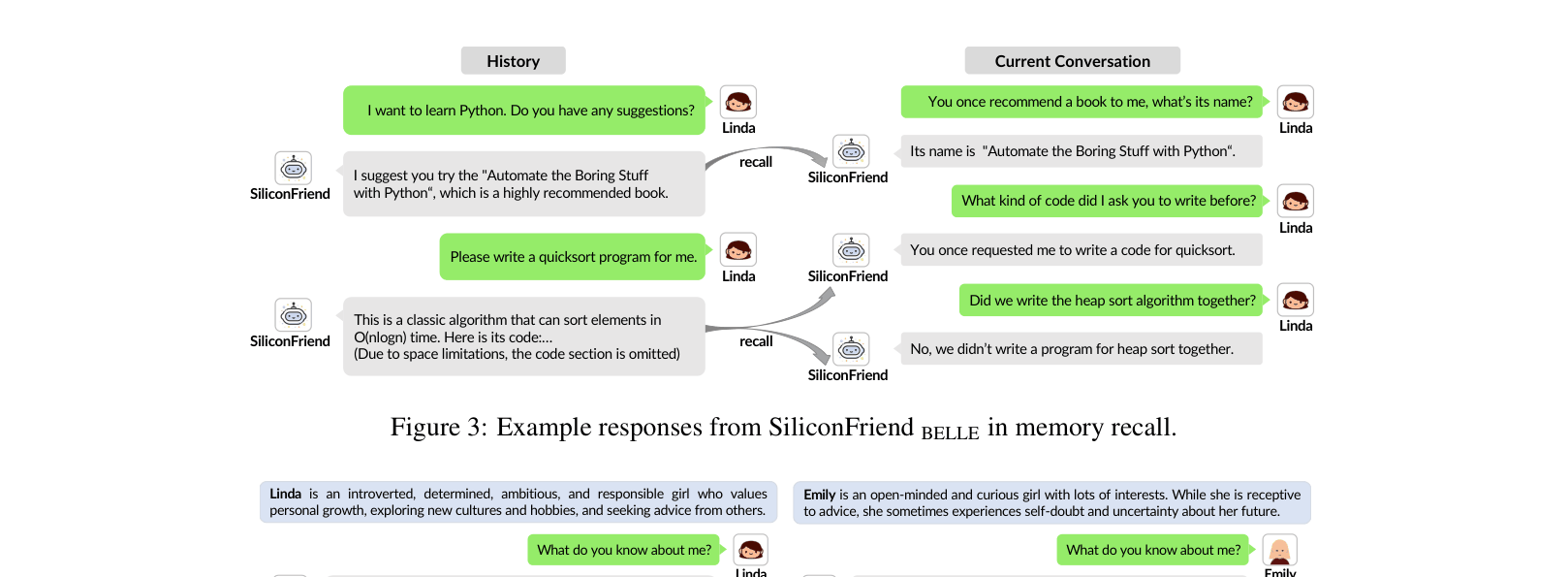
Memory recall
Memory organization
User modeling
MemoryBank equips Large Language Models with a long-term memory system that stores interaction history, summarizes events, and updates memory strength over time using the Ebbinghaus Forgetting Curve.
Core Problem
LLMs lack a built-in long-term memory mechanism, making them unable to recall historical interactions, maintain long-term context, or adapt to user personalities over time.
Why it matters:
- Essential for sustained interaction scenarios like personal companions, psychological counseling, and secretarial assistants
- Current LLMs cannot build rapport by referencing past shared experiences or evolving user understanding
- Absence of memory leads to repetitive or contextually unaware responses in long-term dialogues
Concrete Example:
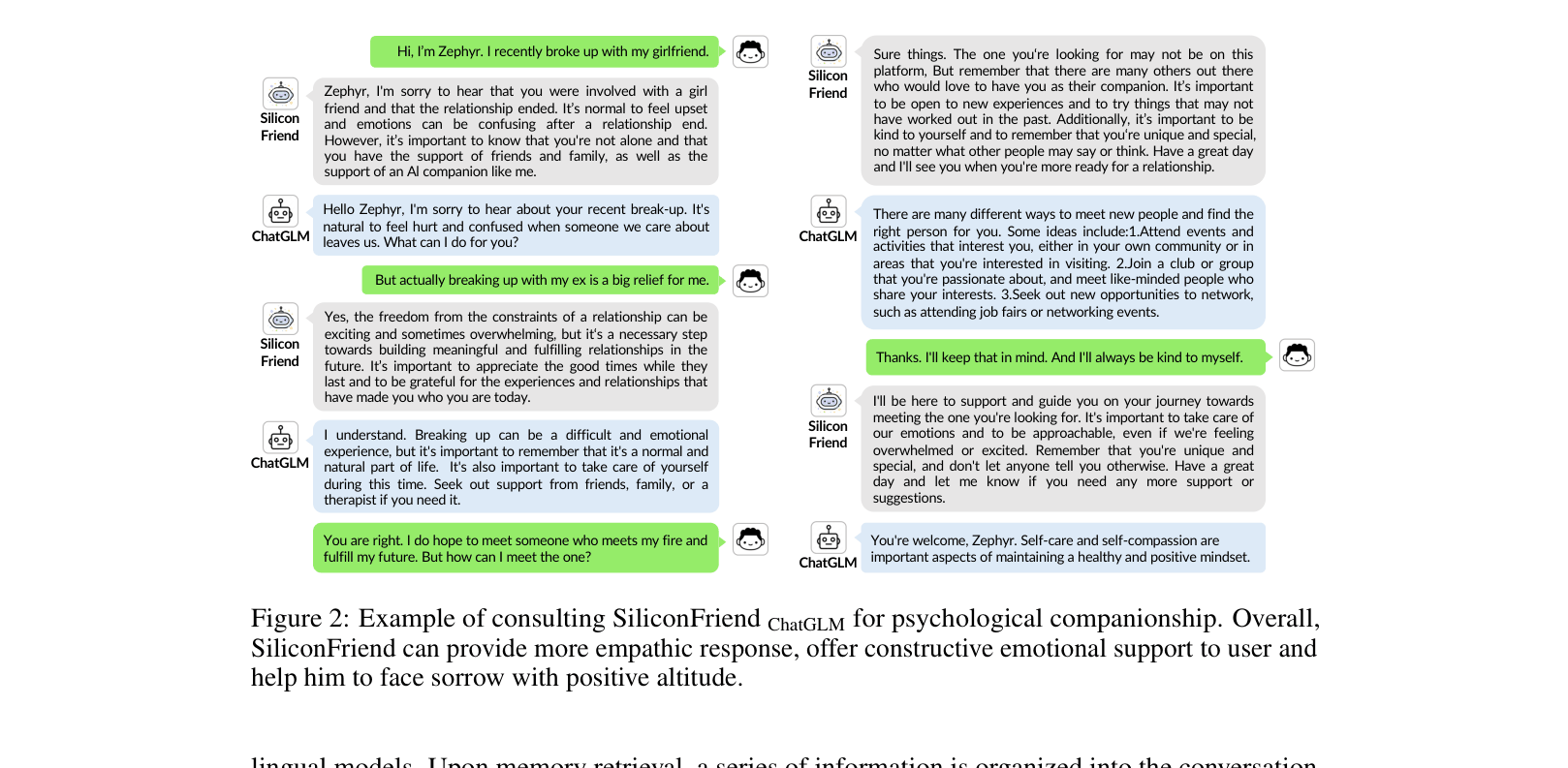
A user tells an AI they broke up with their girlfriend on Monday. On Friday, when the user mentions feeling sad, a standard LLM asks 'Why?' or gives generic advice, failing to recall the breakup event. SiliconFriend recalls the breakup and the user's personality to offer specific emotional support.
Key Novelty
MemoryBank Mechanism with Ebbinghaus Forgetting
- Introduces a dual-level memory storage: raw conversation logs and high-level summaries (events and user portraits)
- Implements a memory updating mechanism inspired by the Ebbinghaus Forgetting Curve, where memory strength decays over time unless reinforced by recall, mimicking human forgetting
- Uses a 'SiliconFriend' framework that tunes models on psychological data and retrieves relevant memories to generate empathetic, personalized responses
Architecture
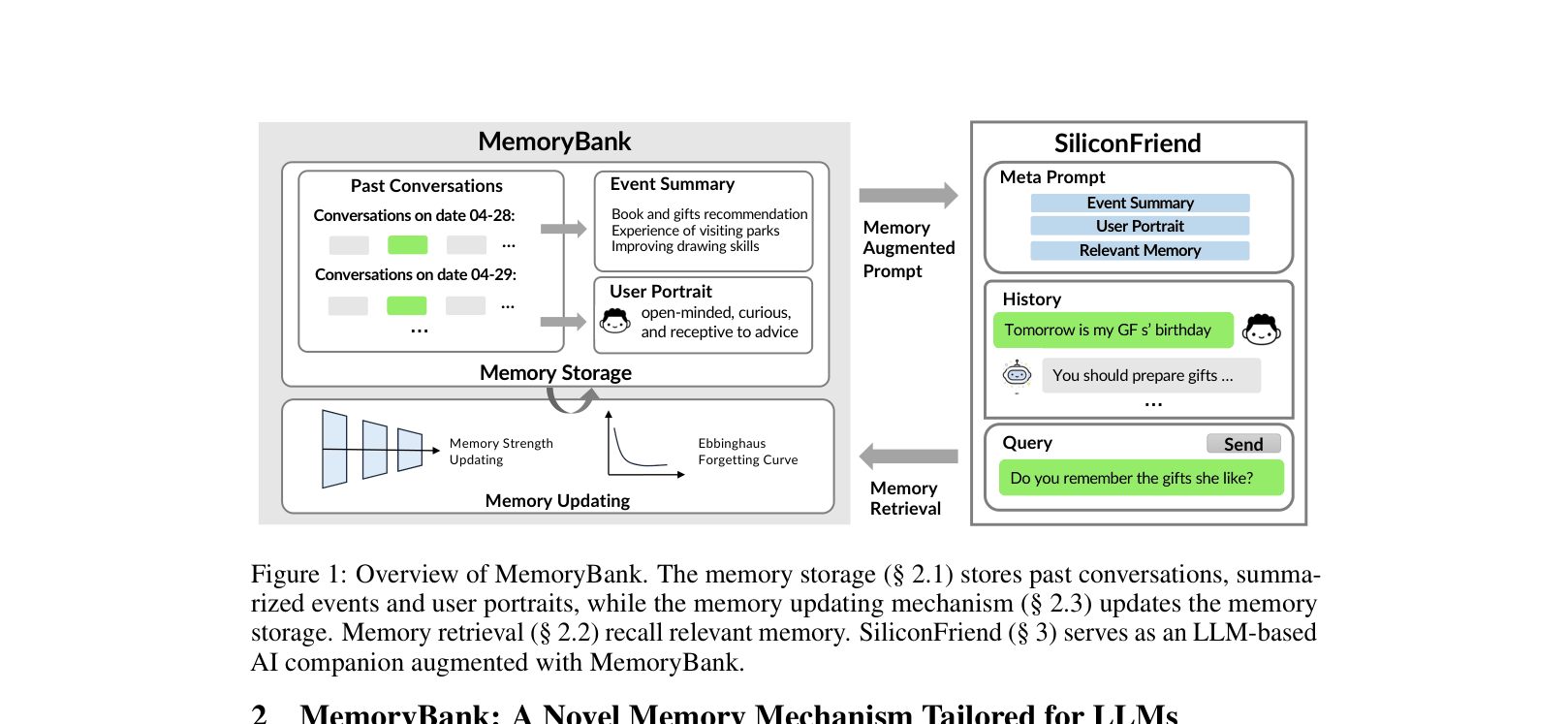
The overall architecture of MemoryBank and its integration into SiliconFriend
Evaluation Highlights
- +0.10 improvement in Retrieval Accuracy for ChatGLM (0.84 vs 0.74 inferred) on Chinese long-term memory tasks [inferred from comparison context]
- SiliconFriend-ChatGPT achieves 0.912 Contextual Coherence score on English memory probing tasks, significantly outperforming open-source baselines
- Demonstrates strong generalization across languages (English/Chinese) and model types (open-source ChatGLM/BELLE vs. closed-source ChatGPT)
Breakthrough Assessment
7/10
Novel integration of psychological forgetting curves into LLM memory management. While the architecture is a straightforward RAG variant, the forgetting mechanism and specific application to psychological companionship are well-executed contributions.