📝 Paper Summary
Tree/graph-baesd memory
Layered memory
Modularized RAG pipeline
EMG-RAG combines an editable memory graph with a reinforcement learning agent to adaptively select and update personal user memories for smartphone assistants.
Core Problem
Existing personalized agents struggle to handle dynamic smartphone data that requires frequent editing (insertion, deletion, replacement) and the selection of complex memory combinations for accurate retrieval.
Why it matters:
- Personal data on devices is dynamic; static databases cannot handle time-sensitive deletions (e.g., expired vouchers) or updates (e.g., flight rescheduling).
- Standard top-k retrieval often fails when a query requires aggregating multiple distinct memories (e.g., flight number + time + passenger) rather than just semantic similarity.
- Current 'Needle in a Haystack' approaches overwhelm LLM context windows with irrelevant noise, degrading performance on specific personal queries.
Concrete Example:
A user asks about a 'secretary's boss's flight.' Standard retrieval might miss the connection. EMG-RAG links: (1) Secretary booked flight to Amsterdam, (2) Flight is EK349, (3) EK349 departs 01:40. It combines these specifically.
Key Novelty
Editable Memory Graph (EMG) with RL-driven Traversal
- Organizes memories into a three-layer structure (Type, Subclass, Graph) that supports efficient partition-based editing (insert, delete, replace) of dynamic personal data.
- Replaces standard vector retrieval with a Reinforcement Learning agent that traverses the memory graph, learning to select the optimal combination of nodes to maximize answer quality.
Architecture
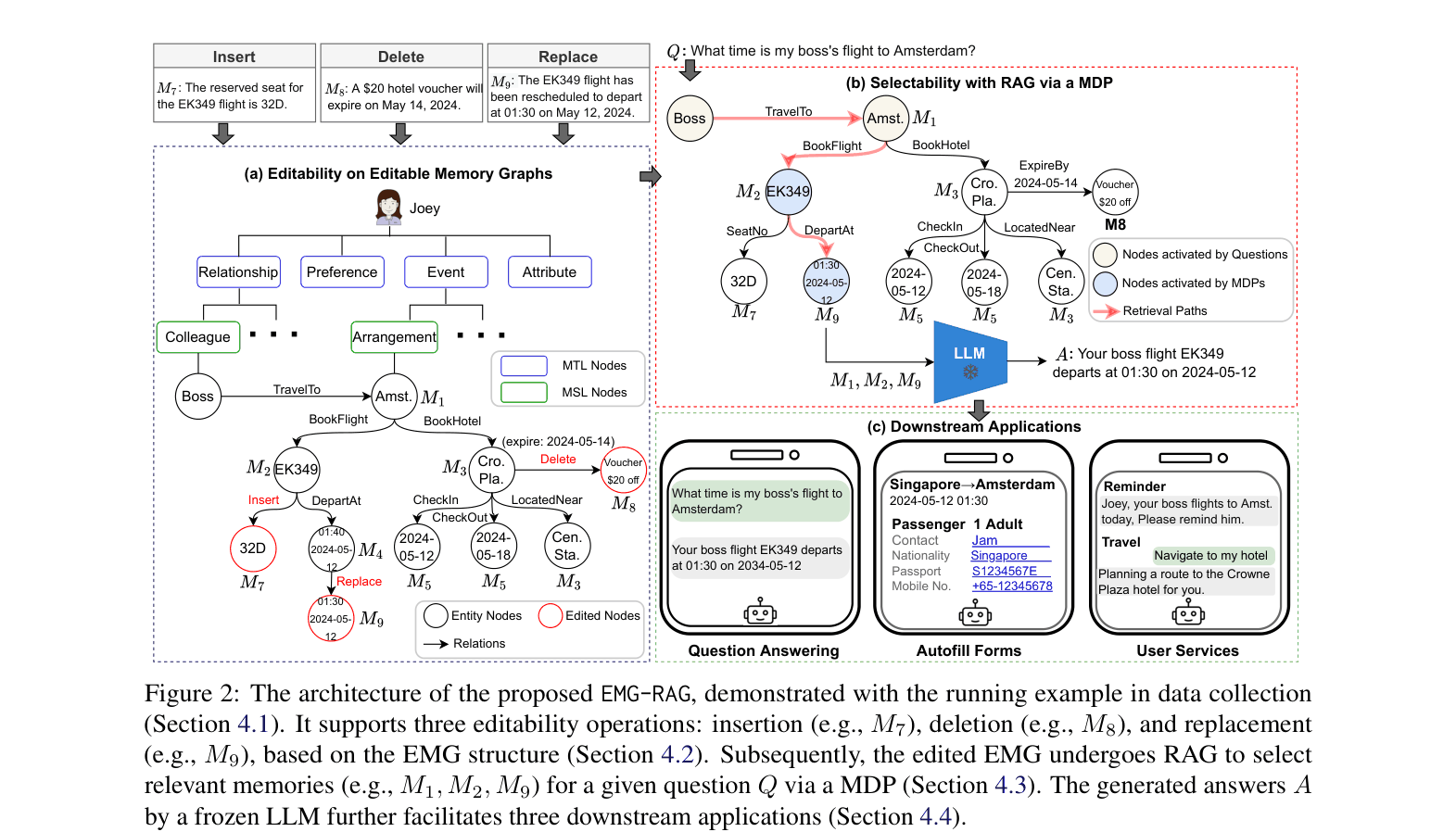
The complete EMG-RAG pipeline including Graph Construction, Editing, Retrieval via MDP, and Downstream Applications.
Evaluation Highlights
- Outperforms M-RAG baseline by ~10.6% in R-L score for question answering after 4 weeks of continuous memory edits.
- Achieves 96.99% Exact Match in autofill forms after 4 weeks, surpassing the best baseline by ~9.5%.
- Online A/B testing showed a 4.5% improvement in Question Answering quality over the previous system.
Breakthrough Assessment
7/10
Strong practical application of graph-based memory for dynamic personalization. The handling of continuous edits is a significant improvement over static RAG, though the core RL method is relatively standard.