📝 Paper Summary
Graph-based RAG pipeline
Agentic RAG pipeline
NeuroPath is a RAG framework that mimics hippocampal place cells to dynamically track goal-directed semantic paths on a knowledge graph and refine retrieval through post-hoc reflection.
Core Problem
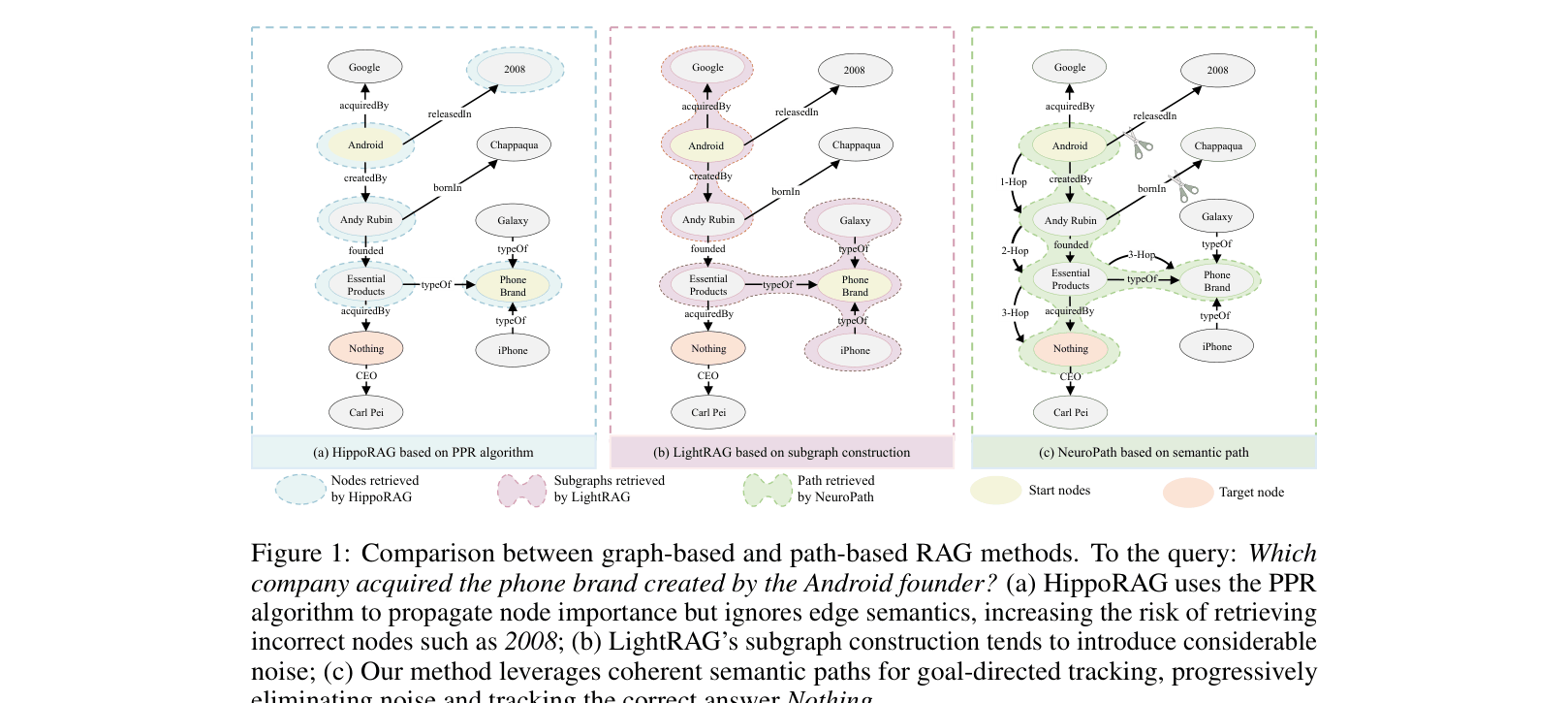
Existing graph-based RAG methods rely on structural algorithms (like PPR) or static subgraph construction, which ignore edge semantics and introduce significant noise during multi-hop retrieval.
Why it matters:
- Naive RAG cannot handle multi-hop questions requiring complex dependencies across documents
- Graph-based methods like HippoRAG prioritize structural connectivity over semantic coherence, often retrieving irrelevant nodes that are structurally central but semantically unrelated to the query path
- Iterative RAG methods lack explicit modeling of knowledge associations, leading to information silos
Concrete Example:
For the query 'Which company acquired the phone brand created by the Android founder?', HippoRAG retrieves irrelevant nodes like '2008' due to structural prominence. LightRAG retrieves a noisy subgraph with 60 entities. NeuroPath tracks the semantic path: Android → Andy Rubin → Essential Products → Nothing, correctly identifying the answer.
Key Novelty
Neurobiology-Inspired Semantic Path Tracking
- Models entities as 'place cells' and triples as 'place fields', simulating hippocampal navigation to dynamically construct paths that align semantically with the query goal
- Introduces a 'preplay' mechanism where an LLM tracks and prunes paths step-by-step based on semantic coherence rather than just graph topology
- Implements a 'replay' mechanism (Post-retrieval Completion) that uses the LLM's intermediate reasoning chain to perform a second-stage retrieval for missing information
Architecture
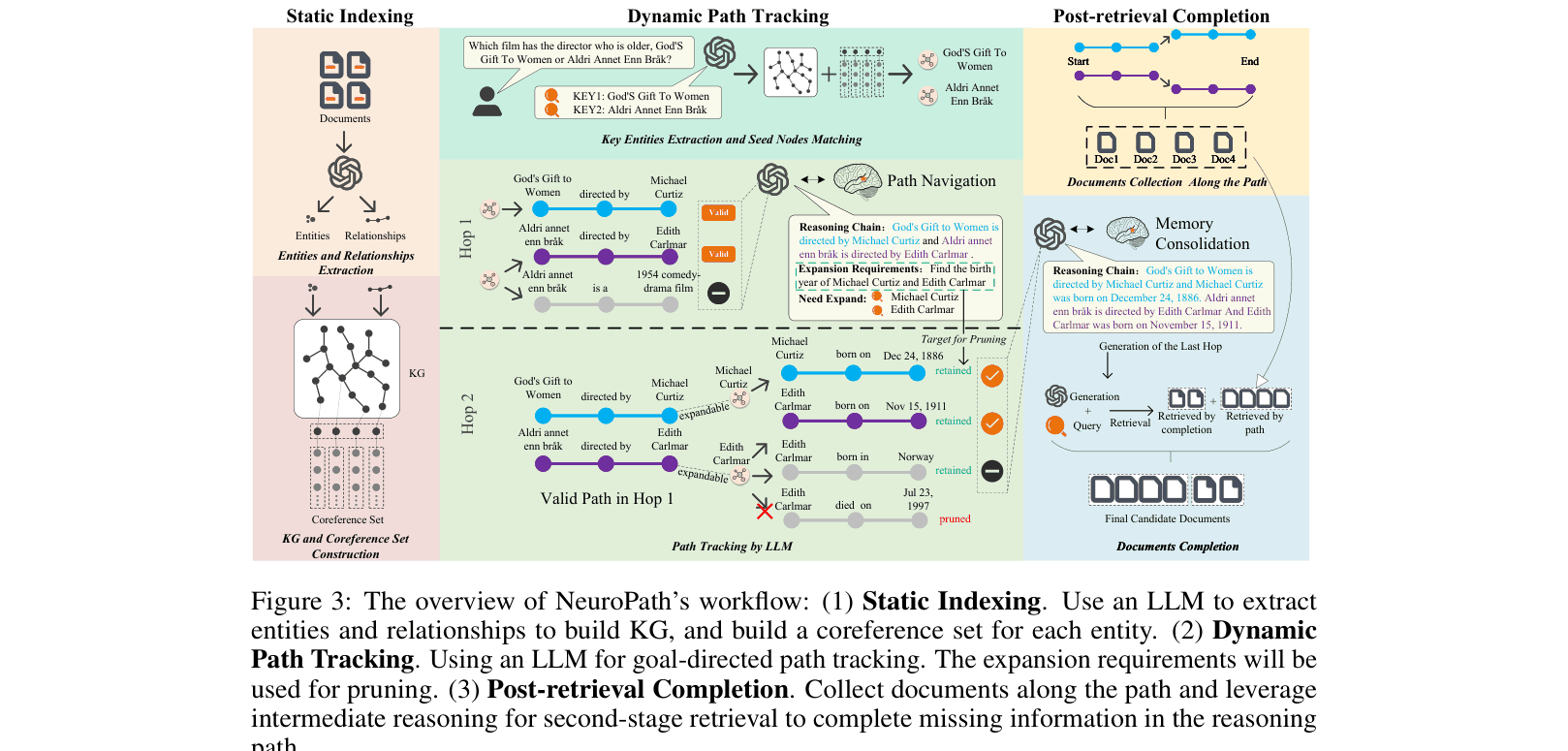
The complete NeuroPath workflow: Static Indexing, Dynamic Path Tracking (Preplay), and Post-retrieval Completion (Replay).
Evaluation Highlights
- +16.3% improvement in Recall@2 and +13.5% in Recall@5 on average over state-of-the-art graph-based RAG methods (HippoRAG, LightRAG) across three multi-hop datasets
- Reduces token consumption by 22.8% compared to iter-based RAG methods while achieving higher accuracy
- Robustness confirmed across multiple LLMs (Llama-3.1-8B, GLM-4-9B, Mistral-7B), consistently outperforming baselines even with smaller models
Breakthrough Assessment
8/10
Significant improvement over strong baselines (HippoRAG 2) with a biologically inspired approach that effectively solves the semantic incoherence problem in graph RAG.