📝 Paper Summary
RAG-based personalization
User-profile based personalization
Agentic RAG pipeline
This survey systematically categorizes how personalization is integrated into Retrieval-Augmented Generation (RAG) and agent workflows, framing agents as advanced 'Personalized RAG++' systems with dynamic memory and planning.
Core Problem
Standard RAG and agent systems typically provide generic, one-size-fits-all responses that fail to account for individual user preferences, history, and specific contexts.
Why it matters:
- Generic responses in AI systems limit user satisfaction and engagement in applications like healthcare, e-commerce, and education where context is critical
- Existing surveys focus on general RAG or generic agents, leaving a gap in understanding how to systematically inject user-specific constraints across the entire pipeline
- Personalization is a key step toward Artificial General Intelligence (AGI) by enabling adaptive, context-aware decision-making rather than static information retrieval
Concrete Example:
In a medical query, a generic RAG might retrieve standard treatment protocols for 'diabetes'. A personalized system would rewrite the query to include the user's specific age and medical history (e.g., 'diabetes treatment for 70-year-old with heart history'), retrieve documents relevant to those comorbidities, and generate a response adjusting the tone and complexity to the user's medical literacy.
Key Novelty
Unified Taxonomy for Personalized RAG and Agents
- Establishes a structural alignment between RAG phases (Rewriting, Retrieval, Generation) and Agent workflows (Understanding, Planning/Execution, Generation), proposing agents as 'Personalized RAG++'
- Categorizes personalization into Explicit (user profiles, history) and Implicit (parameters, embeddings) methods across all pipeline stages
- Identifies distinct roles for techniques like query rewriting (handling ambiguity) vs. query expansion (handling incompleteness) specifically within personalized contexts
Architecture
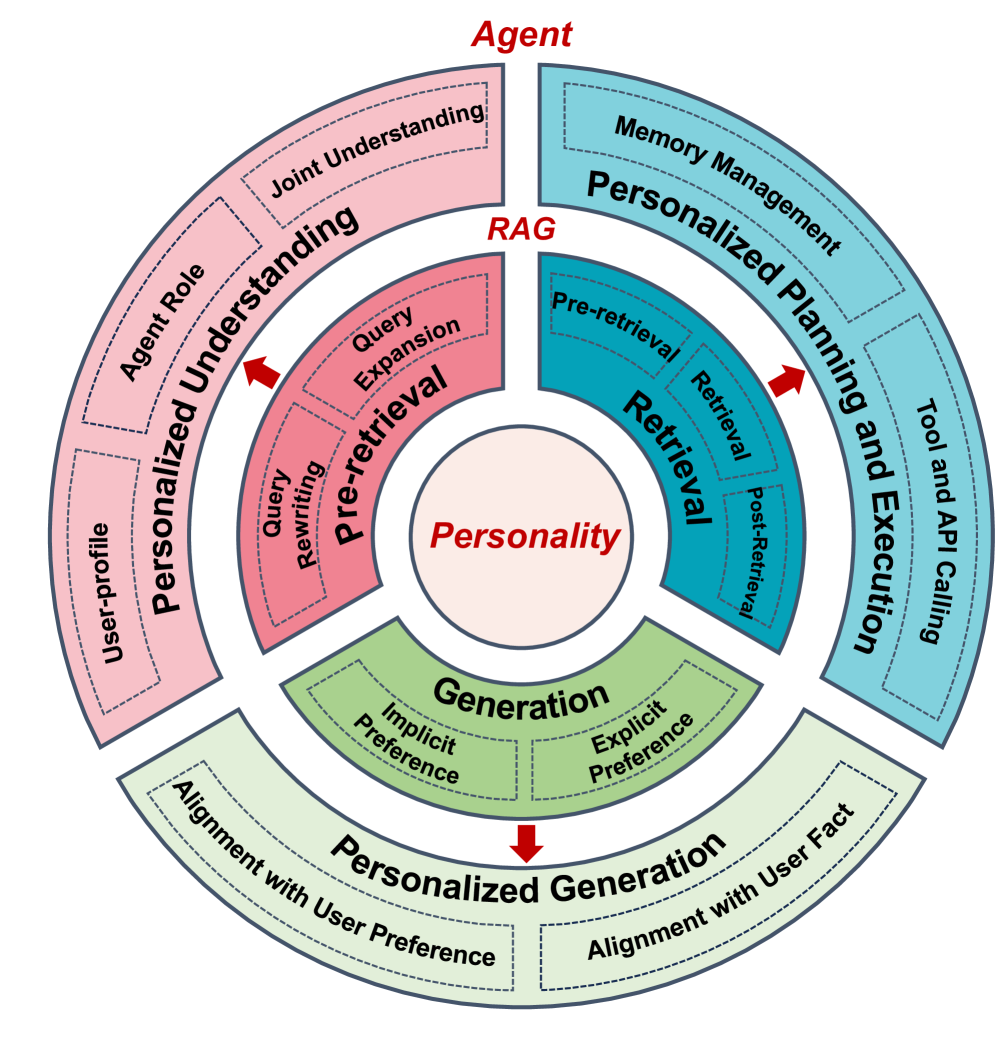
Conceptual alignment between the RAG pipeline and Agent workflows
Breakthrough Assessment
7/10
Comprehensive synthesis of a fragmented field. While it is a survey and does not propose a new model, its framing of agents as an evolution of personalized RAG provides a strong conceptual foundation for future work.