TrainerAgent is a multi-agent system that automates the full AI development lifecycle—from parsing user requests to training and deploying models—by coordinating specialized agents for task planning, data processing, model optimization, and serving.
Core Problem
Training custom AI models for specific business requirements is complex and time-consuming, requiring expert knowledge to navigate data cleaning, model selection, hyperparameter tuning, and deployment.
Why it matters:
Non-experts struggle to translate business needs into technical model specifications
Existing agents (e.g., HuggingGPT) focus on inference via API calls rather than training new models from scratch
AutoML tools often require rigid inputs or high algorithmic understanding, lacking the flexibility of natural language interaction
Concrete Example:A user wants a 'cat vs dog' classifier but only provides raw images. A standard AutoML tool might fail if the data isn't pre-formatted or if the user requests specific speed/accuracy trade-offs in natural language. TrainerAgent parses the request, autonomously cleans the data, selects a model, trains it, and deploys a service API.
Key Novelty
End-to-End LLM-Driven Model Development via Role-Based Agents
Decomposes the machine learning lifecycle into four specialized agents: Task (management), Data (processing), Model (training/tuning), and Server (deployment)
Uses a central Task Agent as a hub to translate natural language requirements into structured plans that coordinate the other three agents
Integrates domain-specific knowledge bases (SOPs) into agent prompts, allowing them to autonomously handle errors, reject unattainable tasks, and optimize for specific metrics like accuracy or latency
Architecture
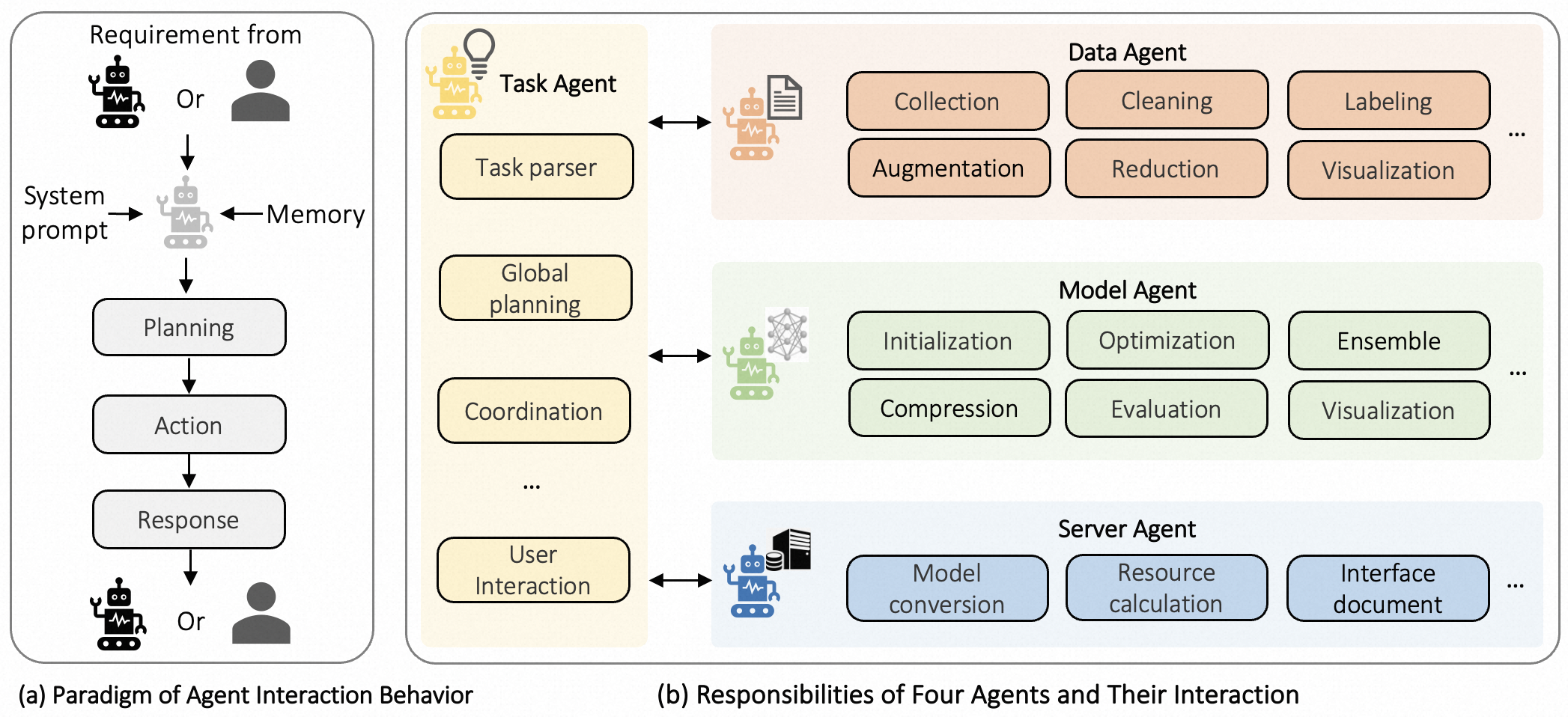
Overview of the TrainerAgent framework. (a) shows the internal structure of a single agent (Profile, Memory, Perception, Planning, Action). (b) shows the multi-agent collaboration workflow where the Task Agent coordinates the Data, Model, and Server Agents.
Evaluation Highlights
Successfully automates training for diverse tasks including Visual Grounding, Image Generation, and Text Classification based on natural language prompts
Demonstrates capability to identify and reject unattainable or unethical tasks (e.g., fantastical scenarios) during the planning phase
Produces deployable service interfaces and documentation automatically after model training
Breakthrough Assessment
7/10
A solid application of multi-agent frameworks to the specific domain of AutoML/MLOps. While it relies on existing LLMs and tools, the structural decomposition of the training pipeline into agent roles is a practical step forward for accessible AI development.
⚙️ Technical Details
Problem Definition
Setting: Automated generation of executable AI models and deployment services from high-level natural language user requirements
Inputs: Natural language task description and user-provided dataset (optional/retrieved)
Outputs: Trained model weights, evaluation metrics, and a deployed inference API service
Pipeline Flow
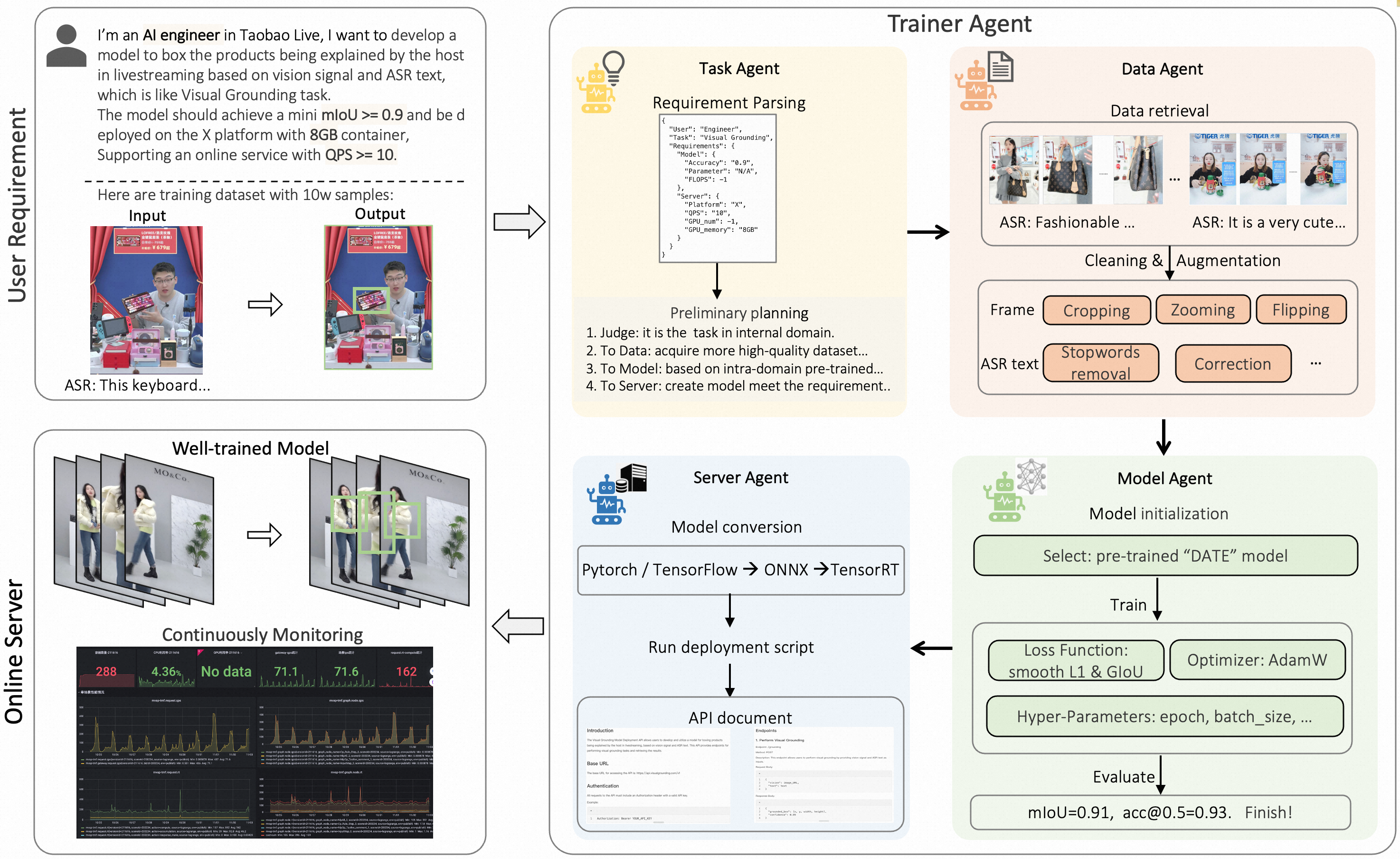
Task Agent (Parses user request -> Global Plan)
Data Agent (Collects/Cleans/Augments Data)
Model Agent (Initializes -> Trains -> Evaluates Model)
Server Agent (Converts -> Deploys -> Documents API)
System Modules
Task Agent
Central hub for user interaction, task parsing, and global coordination
Model or implementation: LLM (specific version not reported)
Data Agent
Handles data lifecycle including collection, cleaning, labeling, and augmentation
Model or implementation: LLM + External Tools
Model Agent
Selects, trains, optimizes, and evaluates models
Model or implementation: LLM + HuggingFace Scripts
Server Agent
Deploys the trained model as an online service
Model or implementation: LLM + Deployment Tools
Novel Architectural Elements
Separation of the training lifecycle into four distinct agent personas (Task, Data, Model, Server) rather than a single monolithic planner
Integration of comprehensive internal knowledge bases (e.g., training scripts, data processing tools) directly into agent memory to reduce hallucination
Modeling
Base Model: LLM (Specific base model used for agents is not explicitly reported in the paper)
Comparison to Prior Work
vs. HuggingGPT: TrainerAgent trains *new* custom models rather than just chaining inference APIs
vs. AutoML-GPT: TrainerAgent accepts flexible natural language inputs rather than requiring structured/fixed inputs
vs. Prompt2Model: TrainerAgent handles a broader range of tasks (CV and NLP), considers private databases, and manages deployment (Server Agent)
vs. MetaGPT [not cited in paper]: Similar role-based multi-agent structure, but TrainerAgent is specifically specialized for the ML training lifecycle (Data/Model/Server roles) rather than general software development
Limitations
Performance heavily depends on the underlying LLM's capability to understand complex instructions
No quantitative benchmarking comparison against other AutoML or Agent frameworks provided in the paper
Specific details on the LLM backend (e.g., GPT-4 vs Llama) and cost analysis are missing
Evaluation is primarily qualitative (case studies) rather than rigorous statistical analysis
Reproducibility
The paper does not provide a link to the code repository or specific prompt templates. It mentions using 'standardized training scripts based on huggingface' but does not release the specific agent implementation details.
📊 Experiments & Results
Evaluation Setup
Qualitative case studies demonstrating the system's ability to handle end-to-end tasks
Benchmarks:
Visual Grounding Task (Computer Vision)
Image Generation Task (Generative AI)
Text Classification Task (Natural Language Processing)
Metrics:
Task completion success (qualitative)
Ability to reject infeasible tasks
Statistical methodology: Not explicitly reported in the paper
Experiment Figures
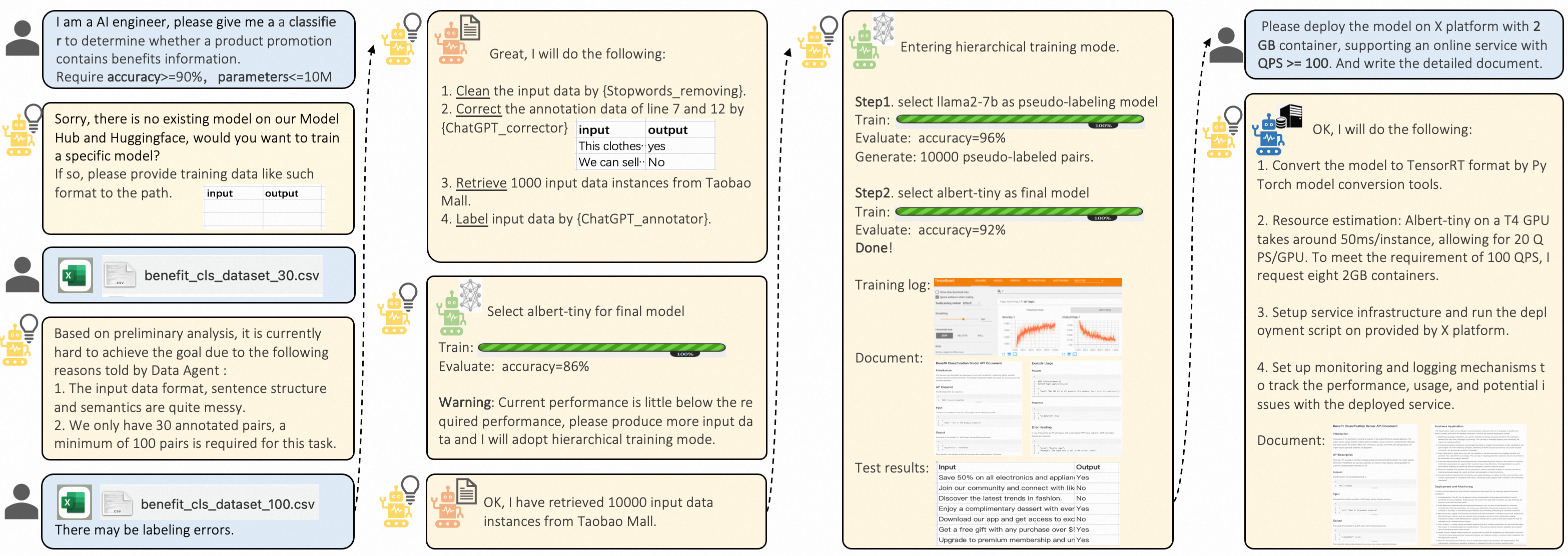
Visualization of the workflow for a Visual Grounding task. It displays the chat interface and the step-by-step execution logs of the agents.
Visualization of Image Generation and Text Classification tasks.
Main Takeaways
The system successfully decomposes high-level requests (e.g., 'train a model to find a person in an image') into executable sub-steps across four agents
Agents demonstrate specialized capabilities: Data Agent performs cleaning/augmentation, Model Agent selects/trains architectures, and Server Agent prepares deployment documents
Robustness check: The system correctly identifies and rejects requests for 'fantastical scenarios' or 'unethical requests', showing safety awareness in the planning phase
The framework unifies data processing, model training, and deployment, which are typically treated as separate workflows in other tools
📚 Prerequisite Knowledge
Prerequisites
Understanding of the standard Machine Learning lifecycle (Data -> Model -> Deployment)
Basic knowledge of Large Language Model (LLM) agent architectures
Familiarity with MLOps concepts
Key Terms
SOPs: Standard Operating Procedures—encoded instructions within agent prompts that guide their step-by-step behavior for specific subtasks
HuggingGPT: A framework using LLMs as controllers to connect various AI models for solving complex AI tasks
AutoML: Automated Machine Learning—the process of automating the tasks of applying machine learning to real-world problems
SFT: Supervised Fine-Tuning—training a model on labeled data to improve performance on specific tasks
ONNX: Open Neural Network Exchange—an open format built to represent machine learning models, used here for model conversion during deployment
TensorRT: A high-performance deep learning inference optimizer and runtime library
hyperparameter tuning: The process of choosing a set of optimal hyperparameters for a learning algorithm