📝 Paper Summary
LLM Agent Taxonomy
Multi-Agent Collaboration
Agent Evolution
This survey proposes a unified taxonomy for LLM agents centered on methodology, analyzing how agents are constructed, how they collaborate in groups, and how they evolve over time.
Core Problem
Existing research on LLM agents is fragmented, with prior surveys focusing narrowly on specific applications or environments without connecting agent design principles to emergent behaviors.
Why it matters:
- The rapid proliferation of agent papers makes it difficult for researchers to grasp the fundamental methodological connections between isolated systems.
- Prior surveys often separate individual agent design from multi-agent collaboration, missing the architectural continuity between them.
- Understanding the full lifecycle—from construction to evolution—is critical as agents transition from theoretical constructs to commercial systems like DeepResearch.
Concrete Example:
A traditional survey might categorize agents solely by application (e.g., 'gaming agents' vs. 'coding agents'). This fails to reveal that a coding agent (like ChatDev) and a research agent (like DeepResearch) share identical underlying 'Centralized Control' collaboration architectures, obscuring reusable design patterns.
Key Novelty
Build-Collaborate-Evolve Framework
- Deconstructs agents into a lifecycle taxonomy: 'Construction' (internal modules), 'Collaboration' (interaction topologies), and 'Evolution' (improvement mechanisms).
- Unifies individual and multi-agent perspectives by showing how internal modules (like memory) support collective behaviors (like decentralized cooperation).
Architecture
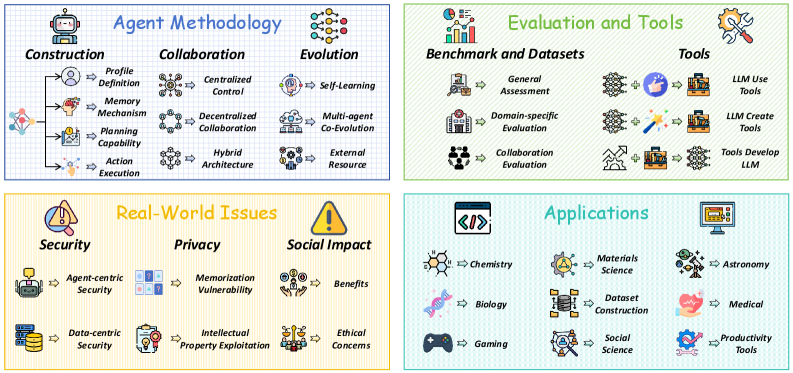
The organizational framework of the survey, visualizing the 'Build-Collaborate-Evolve' taxonomy.
Evaluation Highlights
- Provides a structured taxonomy covering 3 main dimensions: Construction, Collaboration, and Evolution.
- Categorizes collaboration into 3 distinct architectures: Centralized Control, Decentralized Cooperation, and Hybrid Architectures.
- Identifies 3 pathways for evolution: Autonomous optimization, Multi-agent co-evolution, and External resource integration.
Breakthrough Assessment
8/10
A comprehensive, high-utility survey that provides a clean, methodology-centered taxonomy for a chaotic field. While not introducing a new algorithm, its structural framework significantly aids understanding.