📝 Paper Summary
Conceptual Taxonomy
Agent Evolution
This review formalizes the distinction between AI Agents (modular, tool-using single entities) and Agentic AI (orchestrated multi-agent ecosystems with emergent autonomy), providing a structured taxonomy and application roadmap.
Core Problem
The terms 'AI Agent' and 'Agentic AI' are often conflated in literature despite representing fundamentally different design philosophies and capabilities (single-task automation vs. multi-agent orchestration).
Why it matters:
- Misaligned system design: Developers may under-engineer complex scenarios requiring coordination or over-engineer simple tasks suited for single agents
- Lack of standardized evaluation: Performance metrics for isolated agents differ significantly from those needed for distributed, collaborative systems
- Scalability barriers: Without clear distinctions, scaling from tool-augmented LLMs to high-stakes domains like healthcare and robotics risks coordination failure
Concrete Example:
A traditional AI Agent (smart thermostat) reacts to user settings to control temperature. An Agentic AI system (smart home ecosystem) coordinates lighting, security, and HVAC agents, dynamically balancing energy costs against user comfort patterns without explicit commands.
Key Novelty
Formal Taxonomy of AI Agents vs. Agentic AI
- Defines AI Agents as single-entity systems focused on task-specificity, tool usage, and reactive execution rooted in LLMs
- Defines Agentic AI as multi-agent ecosystems characterized by collaborative reasoning, dynamic role assignment, shared memory, and decentralized coordination
- Positions Generative AI as a precursor, AI Agents as tool-augmented executors, and Agentic AI as the current frontier of coordinated autonomy
Architecture
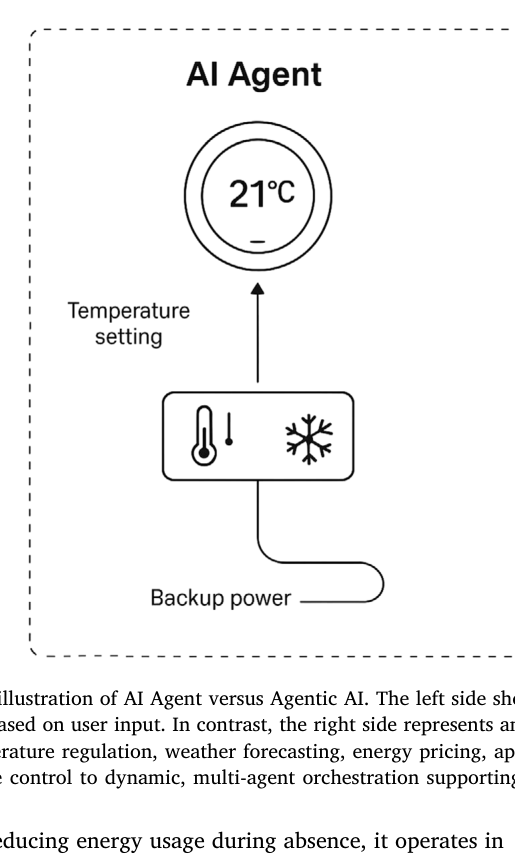
Comparative illustration of AI Agent vs. Agentic AI using a smart home analogy
Breakthrough Assessment
4/10
This is a survey/conceptual review rather than a technical breakthrough. It provides valuable definitions and taxonomies for the field but does not introduce a new model or algorithm.