📝 Paper Summary
Graph-based RAG pipeline
Non-parametric continual learning
Memory organization
HippoRAG 2 improves long-term memory in LLMs by integrating passage-level context into a Personalized PageRank-based knowledge graph and using an online LLM filter to remove irrelevant retrieval paths.
Core Problem
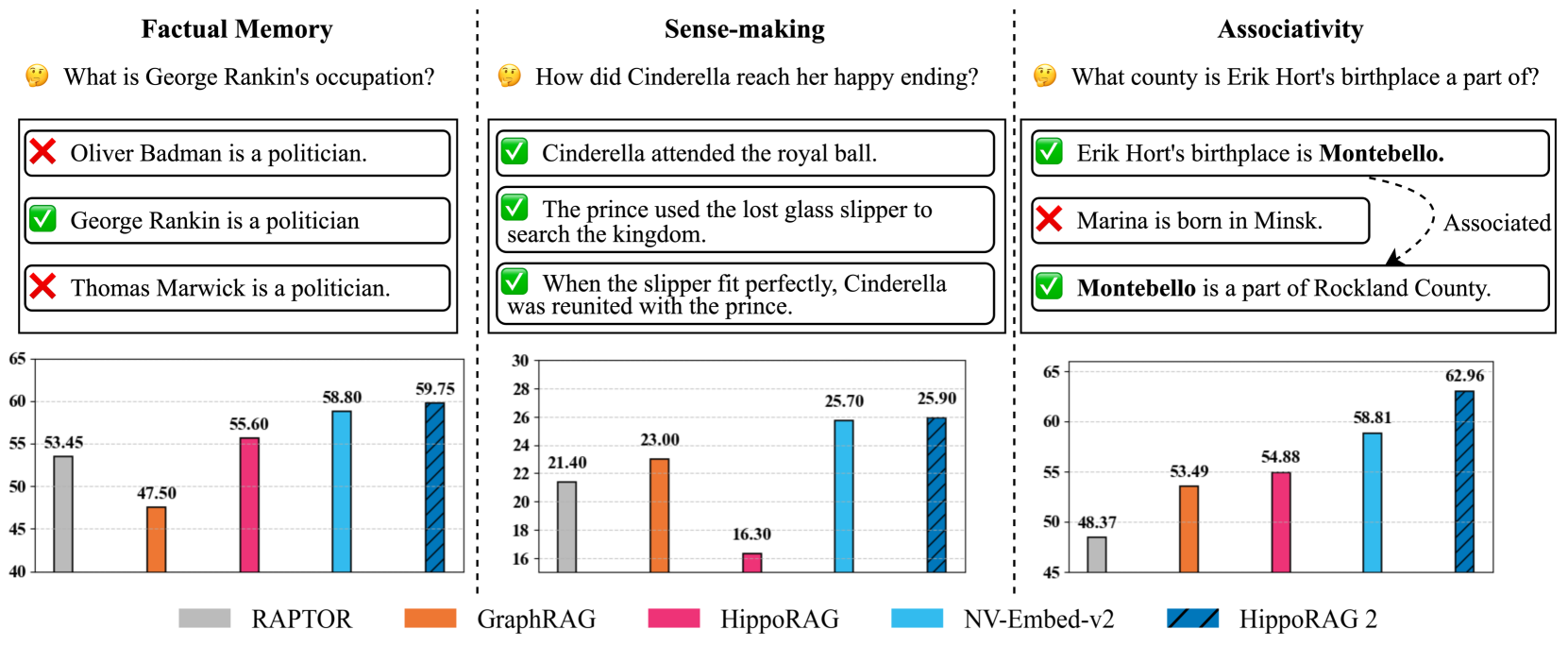
Standard RAG fails at complex reasoning (sense-making) and multi-hop connections (associativity), while previous graph-based RAG methods sacrifice basic factual accuracy and introduce noise through excessive summarization.
Why it matters:
- Human intelligence relies on continuously absorbing and integrating knowledge, a capability current LLMs lack due to catastrophic forgetting or limited context windows.
- Existing structure-augmented RAG methods often degrade performance on simple factual tasks compared to standard vector retrieval, forcing a trade-off between complex reasoning and basic accuracy.
Concrete Example:
In a multi-hop QA scenario, if a user asks about a connection between two disparate entities mentioned in different documents, standard RAG might fail to retrieve the intermediate linking document because it lacks vector similarity to the query. Conversely, methods like RAPTOR might hallucinate connections or lose specific details due to aggressive summarization.
Key Novelty
Neurobiologically-inspired Dual-Process Retrieval with Dense-Sparse Integration
- Combines 'dense coding' (contextual passages) and 'sparse coding' (specific concepts/entities) in a unified graph, mimicking how the human brain integrates context and concepts.
- Implements a 'recognition memory' mechanism where an online LLM filters retrieved graph triples before they seed the PageRank algorithm, preventing irrelevant associations from polluting the search.
- Introduces query-to-triple matching to capture relationship context better than simple entity extraction, aligning query semantics more effectively with the knowledge graph.
Architecture
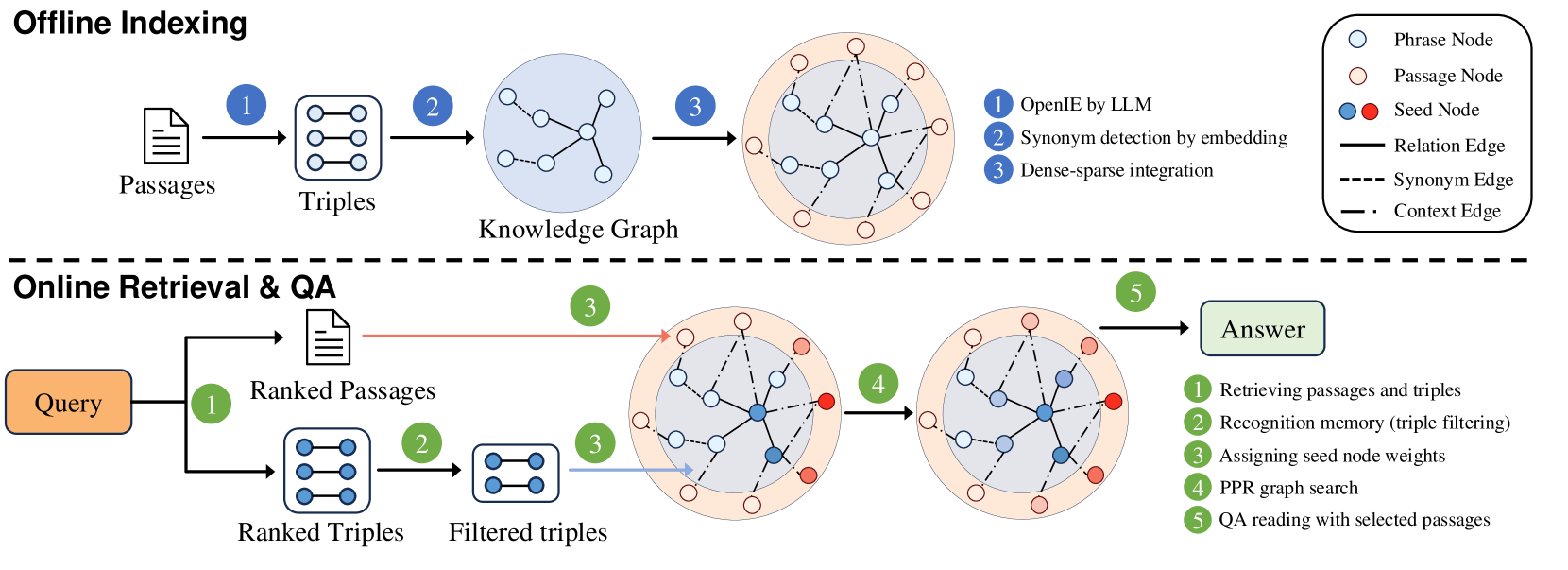
The HippoRAG 2 framework showing both Offline Indexing and Online Retrieval processes.
Evaluation Highlights
- Achieves an average 7.7 point improvement over standard RAG in associativity tasks (multi-hop QA).
- Outperforms state-of-the-art embedding models like NV-Embed-v2 on both factual and sense-making memory tasks, eliminating the trade-off seen in prior graph-based methods.
- Demonstrates robustness across different underlying retrievers and LLM backbones, showing consistent gains regardless of the specific component models used.
Breakthrough Assessment
8/10
Significantly advances graph-based RAG by solving the 'performance tax' on simple tasks while excelling at complex reasoning. The integration of passage nodes and online recognition memory is a strong architectural contribution.