📝 Paper Summary
Modularized RAG pipeline
Knowledge-intensive reasoning
StructRAG enhances RAG performance on complex tasks by dynamically identifying the optimal knowledge structure (tables, graphs, algorithms) and converting raw documents into that format before reasoning.
Core Problem
Existing RAG methods struggle with knowledge-intensive reasoning because essential information is scattered across documents, making it difficult for models to identify key details and perform global reasoning on noisy chunks.
Why it matters:
- Standard chunk-based RAG introduces substantial noise when retrieving scattered information, overwhelming the generation model
- Complex tasks (e.g., financial report analysis) require integrating dispersed indicators rather than simple retrieval
- Current graph-based RAG methods are limited to triplet formats, lacking flexibility for tasks better suited to tables or algorithms
Concrete Example:
In financial report analysis, comparing trends across companies requires digging out scattered indicators. Standard RAG retrieves noisy chunks that miss connections. StructRAG converts these into a table structure, enabling direct comparison of specific numerical indicators.
Key Novelty
Cognitive-Inspired Hybrid Information Structurization
- Mimics human cognitive processes by converting raw information into structured formats (tables, graphs, etc.) best suited for the specific task type
- Introduces a 'Hybrid Structure Router' trained via DPO to automatically select the optimal structure (e.g., table for statistics, graph for long-chain reasoning) for a given query
- Decomposes complex questions into sub-questions to extract precise knowledge from the constructed structures rather than raw text
Architecture
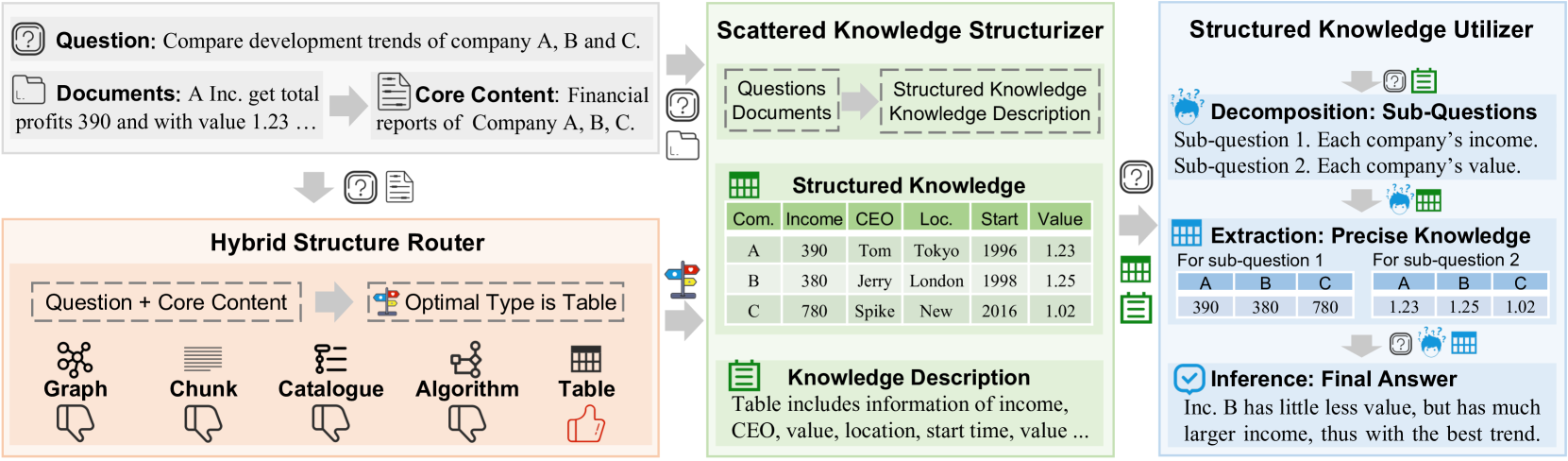
The StructRAG framework illustrating the three-stage process: Hybrid Structure Router, Scattered Knowledge Structurizer, and Structured Knowledge Utilizer.
Evaluation Highlights
- Achieves state-of-the-art performance across multiple knowledge-intensive tasks compared to strong RAG baselines
- Significantly faster inference speed than recent Graph RAG methods while maintaining superior performance
- Improvements become more pronounced as task complexity increases, demonstrating robustness in challenging scenarios
Breakthrough Assessment
8/10
Novel approach to RAG that moves beyond static chunks or graphs to dynamic, task-dependent structures. Addresses a key weakness in current RAG systems regarding scattered information aggregation.