📝 Paper Summary
Benchmark datasets
Metrics and evaluation
Modularized RAG pipeline
KILT unifies eleven knowledge-intensive datasets (QA, fact checking, entity linking, slot filling, dialogue) onto a single Wikipedia snapshot to enable comparing task-agnostic retrieval and generation models.
Core Problem
Knowledge-intensive NLP tasks (like QA and fact checking) typically use different, incompatible knowledge sources and pre-processing formats, making it impossible to evaluate general-purpose retrievers or representations across tasks.
Why it matters:
- Researchers cannot assess if a single knowledge representation (e.g., dense index) works across diverse tasks if every dataset uses a different Wikipedia version
- Comparing architectures is computationally expensive because each task currently requires indexing different large-scale corpora
- Task-specific engineering prevents the emergence of general-purpose memory architectures
Concrete Example:
A model pre-trained on the 2018 Wikipedia dump for Open-Domain QA cannot be fairly evaluated on FEVER (fact checking) if FEVER relies on a 2017 dump, as the underlying evidence pages may have changed, moved, or been deleted.
Key Novelty
Unified In-KB Benchmark (KILT)
- Maps 11 distinct datasets (spanning 5 tasks) to a single, shared snapshot of Wikipedia (5.9M articles), ensuring all ground truth evidence is available in one consistent corpus
- Introduces provenance-aware metrics that only award accuracy points if the model also retrieves the correct supporting evidence (text span or page)
- Provides a common interface (JSON lines) where every instance includes input, output, and a provenance span ID from the shared knowledge source
Architecture
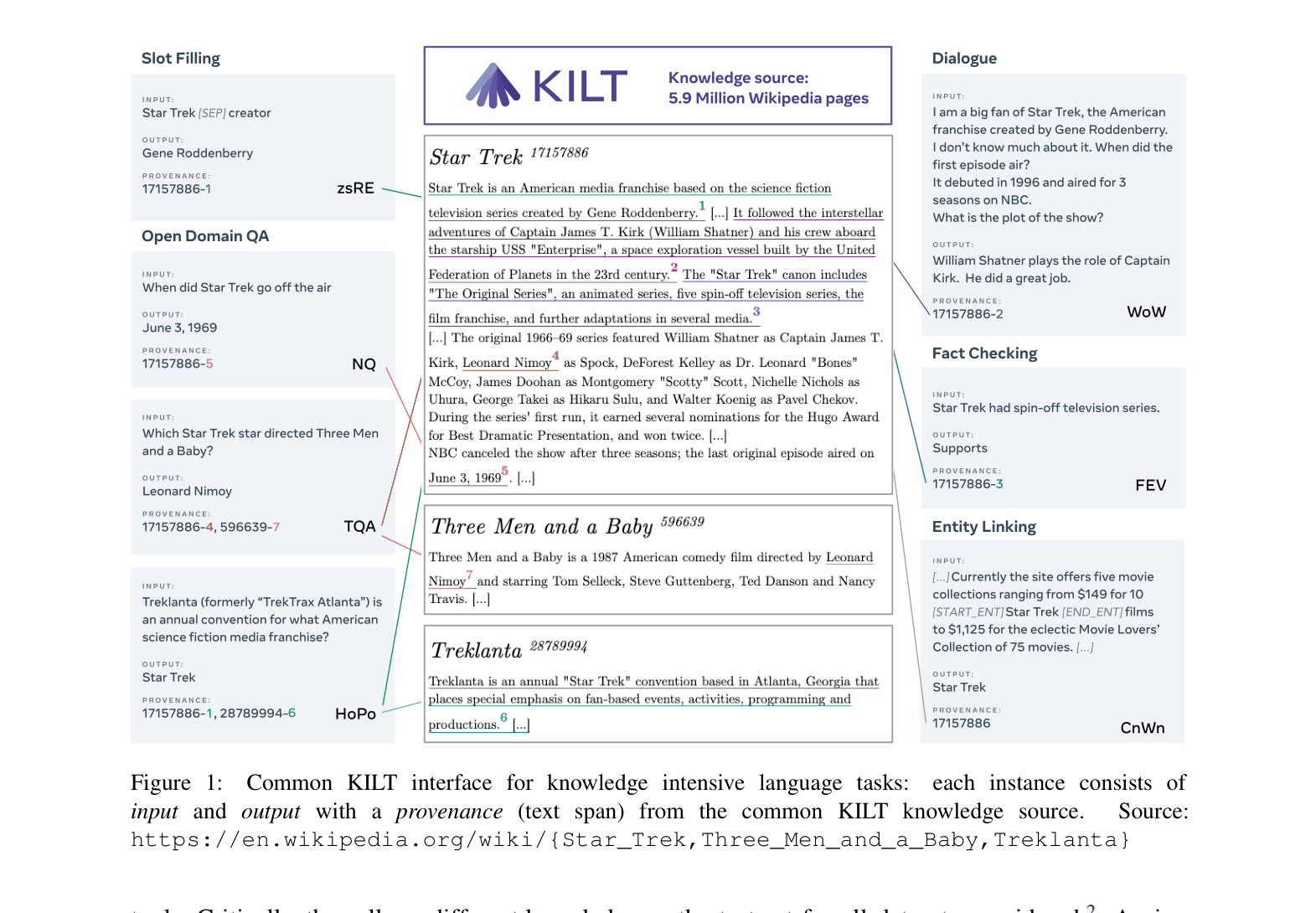
The common KILT interface applied to five different tasks (Fact Checking, Entity Linking, Slot Filling, QA, Dialogue).
Evaluation Highlights
- RAG (Retrieval-Augmented Generation) achieves state-of-the-art results on Open-Domain QA and Fact Checking, significantly outperforming task-specific baselines like NSMN on FEVER (+20% accuracy)
- Jointly training a dense retriever (DPR) on all KILT tasks (Multi-task DPR) improves retrieval R-Precision by up to +44 points compared to single-task DPR
- Generative models (BART) perform surprisingly well on Entity Linking (77.55% accuracy on AIDA CoNLL-YAGO) without explicit retrieval, solely by generating the correct entity title
Breakthrough Assessment
9/10
Foundational benchmark that standardized evaluation for retrieval-augmented generation. It enabled the development of general-purpose retrievers like DPR and RAG by providing a unified testbed.