Pensieve is an end-to-end system for answering recall questions about personal multimodal memories by enriching memory snapshots with text descriptions and using time/location-aware retrieval.
Core Problem
Existing Multimodal RAG approaches struggle with personal memory questions because they fail to leverage vague temporal/spatial anchors (e.g., 'yesterday', 'at Macy's') and cannot effectively aggregate information across multiple memory snapshots due to limited visual context windows.
Why it matters:
Enables smart assistants to function as a 'Second Brain' by recalling specific life events like parking locations or shopping items.
Current VLMs have limited context windows, making it difficult to reason over large sets of raw image memories directly.
Recall questions differ from standard visual QA by focusing on tracking objects and events over time rather than simple visual recognition.
Concrete Example:For a question like 'Where did I park?', a standard system might retrieve irrelevant cars seen recently. Pensieve retrieves the most recent parking memory by combining the visual snapshot with a 'last time' recency score and completes the invocation command 'remember this' with 'remember I parked at slot 142'.
Key Novelty
Pensieve: Task-Oriented Memory Augmentation and Retrieval
Augments raw memory images offline with rich text metadata (OCR, LLM-generated captions, and invocation command completions) to enable purely text-based reasoning later.
Employs a 'multi-signal retriever' that explicitly calculates scores for time recency, date matching, and location matching alongside semantic similarity.
Uses 'noise-injected training' for the answer generator to teach the model to ignore irrelevant retrieved memories.
Architecture
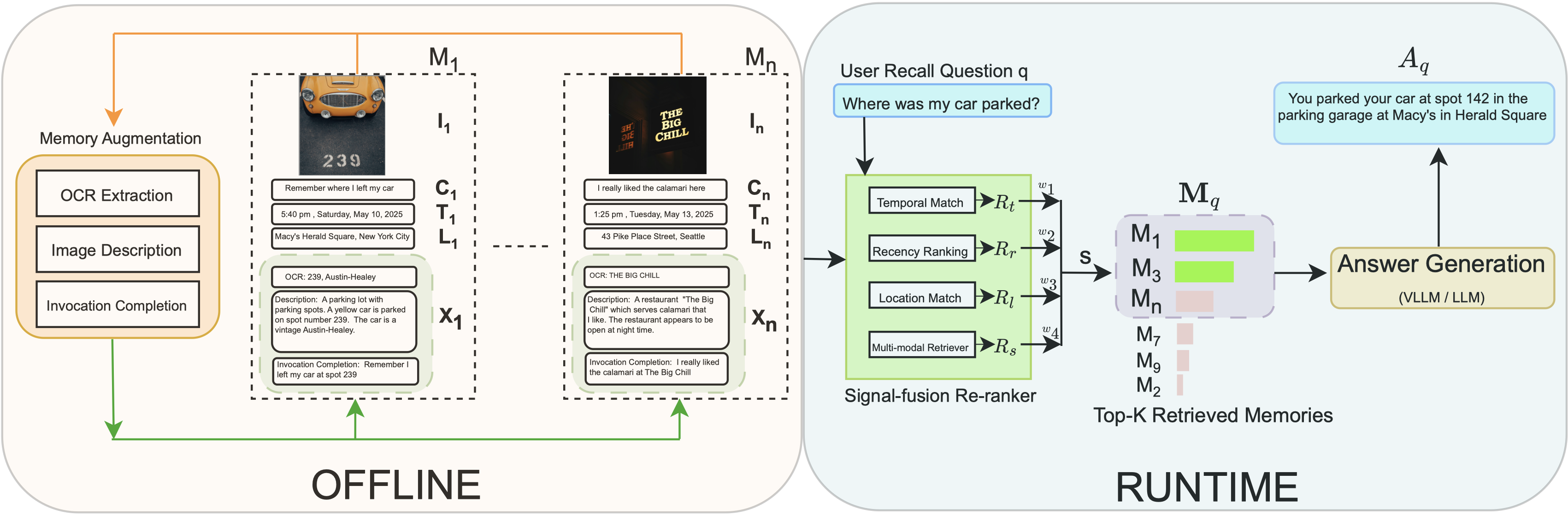
The end-to-end Pensieve pipeline, split into offline augmentation and runtime QA.
Evaluation Highlights
Improves QA accuracy by up to 14% over state-of-the-art MM-RAG solutions on the MemoryQA benchmark.
Achieves comparable performance using text-based LLMs on augmented memories as expensive VLMs using raw images.
Demonstrates robust handling of vague temporal queries (e.g., 'last week') through specialized date parsing and scoring.
Breakthrough Assessment
7/10
Significant practical advance in personal memory systems by effectively combining classic information retrieval signals (time/location) with modern multimodal LLMs. The reliance on offline text augmentation to bypass VLM context limits is a smart engineering choice.
⚙️ Technical Details
Problem Definition
Setting: Retrieval and Question Answering over a repository of multimodal memory entries
Inputs: A recall question q asked at timestamp T_q
Outputs: An answer reflecting information from relevant memories in the repository M
Enrich raw memory entries with text descriptions to facilitate retrieval
Model or implementation: VLM (for captioning/completion) and OCR model
Date Parser (Retrieval)
Extract temporal constraints from the user query
Model or implementation: LLM-based parser
Multi-Signal Retriever (Retrieval)
Retrieve and rank memories based on combined signals
Model or implementation: Multimodal Encoder + Linear Re-ranker
Answer Generator
Generate final answer while filtering irrelevant retrieved memories
Model or implementation: Text-based LLM (fine-tuned)
Novel Architectural Elements
Multi-signal retrieval stack that integrates explicit temporal (recency/date match) and spatial (location match) scores with semantic vector retrieval
QA-guided memory augmentation pipeline that proactively generates potential questions/answers to create better indexable captions
Modeling
Base Model: Text-based LLM (exact model name not explicitly reported for the generator, generic 'LLM' and 'VLM' mentioned)
Training Method: Multi-task instruction fine-tuning with noise injection
Objective Functions:
Purpose: Jointly optimize identification of relevant memories and answer generation.
Formally: Standard autoregressive cross-entropy loss over the sequence of [Positive IDs, Answer]
Training Data:
MemoryQA benchmark (9,357 recall questions)
Noise injection: Training data includes up to 2 confusing candidates as negative examples alongside positive memories
Compute: Not reported in the paper
Comparison to Prior Work
vs. MM-RAG/MuRag: Pensieve uses offline memory-specific augmentation and explicit time/location scoring, whereas standard MM-RAG relies on generic vector retrieval.
vs. VLMs (BLIP-2, LLaVA): Pensieve converts visual info to text offline to bypass VLM context limits, enabling reasoning over more memories.
vs. SnapNTell [not cited in paper]: Pensieve focuses on recall of user-specific history rather than general knowledge seeking about an image.
Limitations
Relies on the quality of offline augmentation; if OCR or VLM captioning fails, retrieval fails.
Date parsing and recency scoring rely on heuristic constants (e.g., decay rates) that may not fit all users.
The approach shifts computational cost to the offline indexing phase, which might be expensive for continuous recording.
Reproducibility
No replication artifacts mentioned in the paper. Code, model weights, and the MemoryQA benchmark dataset are not explicitly linked or stated as available.
📊 Experiments & Results
Evaluation Setup
Memory-QA benchmark containing personal memory snapshots and recall questions
Benchmarks:
MemoryQA (Multimodal Recall QA) [New]
Metrics:
QA accuracy
Statistical methodology: Not explicitly reported in the paper
Key Results
Benchmark
Metric
Baseline
This Paper
Δ
MemoryQA
QA Accuracy
Not reported in the paper
+14%
Main Takeaways
Pensieve outperforms SOTA MM-RAG solutions by up to 14% on the MemoryQA benchmark.
Text-based LLMs using Pensieve's augmented memories achieve results comparable to VLMs processing raw images, suggesting a path to lower-cost deployment.
The multi-signal retriever effectively handles vague temporal and spatial queries which challenge standard semantic retrieval.
📚 Prerequisite Knowledge
Prerequisites
Understanding of Multimodal RAG (Retrieval-Augmented Generation)
Basic knowledge of Vision-Language Models (VLMs) and OCR
Familiarity with vector retrieval and BM25
Key Terms
MM-RAG: Multi-Modal Retrieval-Augmented Generation—systems that retrieve images/text to answer questions
VLM: Vision-Language Model—AI models capable of understanding and generating text based on visual inputs
OCR: Optical Character Recognition—technology to extract text from images
BM25: A ranking function used in information retrieval to estimate the relevance of documents to a search query based on keyword matching
invocation command: The user's spoken instruction when saving a memory (e.g., 'remember this dress')
memory snapshot: A tuple containing an image, invocation command, timestamp, and location captured at a specific moment
noise injection: Training technique where irrelevant or confusing examples are deliberately included to teach the model to filter them out