📝 Paper Summary
Memory recall
Long-term memory organization
AssoMem constructs an associative memory graph linking utterances to abstract clues to enable importance-aware retrieval, fusing relevance, importance, and temporal signals via mutual information for accurate memory recall.
Core Problem
As memory volume increases, retrieval performance deteriorates because memory pools accumulate highly similar items (e.g., repeated meeting topics), making it difficult to distinguish truly relevant information using only semantic distance.
Why it matters:
- Standard RAG methods struggle with 'similarity-dense' scenarios where many memories are semantically close but distinct in importance or time.
- Users ask open-ended recommendation questions (e.g., 'What do I usually complain about?') that require identifying important patterns rather than just specific fact retrieval.
- Existing methods relying solely on semantic relevance fail to capture the associative and temporal nature of human memory organization.
Concrete Example:
For the question 'What do I usually complain about at work?', a standard retriever might find random complaints. AssoMem identifies 'work complaints' as a high-importance clue node in the graph, retrieving the most frequent/connected grievances rather than isolated instances.
Key Novelty
Associative Memory Graph with Multi-Signal Fusion
- Constructs a graph where raw memory utterances are linked to automatically extracted 'clues' (entities, events, topics), mimicking human associative memory.
- Applies Personalized PageRank (PPR) on this graph to calculate an 'Importance' score, prioritizing memories central to the user's history.
- Fuses three distinct signals—semantic relevance, graph-based importance, and temporal alignment—using an adaptive Mutual Information (MI) weighting strategy.
Architecture
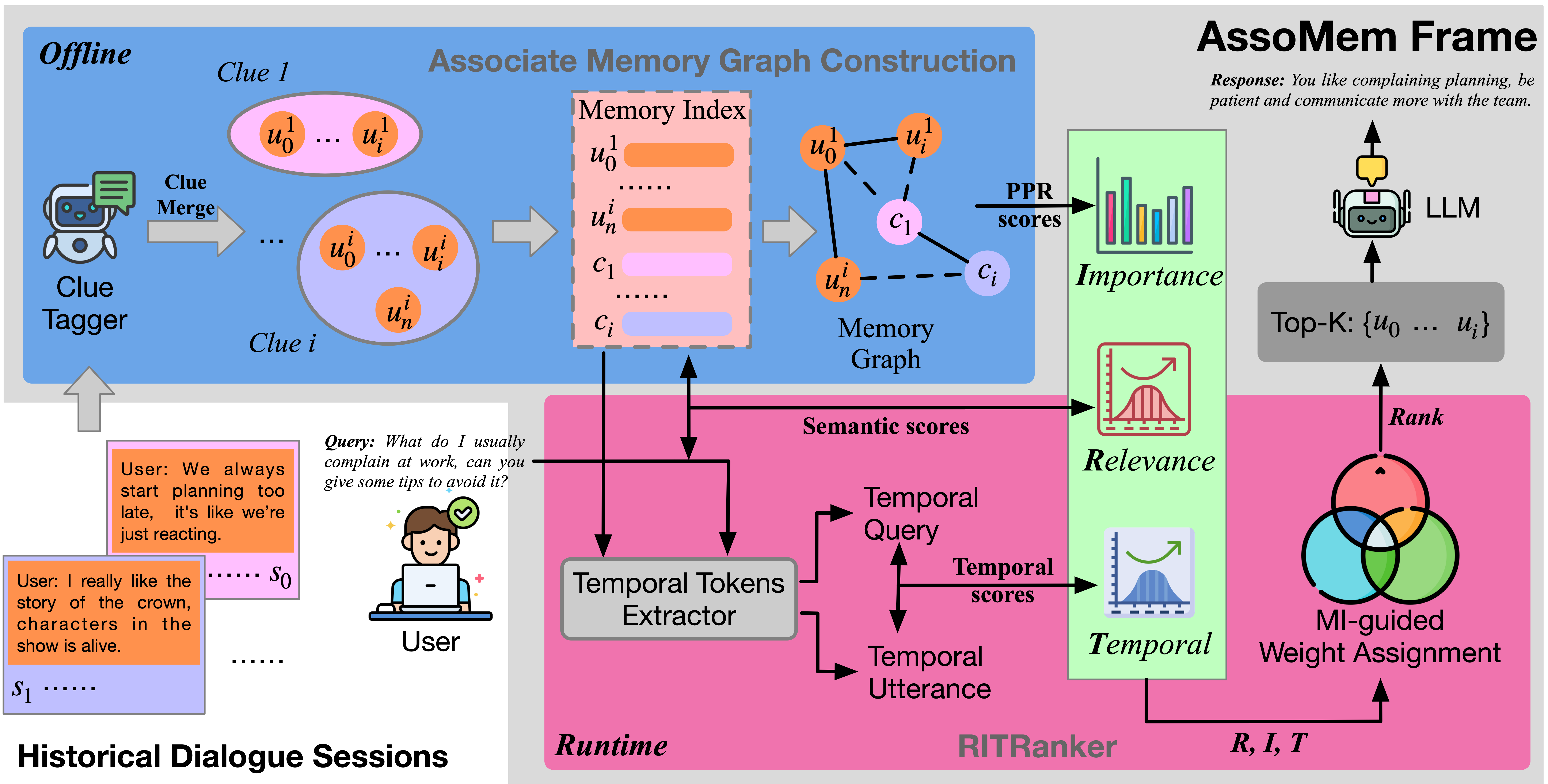
The overall AssoMem framework, illustrating the two-step process: Memory Retrieval (Graph Construction + RITRanker) and Answer Generation.
Evaluation Highlights
- Outperforms state-of-the-art baselines by 24.93% on average across benchmarks.
- Achieves 57.3% accuracy on the newly introduced MeetingQA benchmark, surpassing the best baseline (Hybrid Retrieval) at 44.5%.
- Demonstrates superior recall in similarity-dense environments compared to standard RAG and graph-based approaches.
Breakthrough Assessment
8/10
Significant advance in memory organization by moving beyond simple vector similarity to graph-based associative retrieval. Effectively integrates importance and temporal signals, addressing key failure modes in long-term memory assistants.