📝 Paper Summary
Graph Collaborative Filtering
LLM-enhanced Recommendation
Cold-start Recommendation
TAGCF enhances collaborative filtering by using LLMs to infer interaction 'reasons' as intermediate graph nodes, converting semantic knowledge into topological connectivity rather than textual embeddings.
Core Problem
Existing LLM-enhanced recommenders either inefficiently predict interactions directly or align mismatched semantic text embeddings with collaborative signals, failing to capture the structural nature of user motives.
Why it matters:
- Direct LLM inference is computationally prohibitive for large-scale retrieval due to context window limits.
- Textual embeddings often suffer from dimension mismatch and lack alignment with collaborative filtering objectives, especially in sparse data scenarios.
- Current methods focus on unilateral feature augmentation (user or item side) rather than holistic collaborative signal enhancement through connectivity.
Concrete Example:
A user interacts with an item, but the sparse interaction graph doesn't show why. Standard methods might add a noisy direct edge or a generic text embedding. TAGCF instead infers a shared attribute 'Reason' node (e.g., 'Cinematography'), creating a path User->Cinematography->Item, enabling information flow between users who care about the same underlying attribute.
Key Novelty
Topology-Augmented Graph Collaborative Filtering (TAGCF)
- Transform semantic knowledge into graph structure by extracting 'Attribute' nodes (interaction reasons) via LLMs and inserting them between Users and Items.
- Convert the bipartite User-Item graph into a tripartite User-Attribute-Item graph, enabling new message-passing paths (e.g., User -> Attribute -> Item).
- Use an Adaptive Relation-weighted Graph Convolution (ARGC) to dynamically gate information flow based on the consistency between the relation type and the node's current state.
Architecture
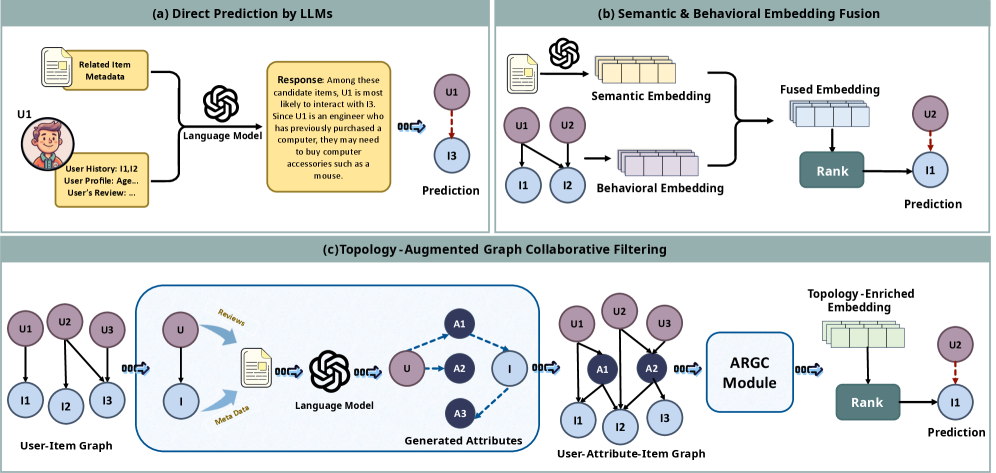
The construction of the User-Attribute-Item (U-A-I) graph compared to traditional bipartite graphs. It illustrates how 'Attribute' nodes act as bridges.
Evaluation Highlights
- Achieves consistent performance gains over LightGCN and other baselines across Yelp, Amazon-Book, and Steam datasets (e.g., Recall@20 improvements).
- Outperforms text-embedding augmentation methods (like LARA and RLMRec) while maintaining the efficiency of standard graph convolution.
- Significantly improves cold-start performance, demonstrating that structural attributes compensate for sparse interaction data better than semantic features alone.
Breakthrough Assessment
7/10
A clever architectural shift from 'LLM-as-feature' to 'LLM-as-topology'. While not a fundamental algorithm change in GNNs, the tripartite construction effectively solves the modality misalignment problem in recommender systems.