📊 Experiments & Results
Evaluation Setup
Open-domain QA using Natural Questions dataset
Benchmarks:
- Natural Questions (NQ) (Open-domain QA)
Metrics:
- Win-rate (identifying gold docs)
- Kendall's tau (correlation with correctness)
- Mean Reciprocal Rank (MRR)
- Answer Accuracy
- Statistical methodology: Sign test used for statistical significance in win-rate comparisons
Key Results
| Benchmark | Metric | Baseline | This Paper | Δ |
|---|---|---|---|---|
| Evaluation of metric properties: Can GroGU identify gold documents and correlate with actual generation accuracy? | ||||
| Natural Questions | Win Rate (Gold vs Distractor) | 0.686 | 0.745 | +0.059 |
| Natural Questions | Kendall's Tau Correlation | -0.093 | 0.377 | +0.470 |
| Downstream application: Using GroGU to train a query rewriter. | ||||
| Natural Questions | Mean Reciprocal Rank (MRR) | Not reported in the paper | Not reported in the paper | Not reported in the paper |
| Natural Questions | Answer Accuracy | Not reported in the paper | Not reported in the paper | Not reported in the paper |
Experiment Figures
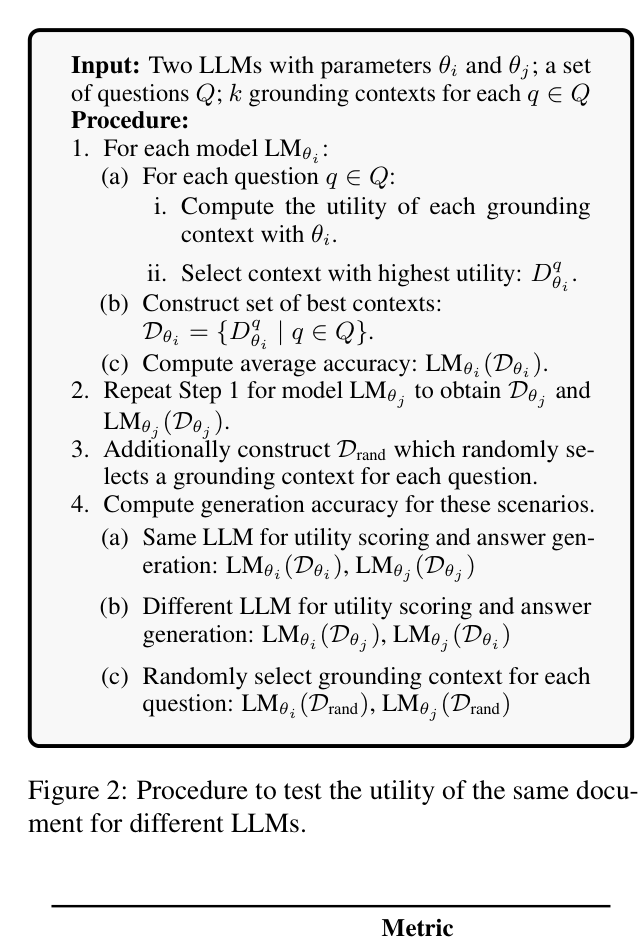
Test procedure for 'Same Document But Different Utility' experiment.
Main Takeaways
- GroGU (KeyEntropy) effectively distinguishes ground-truth documents from high-ranking distractors, outperforming perplexity-based metrics.
- Relevance scores negatively correlate with generation accuracy in scenarios where random documents help generation (noise robustness), whereas GroGU maintains positive correlation.
- Utility is model-specific: A document layout preferred by one model (e.g., Phi) is not necessarily the best for another (e.g., Qwen).
- Training a query-rewriter using GroGU-derived preferences significantly improves both retrieval ranking and final answer accuracy.