📝 Paper Summary
Sequential Recommendation
Explainable Recommendation
LLM-based Recommender Systems
RGCF-XRec integrates dense collaborative filtering signals and reasoning-guided chain-of-thought traces into a language model via a unified projection network to deliver accurate, explainable recommendations across cold and warm scenarios.
Core Problem
Existing LLM-based recommender systems struggle to incorporate dense collaborative signals crucial for warm-start scenarios, while traditional CF models lack the semantic reasoning capabilities needed for cold-start and explainability.
Why it matters:
- LLMs alone often fail to capture latent behavioral patterns available in interaction history, leading to suboptimal performance in standard warm-start settings.
- Traditional CF models are black boxes that cannot explain their recommendations or handle new items (cold-start) effectively without textual semantic understanding.
- Current hybrid methods often treat recommendation and explanation as separate tasks or rely on implicit signals without explicit reasoning paths.
Concrete Example:
A user 'John' has a history of buying serums (warm start), where CF excels. If a new 'facial oil' appears (cold start), CF fails due to lack of history. An LLM alone might miss John's specific texture preferences. RGCF-XRec aligns the serum history (CF) with the oil's description (LLM) using reasoning to bridge the gap.
Key Novelty
Reasoning-Guided Collaborative Filtering (RGCF)
- Enhances CF by using an offline LLM to generate 'reasoning traces' that explain the link between user history and target items, filtering them for quality before use.
- Projects these reasoning traces, along with aligned user/item CF embeddings, directly into the LLM's token space as a 'soft prompt' for single-pass recommendation and explanation.
- Uses a unified encoder that aligns collaborative signals (interaction history) and semantic signals (text descriptions) into a shared space, handling both cold and warm items.
Architecture
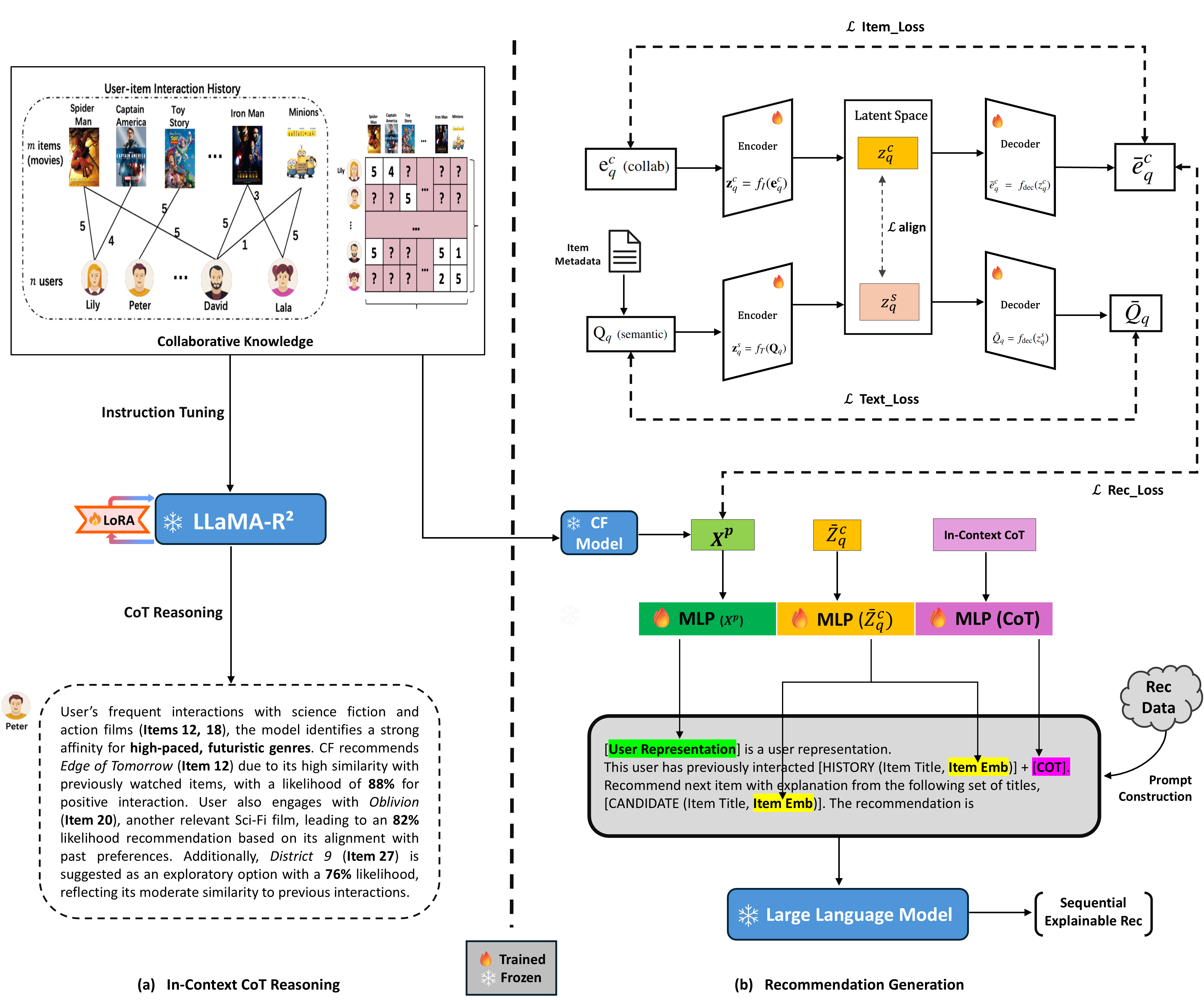
The complete architecture of RGCF-XRec, showing the data flow from raw inputs (interaction history, item text) through the Representation Layer, Fusion/Projection Layer, to the Generation Layer.
Evaluation Highlights
- Improves HR@10 by 7.38% in Sports and 4.59% in Toys datasets compared to leading CF-aware LLM baselines.
- Reduces the cold–warm performance gap, achieving gains of 14.5% in cold-start and 11.9% in warm-start scenarios overall.
- Enhances Zero-Shot HR@5 by 18.54% in Beauty and 23.16% in Toys, demonstrating strong generalization.
Breakthrough Assessment
8/10
Strong contribution in effectively bridging the gap between ID-based CF and LLMs using explicit reasoning traces. The significant gains in both cold-start and zero-shot settings validation the hybrid approach.