📝 Paper Summary
Recommendation Diversity
Knowledge Graph-based Recommendation
KG-Diverse enhances recommendation diversity by pushing user embeddings away from their interaction history using knowledge graph contexts, while maintaining accuracy through item alignment based on shared entities.
Core Problem
Traditional recommender systems prioritize accuracy based on historical interactions, leading to 'echo chambers' where users only see familiar content types, while existing diversity metrics (like category coverage) are too coarse-grained.
Why it matters:
- Users trapped in filter bubbles miss novel items of interest, reducing long-term engagement.
- Existing diversity metrics fail to distinguish between items in the same broad category (e.g., two different phones vs. two models of the same phone), ignoring rich contextual differences.
- Simply optimizing for diversity often hurts accuracy; achieving a better trade-off is a persistent challenge in the field.
Concrete Example:
A user watches 'The Avengers'. A standard system recommends 'Captain America 3' (same genre/actors). A category-diverse system might pick a random non-action movie. KG-Diverse recommends 'Dolittle' (comedy, but same actor R. Downey Jr.) or 'Before We Go' (different genre, same actor Chris Evans as director), offering diversity through specific KG connections rather than just broad genres.
Key Novelty
KG-Diverse (Knowledge Graph-based Diversified Recommendation)
- Introduces Entity Coverage and Relation Coverage metrics to measure diversity at a granular, semantic level rather than just item categories.
- Uses a Diversified Embedding Learning (DEL) module that explicitly pushes user representations away from their past interactions and towards unexplored regions of the embedding space.
- Employs 'Conditional Alignment and Uniformity' to ensure items sharing KG entities remain close in vector space, preserving semantic consistency while diversifying.
Architecture
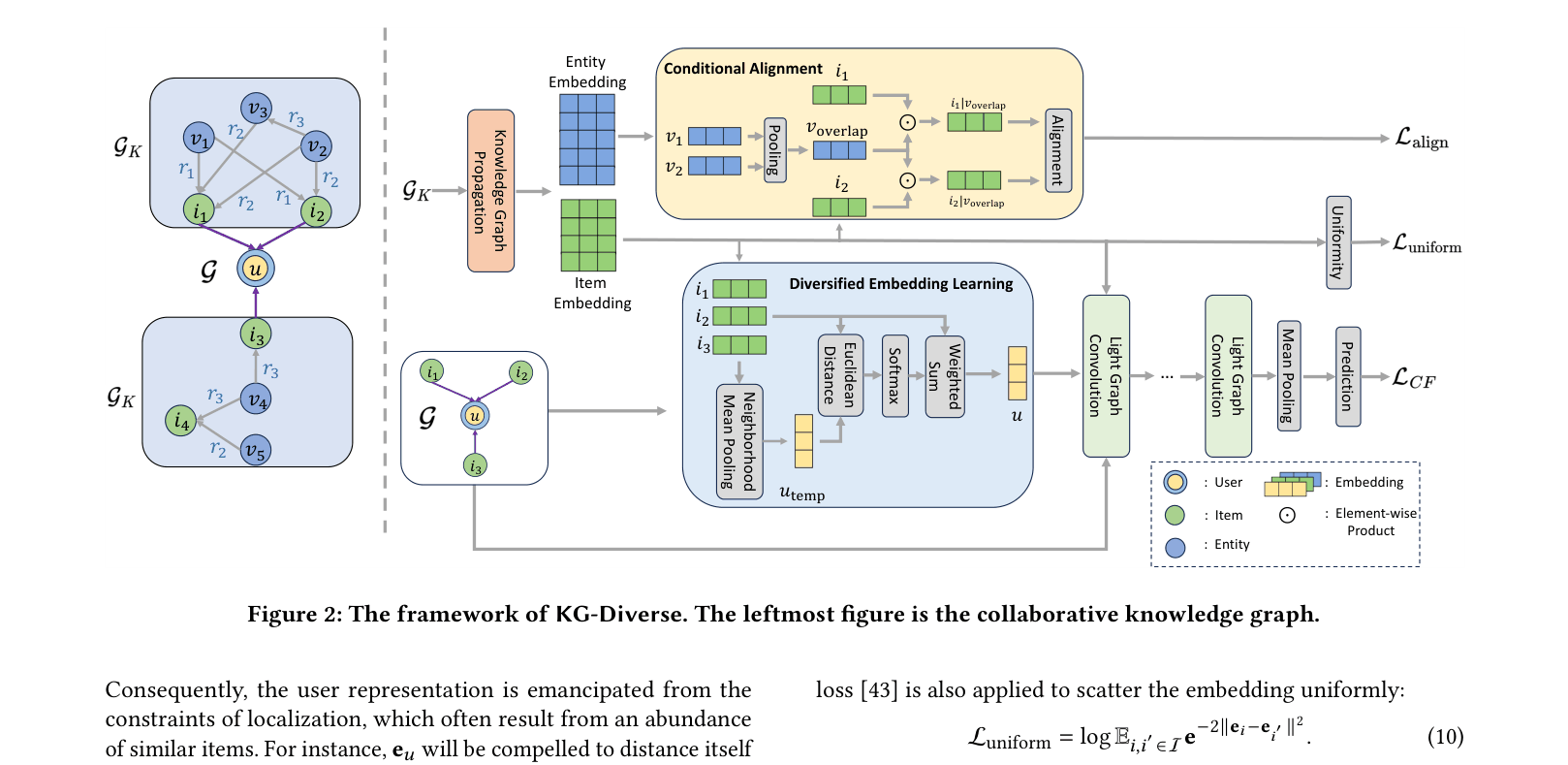
The overall architecture of KG-Diverse, illustrating the flow from KG propagation to user/item representation learning.
Evaluation Highlights
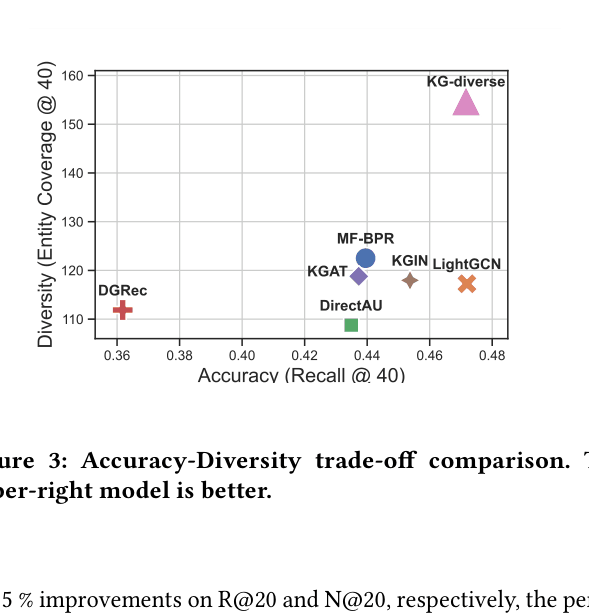
- Outperforms baselines on diversity metrics (Entity Coverage and Relation Coverage) while maintaining comparable accuracy (Recall/NDCG) across three datasets (MovieLens-1M, Last.FM, Book-Crossing).
- Achieves better trade-off between accuracy and diversity compared to state-of-the-art diversified recommendation methods like DGCN and MMR.
- Ablation studies confirm that the Diversified Embedding Learning module is the primary driver for increased diversity scores.
Breakthrough Assessment
7/10
Offers a novel, granular approach to diversity using KGs instead of coarse categories. The proposed metrics and embedding strategy are theoretically sound and empirically effective, though the scope is limited to KG-enhanced scenarios.