📝 Paper Summary
Modularized RAG pipeline
Complex question answering
UniRAG unifies entity-based query decomposition, granular reasoning that verifies sub-facts independently, and iterative rewriting to handle complex knowledge-intensive queries better than standard RAG approaches.
Core Problem
Existing RAG methods struggle with complex queries because they often propagate early reasoning errors, fail to verify independent constraints simultaneously, or rely on incomplete retrieval without self-correction.
Why it matters:
- Standard retrieval often misses nuanced information required for multi-hop or domain-specific questions (e.g., biomedical or legal)
- Current reasoning methods (like Chain-of-Thought) can hallucinate steps or fail when early retrieval is noisy
- Reliability is critical for knowledge-intensive tasks where answers must be fully grounded in evidence, not just plausible-sounding
Concrete Example:
For a multi-hop question requiring two facts (e.g., 'Who is the director of the movie starring X?'), a standard retriever might find documents about X but miss the director. Without explicit verification of the missing 'director' constraint, the model might guess or hallucinate an answer based on partial context.
Key Novelty
Unified Decomposition-Reasoning-Rewriting Framework (UniRAG)
- Decomposes queries based on extracted named entities (via FLERT) to ensure sub-queries focus on specific information needs
- Uses a 'Let's Break It Down' prompting strategy that forces the LLM to verify each retrieved sub-fact independently before synthesizing an answer
- Implements a self-correcting loop where, if evidence is insufficient, the query is rewritten based specifically on the identified reasoning gaps
Architecture
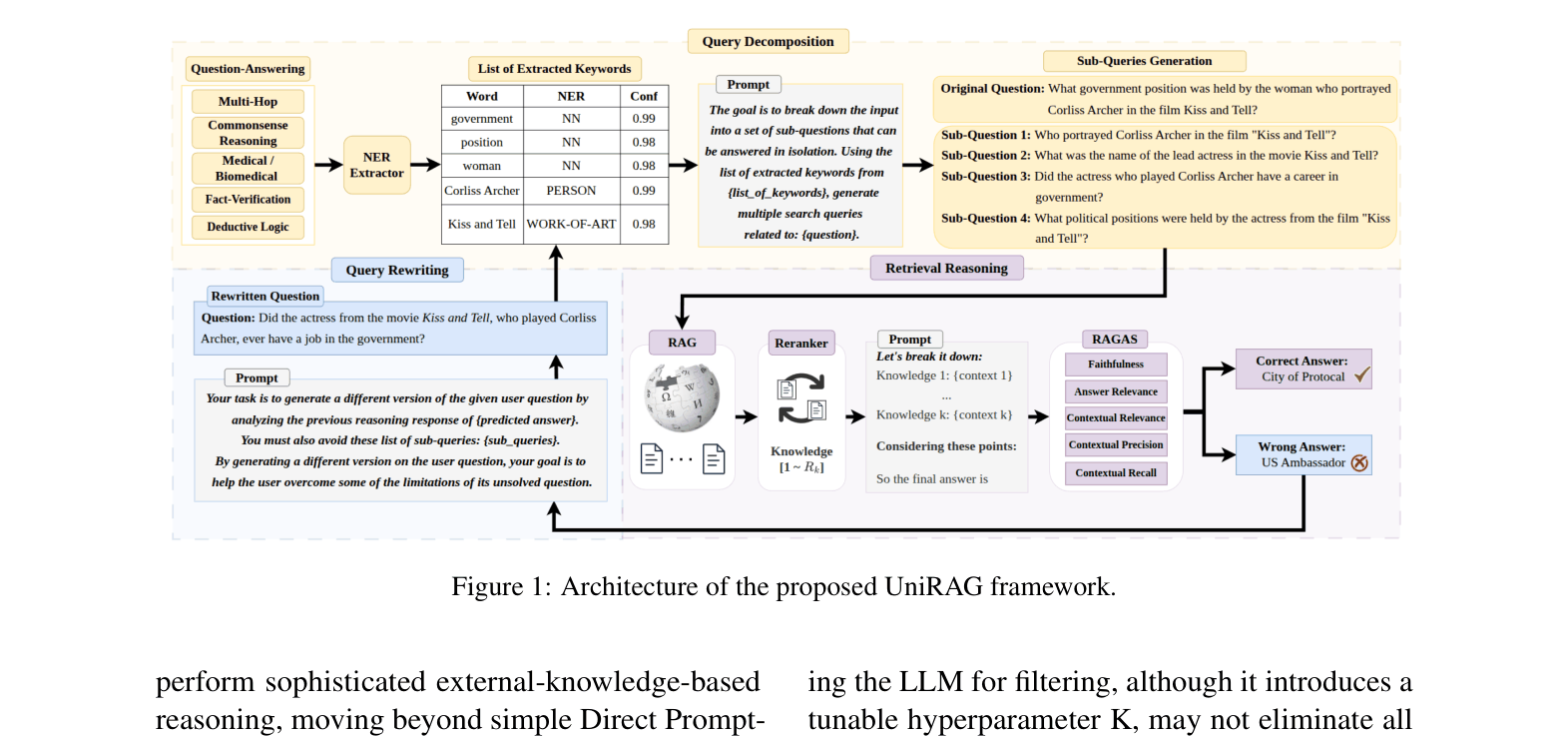
The complete UniRAG workflow, illustrating the three main phases: Entity-Grounded Decomposition, Break-Down Reasoning, and Iterative Rewriting.
Evaluation Highlights
- +28.6% Exact Match improvement on HotPotQA (multi-hop) using LLaMA-3.1-8B compared to the best baseline (ITER-RETGEN)
- +12.78% Accuracy improvement on MedQA (biomedical) using LLaMA-3.1-8B compared to standard Chain-of-Thought prompting
- Achieves 76.6% Exact Match on HotPotQA with LLaMA-3.1-8B, surpassing even GPT-3.5-Turbo's performance with standard RAG
Breakthrough Assessment
7/10
Strong empirical gains across diverse benchmarks (multi-hop, biomedical, commonsense). While the individual components (decomposition, rewriting) are known, the unified integration and specific 'break-down' verification strategy show significant effectiveness.