📝 Paper Summary
Context-Aware Recommender Systems (CARS)
Knowledge Graph-based Recommendation
CA-KGCN is an end-to-end framework that combines users' contextual situations with knowledge graphs via attention-based graph convolution to generate context-adapted recommendations and explanations.
Core Problem
Existing recommender systems either ignore how user preferences shift with context or fail to leverage rich semantic relationships in knowledge graphs, resulting in lower accuracy and static explanations.
Why it matters:
- User preferences are dynamic (e.g., watching a movie with children vs. a partner requires different recommendations)
- Static explanations based solely on item features fail to justify why a recommendation is relevant *right now* (in the current context)
- Traditional tensor-based context modeling suffers from high complexity and sparsity issues compared to graph-based approaches
Concrete Example:
A user choosing a movie might care about the 'director' when alone but prioritize 'genre' (e.g., animation) when with children. A standard system might recommend a drama based on past history, failing to account for the 'with children' context. CA-KGCN identifies that the 'companion' factor is currently critical and shifts attention to appropriate KG relations.
Key Novelty
Context-Aware Knowledge Graph Convolutional Network (CA-KGCN)
- Models users and contexts as a graph where user representation is dynamically re-weighted based on attention to specific contextual factors (e.g., location, time)
- Refines item representations by propagating information from a knowledge graph, weighted by how important specific relations (e.g., 'directed_by') are to the user in that context
- Uses the learned attention weights to generate natural language explanations that justify recommendations based on both the situation and item attributes
Architecture
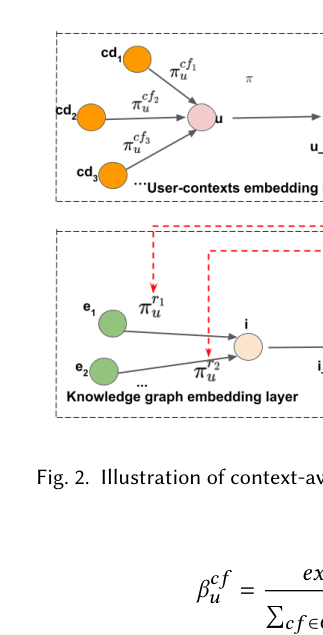
The complete CA-KGCN framework architecture illustrating the data flow from inputs to prediction.
Evaluation Highlights
- Outperforms strong baselines (NFM, DeepFM, LightGCN) on Yelp-CO rating prediction (RMSE 0.961 vs best baseline 1.047)
- Achieves higher ranking accuracy on Frappé dataset (AUC 0.942 vs best baseline 0.881)
- Demonstrates +1.8% to +6.9% improvement in AUC across datasets compared to NFM (best baseline)
Breakthrough Assessment
6/10
Solid combination of context-awareness and Knowledge Graphs using GCNs. While the architecture effectively merges known techniques (attention, GCNs), the explicit focus on context-aware explanations via attention weights is a practical contribution.