📝 Paper Summary
Inductive Recommendation
Graph Neural Networks (GNNs)
Knowledge Graph (KG) Integration
GInRec is an inductive recommender system that uses Graph Neural Networks with relation-specific gates to effectively aggregate knowledge graph information for new users and items without retraining.
Core Problem
Existing recommender systems struggle with inductive settings (new users/items) because they rely on fixed IDs or user metadata that isn't always available, or they fail to exploit Knowledge Graph structure effectively.
Why it matters:
- Transductive methods require heavy retraining whenever new items or users are added, which is computationally expensive
- Existing inductive methods often ignore Knowledge Graphs, relying only on interactions, making recommendations impossible for new items with no interactions
- Current methods relying on subgraph extraction for every user-item pair scale poorly for ranking tasks
Concrete Example:
In a movie system, if a new user rates 'Inception' but has no other history, standard Collaborative Filtering fails. GInRec uses the Knowledge Graph to link 'Inception' to 'Christopher Nolan' and 'Sci-Fi', inferring the user might like 'The Prestige' without needing retrained user embeddings.
Key Novelty
Gated Inductive Recommendation (GInRec) with Relation-Specific Gates
- Replaces standard GNN aggregation with relation-specific gates that learn distinct weights for different edge types (e.g., 'directed_by' vs 'has_genre') in the Knowledge Graph
- Uses an autoencoder jointly trained with the ranking loss to compress rich initial feature vectors (like BERT embeddings of movie plots) into manageable dense representations
- Operates purely inductively by deriving user representations from their current interactions and item features, requiring no user metadata or ID-based embeddings
Architecture
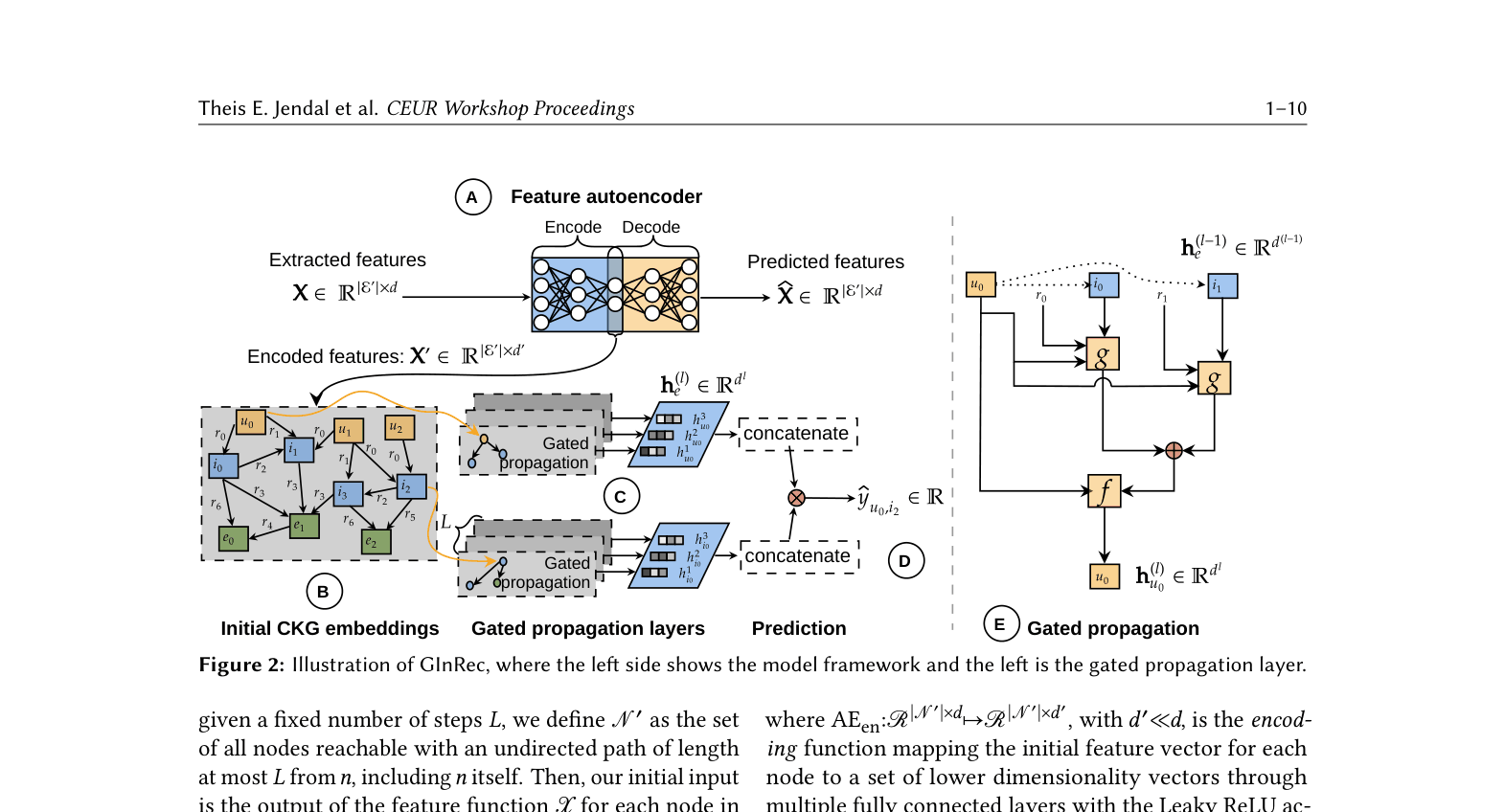
The GInRec architecture, detailing the flow from initial entity features to the final user-item score.
Evaluation Highlights
- Outperforms state-of-the-art inductive baselines (PinSAGE, IDCF) by statistically significant margins on MovieLens-20m and Amazon-Book datasets
- +33% improvement in NDCG@20 over PinSAGE on the Amazon-Book Subsampled dataset (0.06472 vs 0.05398)
- Demonstrates high scalability: generates embeddings for all nodes in MovieLens-Subsampled in 0.48s, compared to PinSAGE's 0.446s, while achieving better ranking performance
Breakthrough Assessment
7/10
Strong engineering contribution combining GNNs, KGs, and gating for inductive tasks. Exposes significant flaws in previous evaluation protocols (negative sampling) and offers a scalable solution.