📝 Paper Summary
Knowledge-aware Recommendation
Graph Neural Networks (GNNs)
Generative Diffusion Models
DiffKG improves recommendation accuracy by using a generative diffusion model to filter noisy connections in knowledge graphs and reconstruct task-relevant subgraphs guided by user interaction signals.
Core Problem
Real-world Knowledge Graphs (KGs) used in recommendation systems often contain noisy, irrelevant connections and long-tail distributions that mislead user preference modeling.
Why it matters:
- Standard KG-enhanced methods assume all KG relations are useful, but irrelevant connections introduce noise that degrades recommendation accuracy.
- Existing contrastive learning approaches rely on random augmentation, which can inadvertently break informative structures or retain noise.
Concrete Example:
A movie recommendation system might link a user's favorite action movie to a drama via a shared but irrelevant 'director' entity. Standard methods treat this as a strong signal, recommending unwanted dramas. DiffKG would identify this 'director' link as noise for this specific user's preference and filter it out.
Key Novelty
Generative KG Diffusion for Structure Denoising
- Applies a diffusion process to the Knowledge Graph structure itself, gradually adding noise to relations and learning to reverse it to recover a clean, robust graph structure.
- Introduces a Collaborative KG Convolution mechanism that injects user-item interaction signals into the diffusion process, ensuring the reconstructed KG focuses on relations relevant to recommendation rather than just generic facts.
Architecture
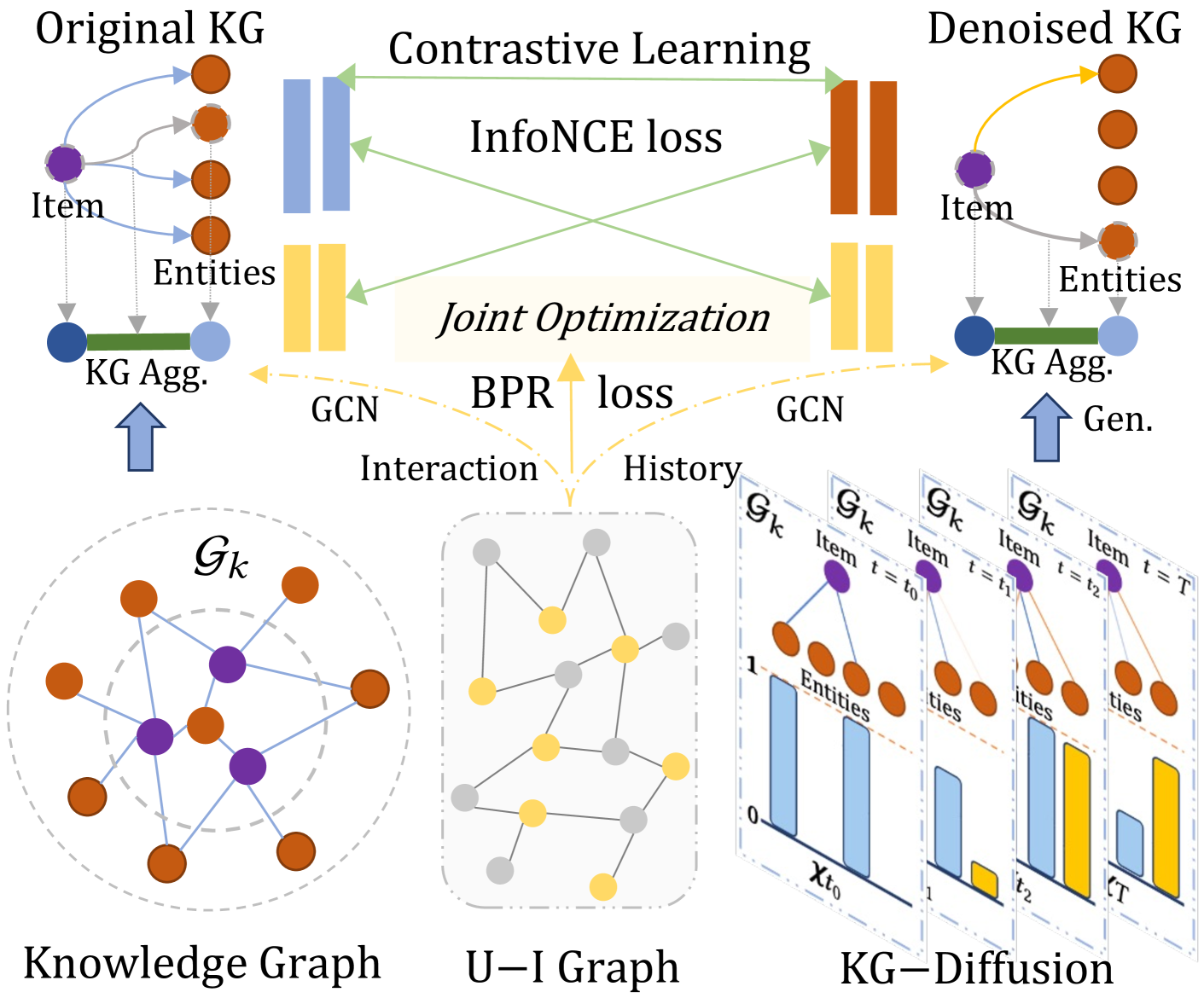
The overall architecture of DiffKG.
Evaluation Highlights
- Outperforms state-of-the-art baselines (including KGCL and KGIC) across three benchmark datasets (Alibaba-iFashion, Amazon-Book, Yelp2018).
- Achieves significant performance gains in sparse data scenarios, demonstrating robustness against data scarcity.
- Ablation studies confirm the necessity of both the KG diffusion module and the collaborative convolution mechanism for optimal performance.
Breakthrough Assessment
7/10
Novel application of diffusion models specifically for graph structure denoising in recommendation. While diffusion in RecSys is growing, integrating it with collaborative signals for KG filtering is a strong, distinct contribution.