📝 Paper Summary
Knowledge-based Question Answering (KBQA)
Modularized RAG pipeline
Chain-of-Thought (CoT)
Keqing improves Large Language Model reliability in question answering by decomposing complex questions into sub-questions that map directly to executable logical chains on a Knowledge Graph.
Core Problem
LLMs often hallucinate when answering knowledge-intensive questions, and existing retrieval-augmented methods using embedding-based retrieval often introduce redundant or irrelevant context that confuses the model.
Why it matters:
- Standard embedding-based retrieval fetches noisy documents that occupy token space without guaranteeing precise answers
- Direct text-to-SQL generation by LLMs is prone to syntax errors and often produces unexecutable queries
- Current methods lack interpretability regarding how an answer was derived step-by-step
Concrete Example:
For the question 'what other works the director of Written on Wind has done?', a standard LLM might hallucinate movies. Keqing decomposes this into 'who was the director of [Written on Wind]?' then '[Director] was the director of which movies?', retrieving exact triplets from the Knowledge Graph.
Key Novelty
Decomposition-based Retrieval on Knowledge Graphs (Keqing)
- Uses predefined templates to decompose complex questions into simpler sub-questions, treating the decomposition process as a natural Chain-of-Thought
- Maps decomposed sub-questions to pre-collected logical chains on a Knowledge Graph to retrieve precise candidate entities rather than dense text chunks
- Iteratively solves sub-questions using retrieved triplets, passing answers as seeds to the next sub-question in the chain
Architecture
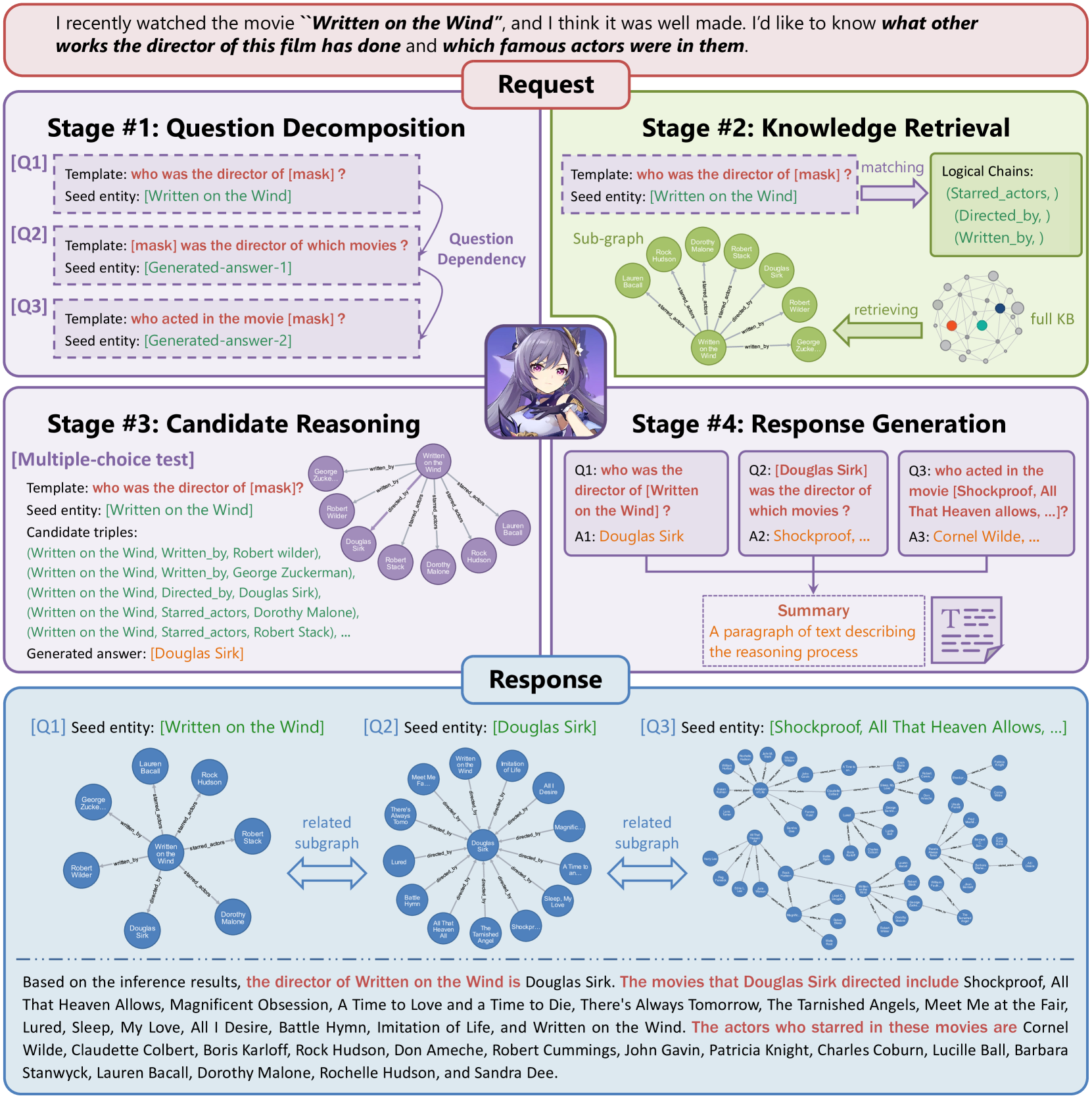
The complete workflow of Keqing answering a complex movie question.
Evaluation Highlights
- Achieves 93.3% accuracy on MetaQA-3hop (complex multi-hop questions), comparable to or exceeding state-of-the-art methods like KB-BINDER
- Surpasses standard embedding-based retrieval (DPR) methods on precision by retrieving structured triplets instead of noisy text passages
- Demonstrates high interpretability by generating responses that explicitly trace the reasoning path (e.g., entity A -> relation R -> entity B)
Breakthrough Assessment
7/10
Solid framework for structured KBQA that avoids the pitfalls of text-to-SQL. It effectively bridges the gap between unstructured LLM reasoning and structured Knowledge Graph querying, though reliance on predefined templates may limit open-ended generalization.