📝 Paper Summary
Semantic Parsing
Knowledge Base Question Answering (KBQA)
Agentic LLM Frameworks
Interactive-KBQA treats the LLM as an agent that iteratively interacts with a Knowledge Base using three generic tools to generate SPARQL queries, enabling high performance with minimal annotated examples.
Core Problem
Semantic parsing-based KBQA methods typically require expensive, large-scale data annotation and struggle with complex queries involving constraints or multi-hop reasoning.
Why it matters:
- Traditional semantic parsing is resource-intensive and lacks transparency ('black box' reasoning).
- Current LLM-based methods underutilize the model's reasoning capabilities, often limiting them to simple classification or draft generation.
- Complex queries (e.g., numerical constraints, aggregations) remain difficult for Information Retrieval-based approaches.
Concrete Example:
For the question 'How many basketball players are taller than 2 meters?', standard IR methods fail because they rely on simple entity recognition. An LLM might hallucinate predicates without verifying against the KB schema. Interactive-KBQA breaks this down: search for 'basketball players', filter by 'height > 2m', and count the results.
Key Novelty
Agent-Environment Paradigm for KBQA
- Conceptualizes the LLM as an agent and the Knowledge Base as an environment, interacting via a unified thought-action loop.
- Introduces three generic atomic tools (SearchNodes, SearchGraphPatterns, ExecuteSPARQL) adaptable to heterogeneous databases (Freebase, Wikidata, Movie KB).
- Implements a human-in-the-loop annotation process where humans correct intermediate reasoning steps, creating high-quality low-resource training data efficiently.
Architecture
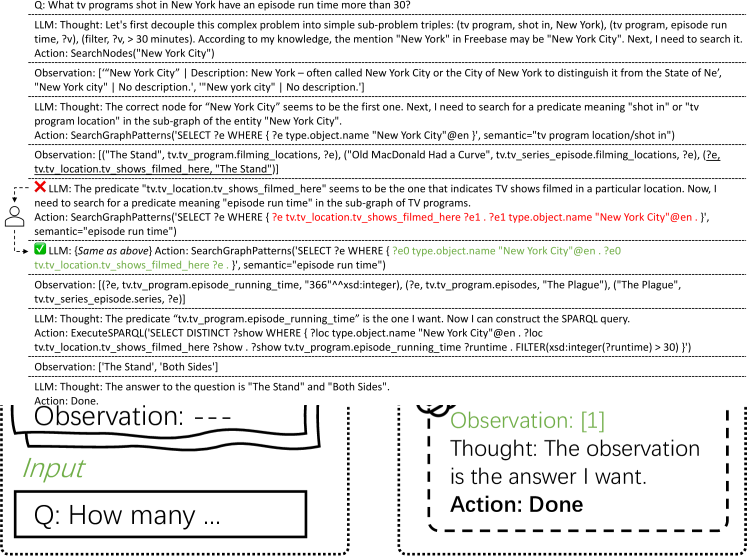
The overall framework of Interactive-KBQA. It depicts the iterative loop between the LLM (Agent) and the Knowledge Base (Environment).
Evaluation Highlights
- Outperforms GPT-4 Turbo on ComplexWebQuestions (CWQ) and KQA Pro using only ~50 annotated examples per question type via fine-tuning.
- Achieves significant gains on specific complex question types: +29.85% on Comparative and +13.96% on Superlative questions in CWQ compared to baselines.
- Demonstrates high efficiency in low-resource settings, rivaling or beating full-data semantic parsing baselines (trained on 3K-33K examples) with minimal data.
Breakthrough Assessment
8/10
Strong contribution in applying agentic workflows to semantic parsing. The human-machine collaborative annotation strategy offers a practical solution to the data scarcity problem in KBQA.