📝 Paper Summary
Continual Pre-training
Knowledge Internalization
Pre-instruction-tuning (PIT), where models learn QA patterns before or alongside new documents, significantly improves the ability of LLMs to absorb and retrieve factual knowledge compared to standard post-training recipes.
Core Problem
Standard continued pre-training followed by instruction-tuning fails to effectively elicit knowledge from new documents, even when document perplexity is minimized (the 'perplexity curse').
Why it matters:
- LLMs need to update their static knowledge base with evolving information without expensive full re-training
- Current methods result in models that can recite documents (low perplexity) but cannot answer questions about the facts contained within them
- Retrieving knowledge stored in parameters remains significantly less effective than open-book settings, limiting the utility of continual learning
Concrete Example:
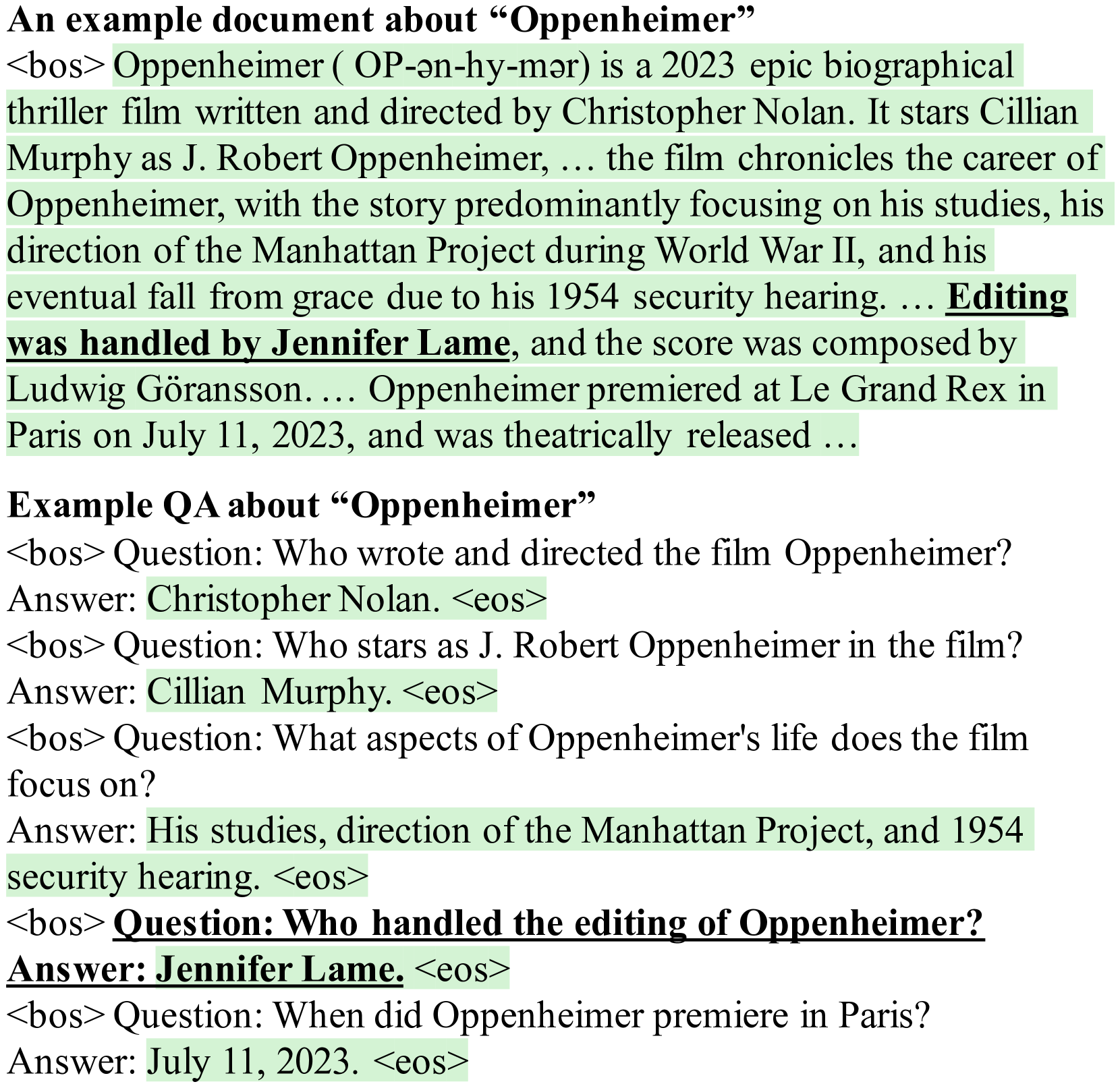
When a model is trained on a document stating 'Editing was handled by Jennifer Lame', it often fails to answer 'Who handled the editing of Oppenheimer?' despite the document text being perfectly memorized, because the model hasn't learned to link the concept of 'editing' in the document to the specific question format.
Key Novelty
Pre-instruction-tuning (PIT)
- Invert the standard order: Expose the LLM to Question-Answer (QA) pairs *before* or *during* the encoding of complex documents
- Prioritizing 'how to access knowledge' (via straightforward QA pairs) primes the model to better encode information from complex, cluttered documents during subsequent training
- Use a specific curriculum: Train on QA pairs first, then a mix of QA pairs and documents, ensuring the retrieval mechanism is established before the knowledge storage occurs
Architecture
A comparison of different training recipes (1-8), showing the order of data exposure (QA pairs vs Documents) and their combinations
Evaluation Highlights
- +17.8% accuracy improvement on Llama-2 7B (48.1% vs 30.3%) using PIT++ compared to standard instruction-tuning on the Wiki2023 dataset
- +16.3% accuracy improvement on Llama-2 70B (62.7% vs 46.4%) using PIT++ compared to standard instruction-tuning
- Cross-domain generalization: PIT trained on non-film domains still outperforms standard instruction-tuning when tested on the film domain (38.8% vs 30.3% for 7B)
Breakthrough Assessment
8/10
Identifies a critical failure mode in standard continual learning ('perplexity curse') and provides a strong, counter-intuitive solution (training on instructions before knowledge) with substantial empirical gains.