📝 Paper Summary
Episodic Memory for LLMs
Long-context Reasoning
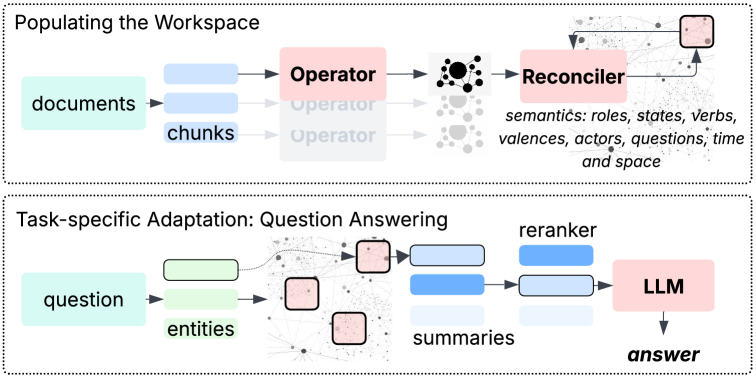
GSW equips LLMs with episodic memory by building a structured, evolving world model that tracks actors, roles, and states across space and time, rather than just retrieving static text chunks.
Core Problem
Current RAG methods treat documents as isolated facts or static graphs, failing to track evolving narratives where actors change roles, states, and locations over time.
Why it matters:
- Standard retrieval misses context when information is spread across multiple chunks, leading to 'lost-in-the-middle' effects
- Fact-based knowledge graphs struggle with narrative texts (e.g., crime reports, news) where entities have transient states (free → arrested) rather than permanent attributes
- Reasoning over long horizons requires an internal world model to maintain consistency across spatiotemporal shifts, which current vector-based methods lack
Concrete Example:
In a story where 'Carter Stewart' is a presenter at a museum in 2026 (Doc #1) and a researcher at a golf course in 2024 (Doc #2), standard graph RAG methods confuse the timelines or hallucinate locations because they cannot bind the specific role 'presenter' to the specific time and place, leading to erroneous merging of distinct events.
Key Novelty
Generative Semantic Workspace (GSW)
- Neuro-inspired architecture modeling the neocortical-hippocampal loop: an 'Operator' extracts semantic structures (actors, roles, states) from text, while a 'Reconciler' binds them into a coherent spatiotemporal timeline.
- Represents memory not as text chunks but as a probabilistic state space of evolving situations, allowing the system to predict future states and enforce logical continuity across events.
Architecture
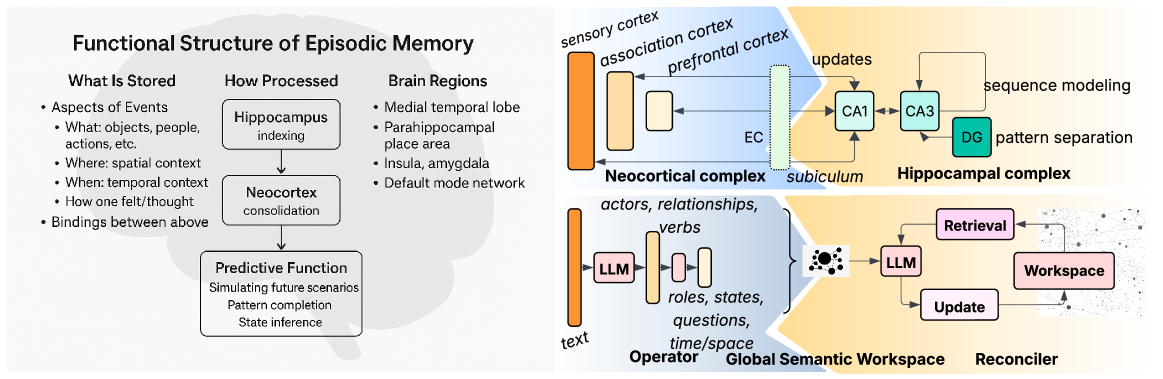
The GSW framework inspired by the neocortical-hippocampal loop.
Evaluation Highlights
- Outperforms HippoRAG2 by up to 20% in recall on complex queries requiring synthesis across 17+ documents.
- Achieves 0.85 F1-score on EpBench-200, surpassing GraphRAG and other structured baselines by over 10%.
- Reduces query-time context tokens by 51% compared to GraphRAG (the next most efficient baseline) by generating targeted summaries instead of retrieving raw chunks.
Breakthrough Assessment
8/10
Significant step forward in structured episodic memory. Effectively bridges the gap between static RAG and dynamic world modeling, with substantial efficiency gains and strong performance on narrative reasoning.