← Back to Paper List

ClaimVer: Explainable Claim-Level Verification and Evidence Attribution of Text Through Knowledge Graphs

PPS Dammu, H Naidu, M Dewan, YM Kim, T Roosta…
University of Washington, University of California, Berkeley, Stanford University, Amazon GenAI
arXiv, 3/2024 (2024)
Factuality KG

📝 Paper Summary

Fact verification Evidence attribution
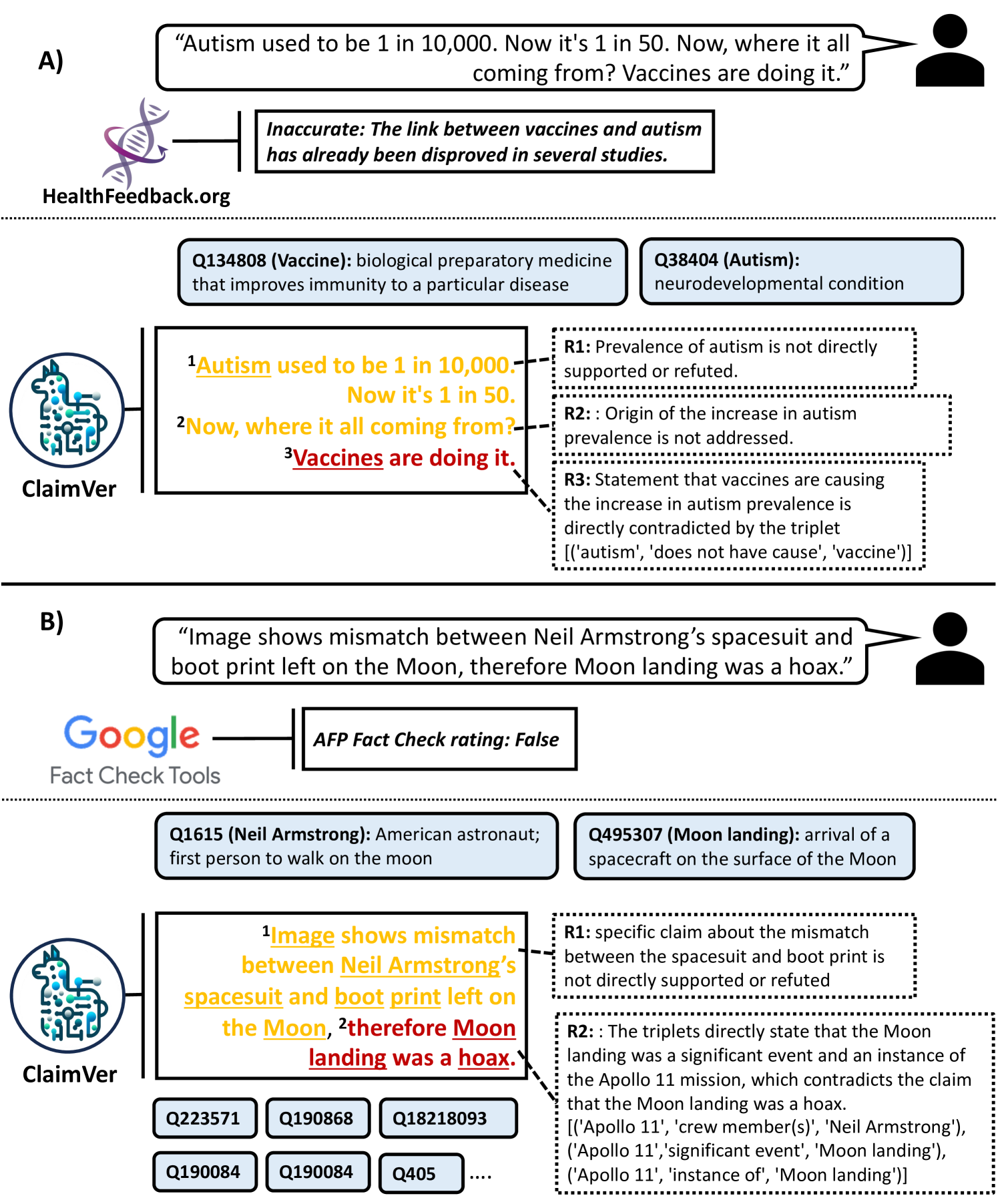
ClaimVer decomposes text into individual claims and verifies them against a Knowledge Graph to provide granular attribution labels, evidence triplets, and natural language explanations.
Core Problem
Existing fact-checkers provide blanket labels for entire paragraphs, failing to distinguish between accurate and inaccurate sub-claims, and often lack granular explanations required for user trust.
Why it matters:
  • Blanket labels mislead users when a text contains a mix of true and false statements (e.g., dismissing a mostly true text due to one error)
  • Users distrust AI systems that do not provide specific rationales or evidence for their verification decisions
  • Traditional methods relying on one-to-one document mapping fail when information is spread across multiple sources or requires multi-hop reasoning
Concrete Example: A text claims 'Autism cases increased due to vaccines.' A standard tool might label the whole paragraph 'False' or 'Misleading.' ClaimVer separates it into: (1) 'Autism cases increased' (True, attributed to testing changes) and (2) 'due to vaccines' (False, contradicted by medical data), preventing the user from rejecting the valid statistic along with the false cause.
Key Novelty
Claim-Level Granular Verification via Knowledge Graphs
  • Decomposes input text into atomic claims rather than verifying sentences or paragraphs as a whole
  • Uses a Knowledge Graph (Wikidata) as a consolidated truth source, enabling multi-hop verification without needing a one-to-one mapping to reference documents
  • Introduces a continuous 'KG Attribution Score' that penalizes contradictions more heavily than hallucinations, aiding downstream ranking tasks
Evaluation Highlights
  • Fine-tuned 8 open-source LLMs (2B-10B parameters) using a custom dataset distilled from GPT-4, achieving ROUGE-L scores > 0.658 across all models
  • Proposed KG Attribution Score (KAS) successfully quantifies claim validity using a modified sigmoid function to penalize contradictions
Breakthrough Assessment
7/10
Strong practical contribution by shifting verification to the claim level and using KGs for explainability. The approach of distilling GPT-4 reasoning into smaller models for this specific task is valuable, though the core novelty relies on integrating existing components (BFS, KGs, LLMs).
×