📝 Paper Summary
Commonsense Reasoning
Multiple-Choice Question Answering
ASMR improves multiple-choice commonsense reasoning by first prompting an LLM to generate open-ended answers, then using those answers to semantically retrieve the most relevant choices before final prediction.
Core Problem
Providing all answer choices directly to an LLM in multiple-choice tasks restricts the model's potential to access its internal commonsense knowledge, often leading to distraction by plausible incorrect options.
Why it matters:
- LLMs frequently suffer from biases like majority label bias and recency bias when presented with multiple choices
- Direct multiple-choice prompting limits the model to comparing given options rather than first formulating its own understanding, unlike human reasoning processes
Concrete Example:
Question: 'Why are dogs often known as man’s best friend?' Choices: A. aggressive, B. friendly, C. very loyal... A standard LLM (MCP) incorrectly picks 'B. friendly' because it seems plausible. ASMR first generates the open-ended answer 'loyal', which matches choice C, leading the model to correctly select 'C. very loyal'.
Key Novelty
Aggregated Semantic Matching Retrieval (ASMR)
- Mimic human reasoning by generating a preliminary open-ended answer before seeing the choices
- Use the semantic similarity between the generated open-ended answer and the provided options to filter/retrieve the most relevant choices
- Re-prompt the LLM with only the top-k semantically relevant choices to make the final decision
Architecture
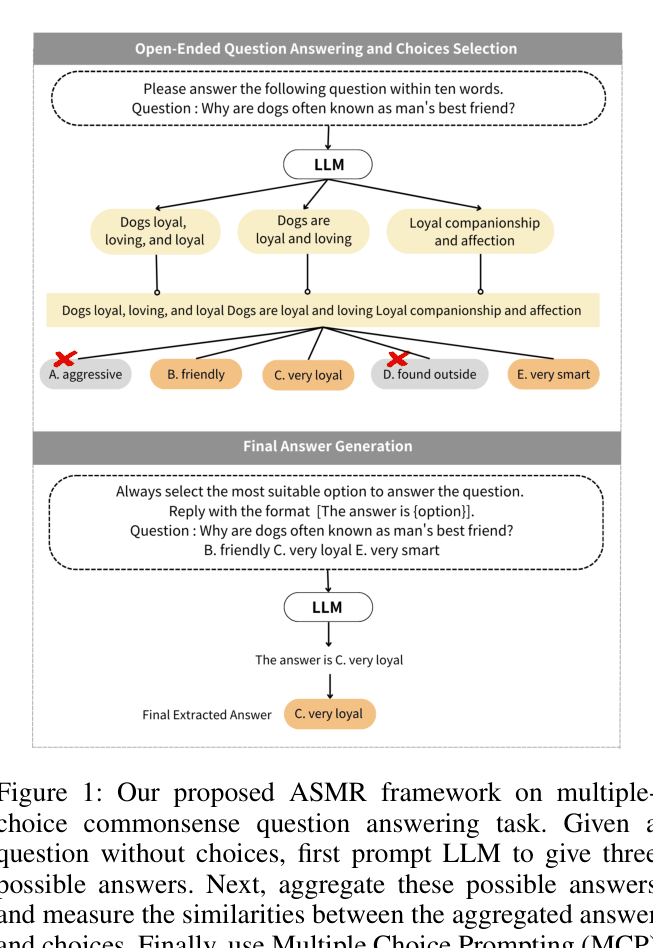
The proposed ASMR framework workflow compared to standard approaches
Evaluation Highlights
- +15.3% accuracy improvement over the previous SOTA (MCP) on the SIQA dataset using ASMR-C (Concatenation) with top-3 retrieval
- Consistently outperforms Zero-Shot Self-Consistency (ZS-SC) and Multiple Choice Prompting (MCP) across CSQA, SIQA, and ARC datasets
- ASMR-C achieves 60.9% accuracy on CSQA (vs 51.2% baseline) and 72.6% on ARC-Easy (vs 58.9% baseline)
Breakthrough Assessment
7/10
Significant performance gains (+15% on SIQA) using a simple, model-agnostic prompting strategy that aligns well with human intuition. However, it relies on existing components (SimCSE) rather than new architecture.