📝 Paper Summary
Graph-based RAG pipeline
Benchmark datasets
BRINK is a benchmark for Knowledge Graph RAG that systematically evaluates reasoning capabilities by removing direct links to answers and forcing models to infer them through multi-hop logical rules.
Core Problem
Existing KG-RAG benchmarks use complete graphs where answers are often directly connected to the query entity, failing to distinguish between simple lookup and actual reasoning over incomplete knowledge.
Why it matters:
- Real-world Knowledge Graphs are notoriously incomplete, making reasoning over missing links essential for practical deployment
- Current benchmarks inflate performance by allowing models to retrieve direct answers rather than inferring them, masking poor reasoning capabilities
- Inconsistent evaluation protocols (ambiguous metric definitions, code-paper discrepancies) make cross-paper comparisons unreliable
Concrete Example:
For the question 'Who is the brother of Justin Bieber?', standard benchmarks provide the triple 'hasBrother(Justin, Jaxon)'. A model can answer via simple lookup. In BRINK, this direct triple is removed, forcing the model to reason: 'hasParent(Justin, Jeremy) AND hasChild(Jeremy, Jaxon) implies hasBrother(Justin, Jaxon)'.
Key Novelty
Benchmark for Reasoning under Incomplete Knowledge (BRINK)
- Constructs questions by first mining logical rules (e.g., parent's child is a sibling) and then selectively removing the 'head' triple (direct answer) from the KG
- Ensures the answer is still inferable by preserving the 'body' triples (evidence) required by the rule, forcing the model to traverse a reasoning path rather than a single edge
- Standardizes evaluation by formally defining metrics like Hits@Any and Hard Hits Rate, addressing prevalent inconsistencies in prior work
Architecture
The logical flow for constructing the BRINK benchmark, illustrating the transition from a complete KG to an incomplete one via rule mining.
Evaluation Highlights
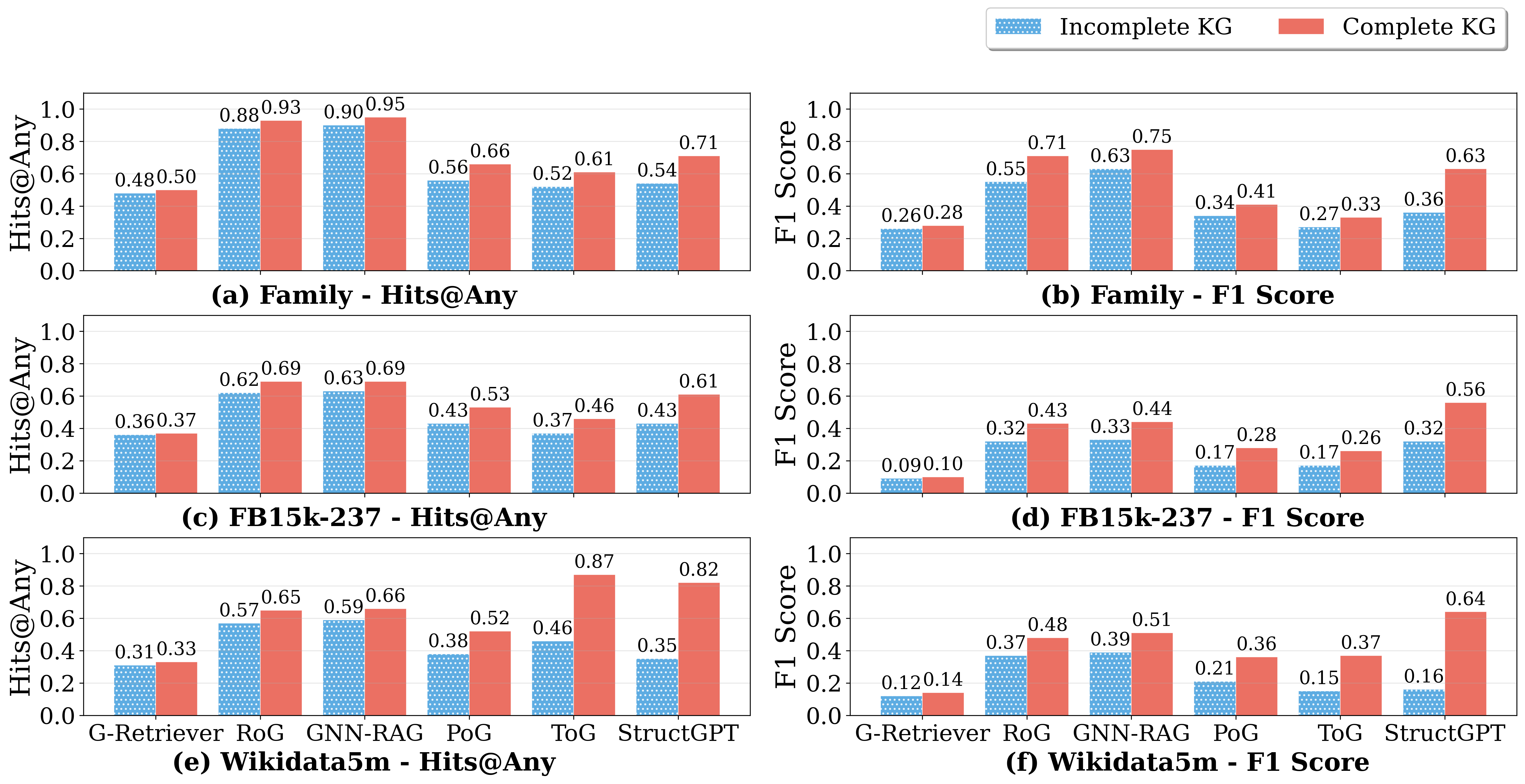
- Most KG-RAG models suffer significant performance drops (e.g., -20% to -60% Hits@1) when direct links are removed, revealing reliance on lookup
- Training-based methods like RoG and GNN-RAG show greater robustness to incompleteness compared to training-free prompting methods
- Removing textual entity labels causes massive performance degradation, indicating models rely heavily on internal parametric memory rather than structured graph reasoning
Breakthrough Assessment
8/10
Identifies a critical flaw in existing evaluations (lookup vs. reasoning) and provides a rigorous method to fix it. The standardized protocol and findings on 'fake' reasoning are highly valuable.