📝 Paper Summary
Graph-based RAG pipeline
Knowledge Graph Question Answering (KGQA)
GNN-RAG improves KGQA by using a Graph Neural Network to retrieve reasoning paths from dense subgraphs, which are then verbalized for an LLM to generate the final answer.
Core Problem
Existing KGQA methods relying on LLMs for graph traversal or semantic parsing are inefficient for complex questions involving multi-hop or multi-entity reasoning due to exponential context expansion and high cost.
Why it matters:
- LLMs struggle to process exponentially expanding graph context at deeper hops, leading to 'lost in the middle' issues
- Retrieval methods based on off-the-shelf NLP retrievers or simple graph algorithms often fail to capture complex graph structures required for multi-hop QA
- Current LLM-based traversal methods require many costly API calls to navigate the graph hop-by-hop
Concrete Example:
For the question 'In which state did fictional character Gilfoyle live?', a standard KG-RAG baseline retrieves only the immediate fact about 'Gilfoyle' living in 'Toronto'. It fails to retrieve the second necessary hop ('Toronto' is in 'Ontario'), which GNN-RAG successfully finds by reasoning over the graph structure.
Key Novelty
GNN-RAG: Graph Neural Retrieval for Efficient Large Language Model Reasoning
- Use a Graph Neural Network (GNN) as a dense subgraph processor to identify relevant answer nodes by propagating question-specific importance weights
- Retrieve the shortest paths connecting question entities to GNN-identified answer candidates as 'reasoning paths'
- Verbalize these reasoning paths into natural language context for a standard LLM to generate the final answer
Architecture
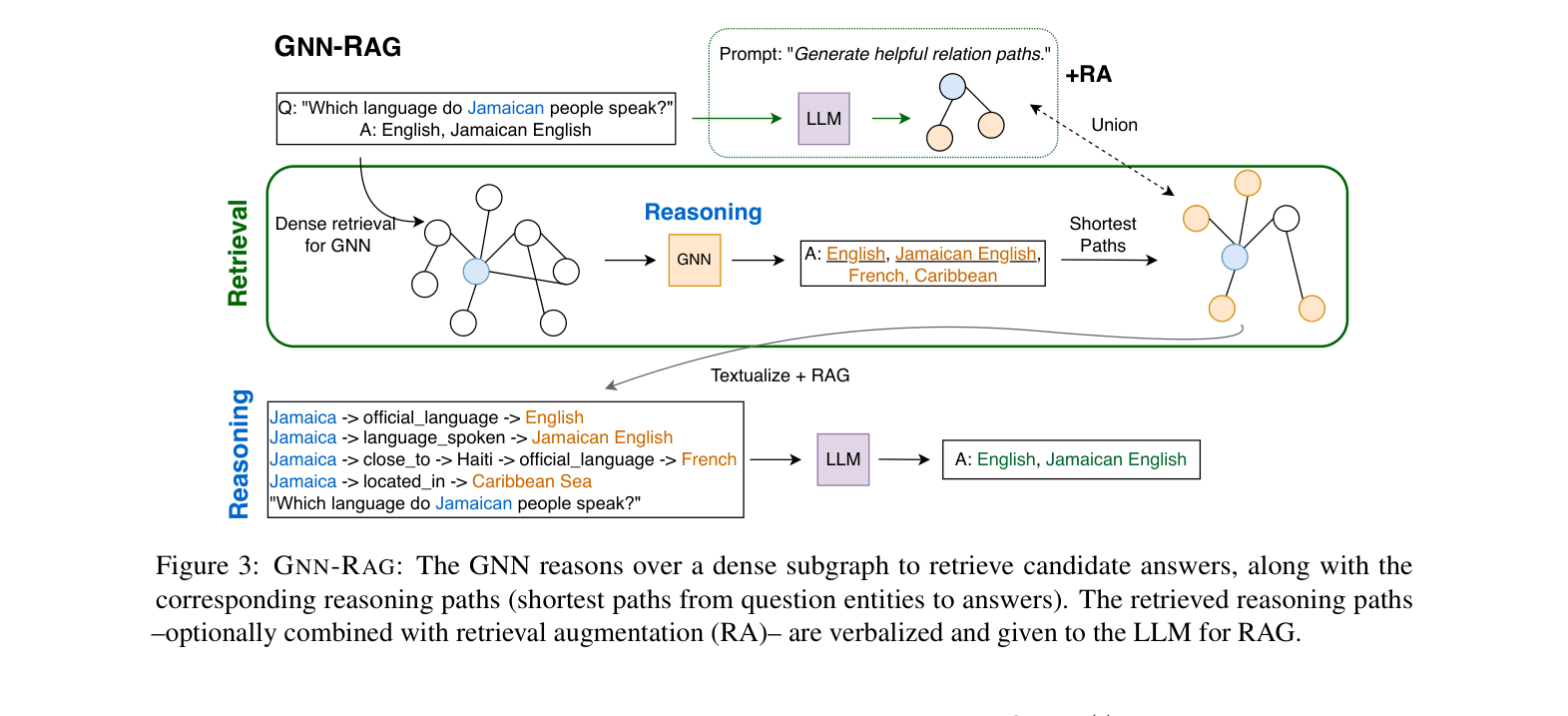
The GNN-RAG inference framework: Dense retrieval, GNN scoring, Path extraction, and RAG.
Evaluation Highlights
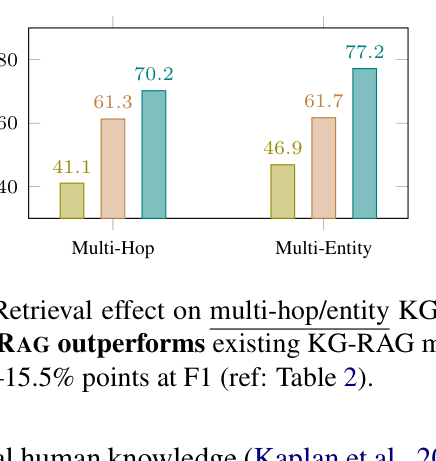
- +8.9 to +15.5 percentage points improvement in F1 score on complex multi-hop/multi-entity questions compared to LLM-based retrieval methods (RoG)
- Outperforms or matches GPT-4 based methods (ToG) using only a 7B parameter model, while requiring significantly fewer KG tokens
- GNN-RAG+Route improves efficiency by using 9x fewer KG tokens than long-context retrieval baselines while achieving higher accuracy
Breakthrough Assessment
8/10
Significantly improves efficiency and performance for complex KGQA without relying on massive LLMs for retrieval. Effectively bridges dense graph reasoning with LLM generation.