📝 Paper Summary
Modularized RAG pipeline
DRAD reduces LLM hallucinations by dynamically triggering retrieval only when real-time uncertainty metrics (probability and entropy) indicate a potential error, avoiding unnecessary external calls.
Core Problem
Existing dynamic RAG methods trigger retrieval based on heuristic timing (e.g., every K tokens) or simple probability thresholds without explicitly verifying if a hallucination is actually occurring.
Why it matters:
- Unnecessary retrieval augmentation introduces irrelevant or noisy data to LLMs, potentially degrading performance
- Frequent, indiscriminate invocation of the retrieval module significantly increases inference time and computational costs
- Current methods fail to synchronize the timing of retrieval with the specific moments where the model lacks knowledge
Concrete Example:
When asked 'Alice's childhood neighbor now lives in____', an LLM lacks specific knowledge and generates a random entity with low confidence. Standard RAG might retrieve based on the input query alone, while DRAD detects the uncertainty at the specific token generation step to trigger a targeted search.
Key Novelty
Dynamic Retrieval Augmentation based on Hallucination Detection (DRAD)
- Real-time Hallucination Detection (RHD): Identifies potential hallucinations by monitoring entity-level uncertainty (low probability + high entropy) without external models
- Self-correction based on External Knowledge (SEK): Triggers retrieval only when hallucination is detected, constructs a query from the context, and regenerates the specific uncertain segment using retrieved data
Architecture
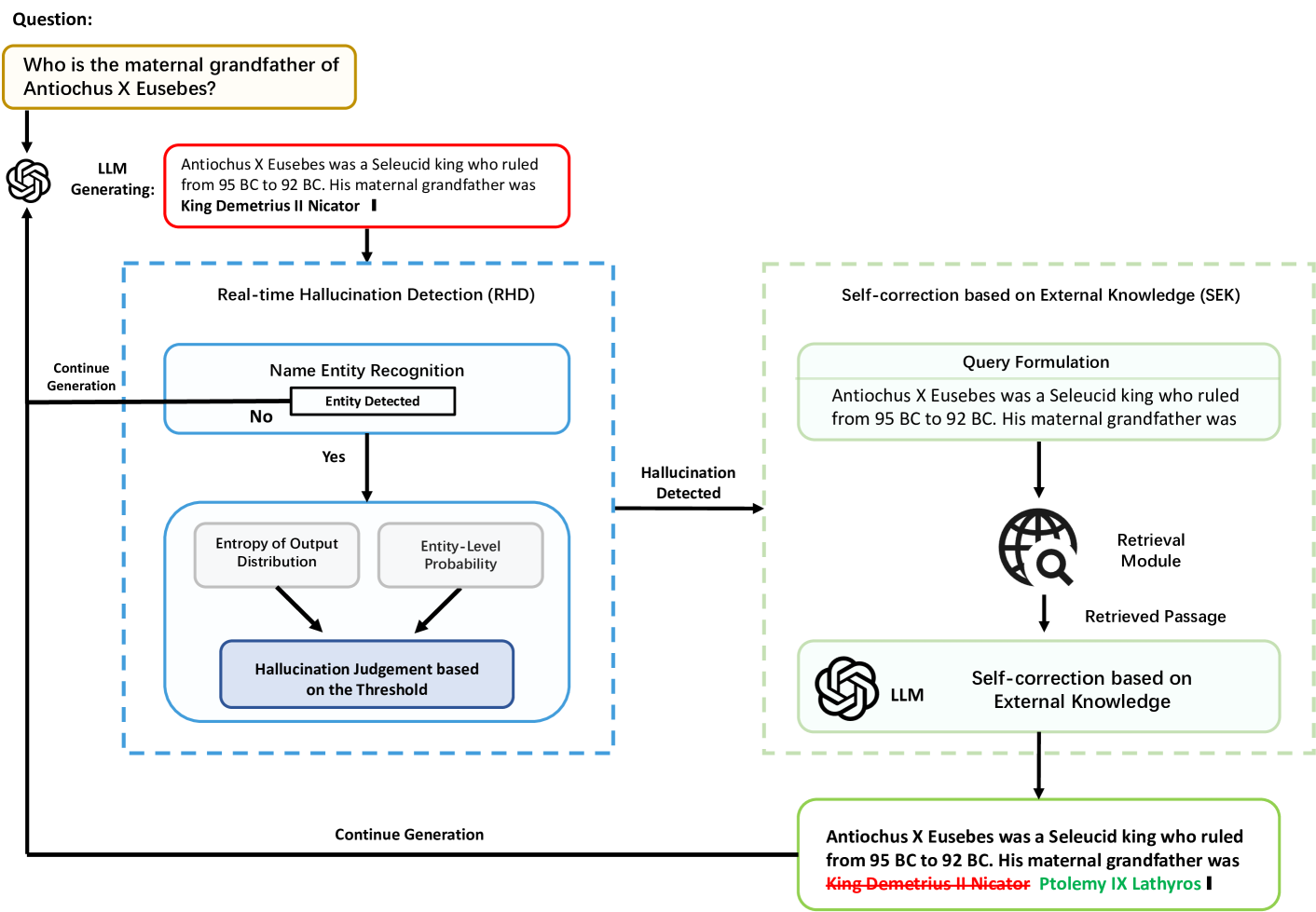
Conceptual diagram of the DRAD framework
Evaluation Highlights
- Significantly outperforms existing single-round and multi-round RAG methods (like FLARE and RETRO) across three complex QA benchmarks
- Real-time Hallucination Detection (RHD) component achieves state-of-the-art performance in detecting hallucinations compared to baselines like SelfCheckGPT
- Demonstrates superior efficiency by retrieving only when necessary, avoiding computational waste associated with fixed-interval or always-on retrieval
Breakthrough Assessment
7/10
Solid contribution linking uncertainty-based hallucination detection directly to retrieval triggering. While the components (entropy, RAG) are known, the specific integration for dynamic control is effective and efficient.