📝 Paper Summary
Knowledge Conflict in LLMs
Contrastive Decoding
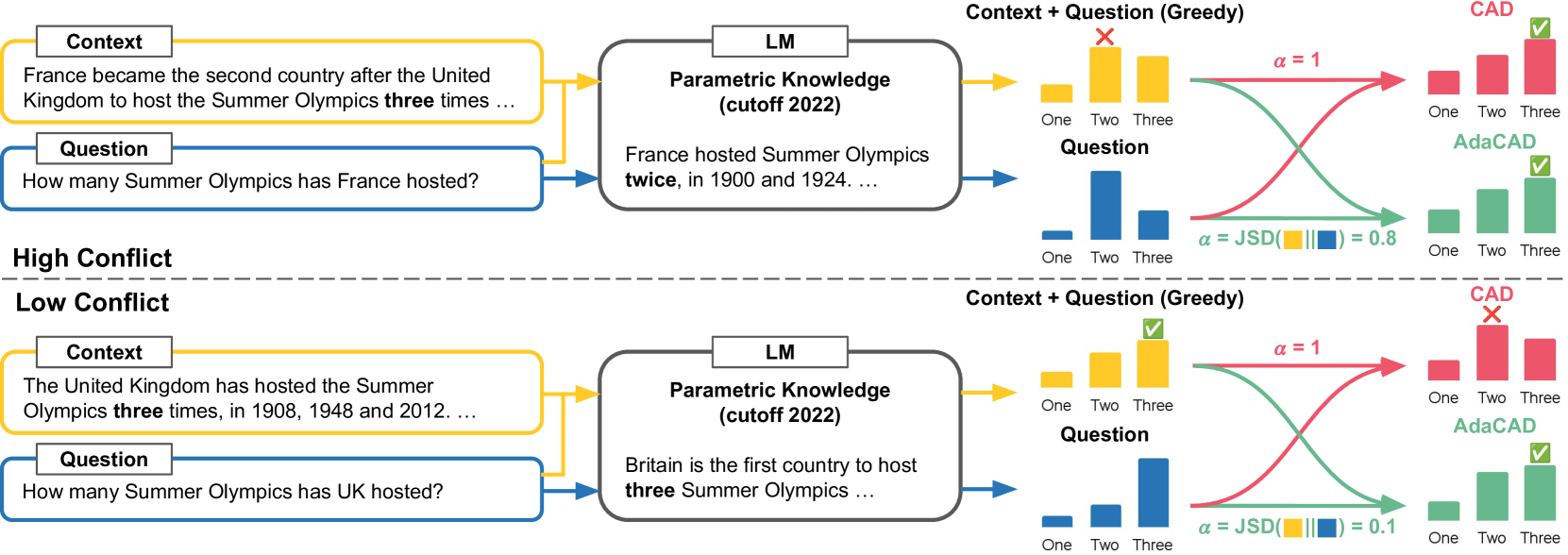
AdaCAD dynamically adjusts the decoding weight for every token based on the Jensen-Shannon divergence between contextual and parametric distributions to resolve knowledge conflicts.
Core Problem
Existing contrastive decoding methods use a fixed weight to balance context and parametric knowledge, but real-world data contains varying degrees of conflict (or no conflict).
Why it matters:
- Fixed-weight methods (like CAD) over-correct on low-conflict examples, degrading performance on standard queries where the model is already correct
- LLMs struggle to prioritize retrieved context over outdated parametric memory when conflicts arise (e.g., outdated Olympic host counts)
- Current dynamic methods rely on coarse binary classification (high/low conflict) or heuristics that require additional noisy contexts
Concrete Example:
If an LLM knows France hosted the Olympics 2 times (parametric) but a retrieved document says 3 times (context), CAD helps. However, if the document also says 2 times (no conflict), CAD over-adjusts the distribution, leading to a nonsensical answer, whereas AdaCAD detects low conflict and reduces adjustment.
Key Novelty
Adaptive Context-Aware Decoding (AdaCAD)
- Measures the 'degree of conflict' at each decoding step by calculating the Jensen-Shannon Divergence (JSD) between the model's output distribution with context vs. without context
- Uses this JSD value to dynamically scale the decoding adjustment weight (alpha) per token: high divergence implies high conflict (needs strong adjustment), low divergence implies agreement (needs weak adjustment)
Architecture
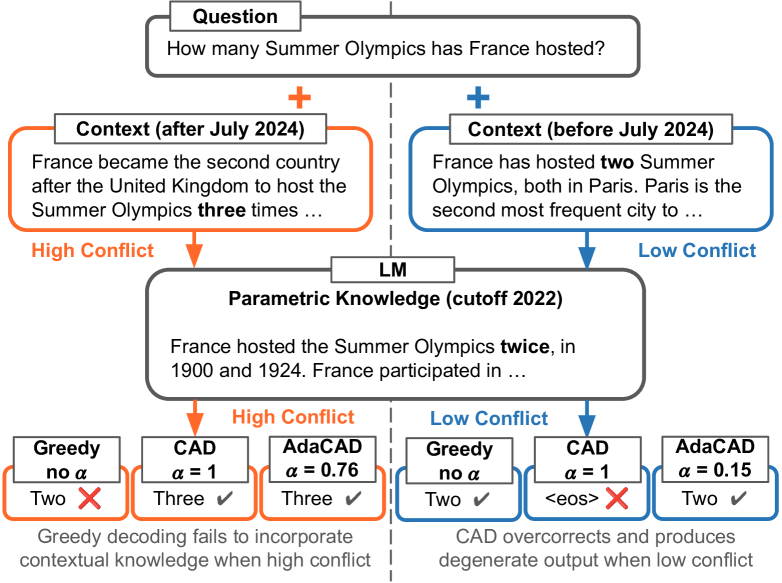
Conceptual illustration of how AdaCAD handles varying knowledge conflicts compared to CAD and Greedy decoding.
Evaluation Highlights
- +14.21% average QA accuracy gain over static Context-Aware Decoding (CAD) across four LLMs and six datasets
- +10.29% accuracy improvement over the COIECD baseline on the high-conflict NQ-SWAP dataset
- +6.19 AlignScore improvement in summarization factuality compared to standard decoding
Breakthrough Assessment
7/10
Simple, training-free, and effective solution to a known limitation of contrastive decoding. The dynamic JSD-based weighting is intuitive and outperforms more complex baselines like COIECD.