Transformer-based language models naturally learn to encode task-specific information by clustering hidden states corresponding to the same task, a process that evolves dynamically during training without explicit supervision.
Core Problem
The mechanisms underlying how Large Language Models (LLMs) successfully follow instructions are not well-understood, particularly how they internally represent different tasks.
Why it matters:
LLMs show great instruction-following capabilities, but their internal decision-making processes remain opaque
Understanding these mechanisms is crucial for explaining model behavior and improving alignment
Current research focuses on training techniques (RLHF, instruction tuning) rather than analyzing the resulting internal representations
Concrete Example:In a task like 'given a location, state its continent', the model must identify the function $f$ from the instruction. If the model cannot distinguish this task from a similar one sharing the same inputs (e.g., 'given a location, state its country'), it will fail. The paper investigates if the model groups these distinct tasks internally.
Key Novelty
Emergent Task Clustering in Hidden Space
Demonstrates that Transformers spontaneously organize hidden states into clusters based on task identity, even when task labels are never explicitly provided during training
Shows that this clustering is dynamic, improving throughout the training process until saturation, and becomes more pronounced in deeper layers of the network
Architecture
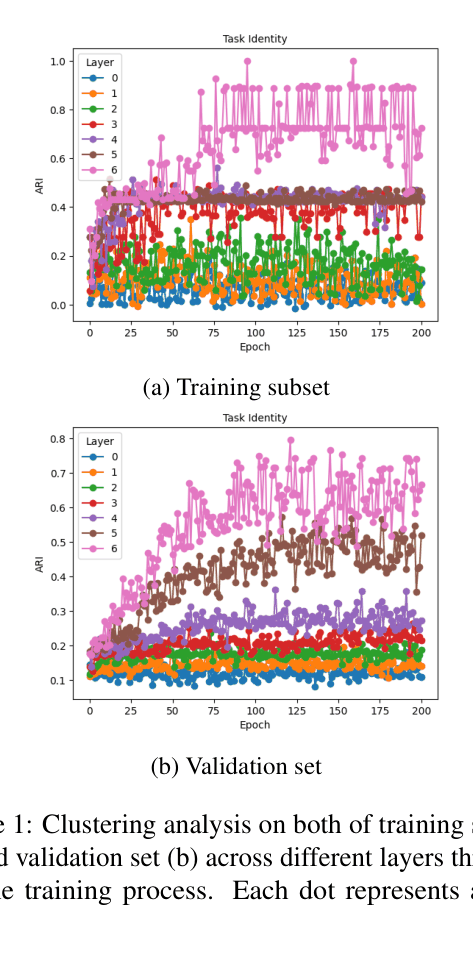
Scatter plots showing Clustering Performance (ARI) vs. Training Steps for different layers (Layer 0 to Layer 5) on both training and validation sets.
Evaluation Highlights
Clustering performance (measured by Adjusted Rand Index) improves consistently throughout training on both training and validation sets
Higher layers of the Transformer exhibit stronger clustering of task identities compared to the embedding layer (layer 0), which remains static
The clustering effect generalizes to unseen validation instances, confirming it is a learned inductive bias rather than memorization
Breakthrough Assessment
4/10
Provides a specific, interesting insight into internal model representations using a simplified synthetic setting. While the finding is conceptually valuable for interpretability, the scope is limited to small synthetic experiments.
⚙️ Technical Details
Problem Definition
Setting: Simplified instruction-following treated as causal language modeling over sequences $[I; x; y]$
Inputs: Sequence containing an instruction $I$ and an input $x$
Outputs: Predicted output token $y$ corresponding to task function $f(x)$
Pipeline Flow
Data Generation (Synthetic Tasks)
Transformer Training (CLM Objective)
Hidden State Extraction
Clustering Analysis (KMeans)
System Modules
Synthetic Data Generator
Create tasks defined by regular expressions, generating sequences [Instruction; input; output]
Model or implementation: Python script (Regular Expression sampling)
Causal Language Model
Learn to predict output tokens from instruction and input tokens
Model or implementation: GPT-2 (6 layers)
Analysis Module
Extract hidden states and perform clustering to measure task separation
Model or implementation: KMeans Clustering
Modeling
Base Model: GPT-2 architecture (6 layers)
Training Data:
50 synthetic tasks based on regular expressions
Average of 152 instruction variants per task
Inputs/Outputs are discrete single tokens
Key Hyperparameters:
layers: 6
optimizer: AdamW
schedule: Cosine annealing
Comparison to Prior Work
vs. Standard Instruction Tuning papers (e.g., Ouyang et al., 2022): This work focuses on analyzing the *mechanism* of task encoding in a simplified synthetic setting rather than proposing a new training method for performance.
Limitations
Relies entirely on simplified synthetic datasets (regular expressions) rather than natural language
Model is very small (6 layers) compared to real-world LLMs
Analysis is limited to clustering metrics; causal intervention is not performed to prove clusters drive behavior
Reproducibility
The paper describes the synthetic data generation logic (random regular expressions) and model architecture (6-layer GPT-2). No code URL is provided.
📊 Experiments & Results
Evaluation Setup
Clustering analysis of hidden states from a model trained on synthetic instruction tasks
Benchmarks:
Synthetic Regular Expression Tasks (Instruction Following / Pattern Matching) [New]
Metrics:
Adjusted Rand Index (ARI)
Task Accuracy
Statistical methodology: Not explicitly reported in the paper
Key Results
Benchmark
Metric
Baseline
This Paper
Δ
Synthetic Tasks (Validation Set)
Adjusted Rand Index (ARI)
Near 0
High positive value (visual estimate > 0.6 based on Fig 1b)
Large positive increase
Main Takeaways
Task-specific clustering emerges in hidden states without explicit supervision labels.
The clustering quality (ARI) improves over training steps, correlating with the learning process.
Deeper layers show stronger clustering than the initial embedding layer, suggesting the model builds these representations dynamically.
📚 Prerequisite Knowledge
Prerequisites
Transformer architecture (layers, hidden states)
Causal Language Modeling (next-token prediction)
Clustering algorithms (KMeans)
Key Terms
CLM: Causal Language Model—a model trained to predict the next token in a sequence based on previous tokens
Adjusted Rand Index: A measure of the similarity between two data clusterings, adjusted for chance, used here to evaluate how well hidden states group by task
t-SNE: t-Distributed Stochastic Neighbor Embedding—a technique for dimensionality reduction that is well-suited for visualizing high-dimensional datasets
hidden states: The internal vector representations of data at specific layers within a neural network
inductive bias: The set of assumptions a learning algorithm makes to predict outputs for inputs it has not encountered