📝 Paper Summary
Knowledge Graph-enhanced Recommendation
LLMs for Recommendation
CoLaKG uses Large Language Models to generate semantic embeddings from local and global knowledge graph structures, fusing them with collaborative ID embeddings to improve recommendation accuracy and robustness against missing facts.
Core Problem
Existing Knowledge Graph (KG) recommenders struggle with missing facts in manually curated KGs, fail to capture semantic nuances by converting text to IDs, and have difficulty modeling high-order connections efficiently.
Why it matters:
- Missing attributes (e.g., a movie missing a genre link) break connectivity in the graph, causing recommendation models to miss relevant items.
- Converting rich text attributes (e.g., 'horror' vs. 'thriller') into arbitrary IDs discards semantic similarity, preventing the model from recognizing related concepts.
- Traditional GNN-based propagation suffers from over-smoothing and inefficiency when trying to capture long-distance relationships in large graphs.
Concrete Example:
In a movie KG, if Movie A is 'Horror' and Movie B is 'Thriller', a standard ID-based model sees two unrelated IDs (e.g., 51 and 320) and fails to connect them. CoLaKG uses an LLM to recognize the semantic closeness of these genres, establishing a connection even if an explicit edge is missing.
Key Novelty
Dual-Stage LLM-Enhanced KG Representation (Local + Global)
- Local Comprehension: Instead of just using IDs, the model feeds item-centered subgraphs (converted to text triples) into an LLM to generate dense semantic embeddings that capture local context and infer missing links.
- Global Retrieval: It circumvents GNN depth limits by retrieving semantically similar items from the *entire* graph using the LLM-generated embeddings, creating direct connections between distant but related items.
Architecture
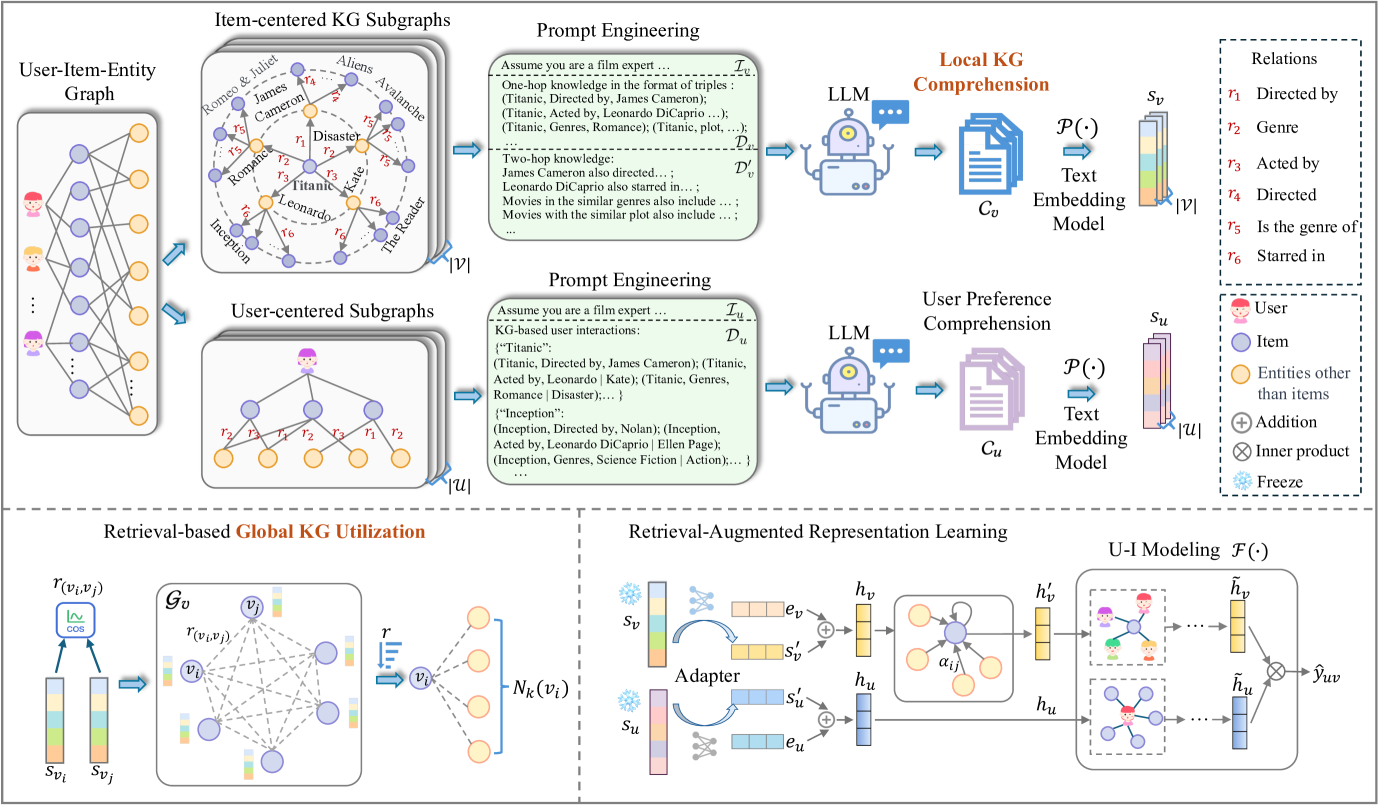
The overall framework of CoLaKG, detailing the two-stage process: LLM-based KG comprehension and the recommendation model integration.
Evaluation Highlights
- Outperforms state-of-the-art baselines (including KGIN and KGAT) on all four datasets (Amazon-Book, Last.FM, Yelp2018, Alibaba-iFashion).
- Achieves significant improvements in Recall@20 (e.g., +6.3% on Alibaba-iFashion compared to the best baseline).
- Demonstrates robustness to data sparsity, maintaining higher performance than baselines even when interaction data is extremely scarce.
Breakthrough Assessment
7/10
Strong pragmatic combination of LLM semantic reasoning with traditional collaborative filtering. Effectively addresses the 'semantic gap' in ID-based KG methods, though the architecture is a logical evolution rather than a radical paradigm shift.