LTU-AS couples a frozen Whisper encoder with a LLaMA LLM via a Time-Layer-Wise Transformer, enabling a single model to simultaneously perceive and reason about both spoken text and non-speech background sounds.
Core Problem
Existing models typically specialize in either speech recognition (ASR) or audio event detection, lacking the reasoning capability to understand the interrelationship between speech content and environmental sounds (e.g., a car horn and a shout).
Why it matters:
Real-world audio environments are multifarious, containing both speech and non-speech elements that require integrated interpretation for situational awareness
Current audio-LLMs often ignore paralinguistic features (emotion, pitch) or fail to process background events while transcribing speech
There is a lack of datasets combining speech and audio events for joint reasoning supervision
Concrete Example:When hearing 'watch out!' and a car horn simultaneously, humans infer danger. Separate models might just transcribe the text or identify the horn, missing the causal link. LTU-AS can answer 'Why is the atmosphere tense?' by combining the semantic meaning of the shout with the acoustic event.
Key Novelty
LTU-AS (Listen, Think, Understand Audio and Speech)
Dual-path perception: Uses Whisper to extract both discrete spoken text (via decoder) and continuous audio/paralinguistic tokens (via encoder + TLTR), feeding both to the LLM
Time and Layer-Wise Transformer (TLTR) adapter: Applies attention across Whisper's encoder layers to capture 'soft' audio events and paralinguistic info that might be lost in the final layer
Open-ASQA Dataset: A constructed dataset of 9.6 million (audio, question, answer) tuples, combining 13 datasets and using GPT-generated instructions to teach joint reasoning
Architecture
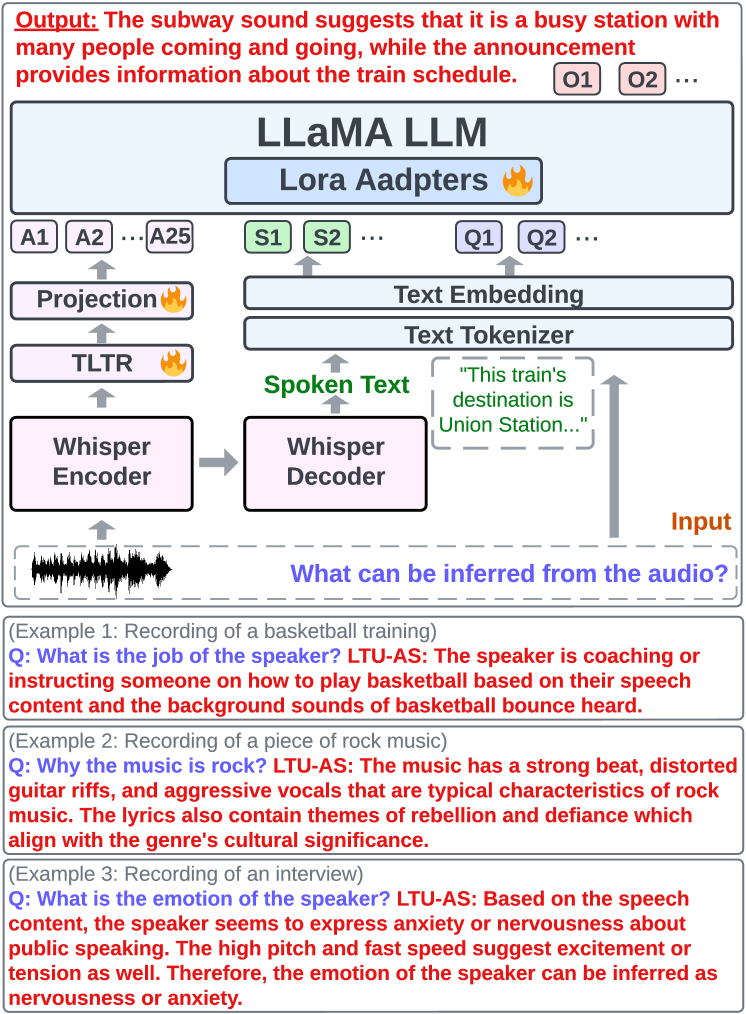
The LTU-AS architecture demonstrating the inputs (Audio, Question) and the dual pathway through Whisper (Decoder for text, TLTR for audio tokens) into LLaMA.
Evaluation Highlights
Achieves an instruction following rate of over 95% on open-ended questions as evaluated by GPT-4
Maintains strong ASR performance with 4.9% WER (Word Error Rate), retaining most of the frozen Whisper backbone's capability (3.5% WER)
Outperforms CLAP on zero-shot music genre classification by nearly double the accuracy (qualitative claim in text, exact number not in snippet)
Breakthrough Assessment
8/10
Significant step in multimodal audio understanding. The 'dual-path' integration of text and audio features into an LLM is a robust architectural choice, supported by a massive new dataset (Open-ASQA).
⚙️ Technical Details
Problem Definition
Setting: Open-ended Question Answering on Audio signals (Speech + Non-Speech)
Inputs: Audio signal A and a natural language question Q
Outputs: Natural language answer/text sequence O
Pipeline Flow
Audio Input -> Whisper Encoder
Path 1: Whisper Encoder -> Whisper Decoder -> Spoken Text
Extract rich acoustic representations from raw audio
Model or implementation: Whisper-large-v2 (32 layers, 1280-dim)
Whisper Decoder (Perception)
Transcribe speech to discrete text
Model or implementation: Whisper-large-v2 Decoder
TLTR Adapter (Perception)
Encode paralinguistic and non-speech event information from encoder layers
Model or implementation: Time and Layer-Wise Transformer (AudioSet pretrained)
LLM Reasoner
Generate answers based on audio tokens, transcribed text, and questions
Model or implementation: LLaMA-7B (Vicuna instruction tuned)
Novel Architectural Elements
Dual-injection strategy: Audio is fed to the LLM as both discrete transcribed text (via Whisper decoder) AND continuous feature tokens (via TLTR), preserving linguistic content and acoustic nuance simultaneously
Modeling
Base Model: LLaMA-7B
Training Method: Supervised Fine-Tuning (SFT) with Next Token Prediction
Objective Functions:
Purpose: Maximize probability of generating the correct text answer given inputs.
Formally: Cross-entropy loss on P(Ot | O<t, A, S, Q)
Adaptation: LoRA (rank=8, alpha=16) on self-attention projection layers
Trainable Parameters: 49 million (0.6% of total 8.5B params)
Training Data:
Open-ASQA Dataset: 9.6 million tuples
Includes 13 public datasets (AudioSet, LibriTTS, FMA, etc.)
6.9M samples are open-ended QA generated by GPT via Audio Instruction Generation (AIG)
vs. LTU: LTU-AS replaces AST with Whisper+TLTR to handle speech and audio simultaneously; LTU only handles non-speech
vs. SpeechGPT: LTU-AS keeps the ASR model separate/frozen to feed text explicitly, whereas SpeechGPT fine-tunes the LLM for ASR capabilities
vs. CLAP: LTU-AS generates free-text answers rather than requiring fixed label sets/contrastive matching
Limitations
ASR performance (4.9% WER) is slightly degraded compared to the frozen internal Whisper model (3.5% WER) due to instruction following variance
Audio token length is trimmed to 25 (10 seconds), potentially limiting long-form audio understanding
Computationally expensive inference due to running both Whisper Encoder/Decoder and LLaMA
Reproducibility
Data construction method (Open-ASQA) is detailed, involving mixing 13 datasets. The prompt for GPT generation is provided. Code URL is not provided in the text. Pre-trained weights (Whisper, LLaMA) are public.
📊 Experiments & Results
Evaluation Setup
Open-ended generation evaluated by GPT-4 and closed-ended classification/ASR tasks
Benchmarks:
ASR Task (Internal) (Speech Recognition)
GTZAN (Music Genre Classification)
IEMOCAP (Emotion Recognition)
VoxCeleb2 (Speaker Age/Gender Prediction)
Metrics:
Word Error Rate (WER)
Instruction Following Rate (GPT-4 evaluated)
Mean Absolute Error (MAE)
Accuracy
Statistical methodology: Not explicitly reported in the paper
Key Results
Benchmark
Metric
Baseline
This Paper
Δ
ASR Task
WER
3.5
4.9
+1.4
Open-ended QA
Instruction Following Rate
Not reported in the paper
95
Not reported in the paper
Main Takeaways
LTU-AS serves as a universal perception model, performing well on tasks requiring either speech or audio understanding, and excelling at joint tasks (like music genre requiring lyrics+melody).
Ablation studies show that missing either the audio token input {A} or the spoken text input {S} leads to performance drops, proving LLaMA utilizes both modalities for decision making.
Training with both speech and non-speech data is critical; models trained on only one domain fail to generalize to the other.
📚 Prerequisite Knowledge
Prerequisites
Transformer architecture (Encoder-Decoder)
Automatic Speech Recognition (ASR) pipelines
Large Language Model fine-tuning (LoRA)
Key Terms
ASR: Automatic Speech Recognition—converting spoken audio into text
TLTR: Time and Layer-Wise Transformer—a mechanism to aggregate information across different layers of a neural network (Whisper encoder) and time steps
LoRA: Low-Rank Adaptation—a parameter-efficient fine-tuning technique that freezes the main model weights and trains small adapter matrices
WER: Word Error Rate—a common metric for speech recognition accuracy (lower is better)
LLaMA: Large Language Model Meta AI—the base text-generation model used for reasoning
Whisper: A robust speech recognition model trained on 680k hours of audio, used here as the audio encoder
AIG: Audio Instruction Generation—using a text-only LLM (like GPT-3.5) to generate training questions/answers based on metadata labels