Large Audio Language Models (LALMs)Reinforcement Learning (RL)Multimodal Reasoning
Audio-Thinker improves multimodal reasoning by using reinforcement learning with adaptive rewards to teach models when to engage in deep thinking and model-based supervision to ensure reasoning quality.
Core Problem
Current Large Audio Language Models (LALMs) lack the ability to adaptively decide when to reason based on difficulty, and their explicit reasoning processes (Chain-of-Thought) often lack coherence or do not improve accuracy.
Why it matters:
Explicit reasoning in current audio models (like R1-AQA) has not yielded substantial benefits for Question Answering compared to direct answering
Prompting alone fails to make models 'difficulty-aware'; they do not naturally adjust thinking depth based on problem complexity (Observation 2)
Models can learn to produce correct answers with flawed or incoherent reasoning logic if only the final answer is supervised
Concrete Example:A model might correctly answer '1' but generate a reasoning chain that concludes 'the final answer is 1' after outputting unrelated or erroneous logic (e.g., <think>...answer is 1</think><answer>2</answer>), showing misalignment between thought and output.
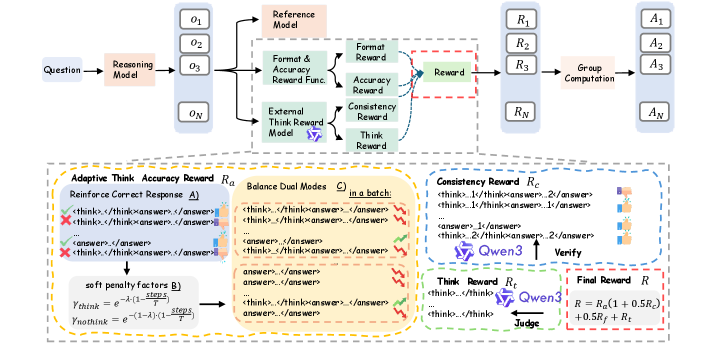
Introduces an 'Adaptive Think Accuracy Reward' that incentivizes the model to skip reasoning for easy questions (efficiency) and engage in it for hard ones, correcting the static behavior of prior models
Uses an external 'Expert LLM' (Qwen3-8B-Base) to act as a reward model, scoring the *quality* and *consistency* of the reasoning process itself, not just the final answer accuracy
Architecture
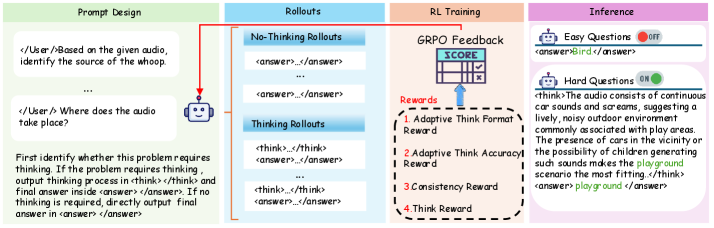
Overview of the Audio-Thinker framework, showing the prompt design and the RL training loop.
Breakthrough Assessment
7/10
Addresses a critical gap in multimodal reasoning (adaptability and process supervision) with a well-motivated RL framework. Score limited only by the lack of visible experimental validation in the provided text.
⚙️ Technical Details
Problem Definition
Setting: Audio Question Answering (AQA) with Reinforcement Learning Fine-Tuning
Inputs: Audio input and a text query q
Outputs: A response generated either directly or via a reasoning chain (<think>...</think>)
Pipeline Flow
Input Processing (Audio/Text)
Adaptive Policy (Decides Think vs. No-Think)
Generation (Reasoning + Answer or Direct Answer)
System Modules
LALM Policy
Decides whether to reason (<think>) and generates the response
Model or implementation: Not explicitly specified in snippet (Likely Qwen2-Audio or Qwen2.5-Omni based on context)
Consistency Reward Model (Training Supervision)
Evaluates alignment between reasoning process and final answer
Model or implementation: Qwen3-8B-Base
Think Reward Model (Training Supervision)
Evaluates the quality of the intermediate reasoning steps specifically
Model or implementation: Qwen3-8B-Base
Novel Architectural Elements
Integration of an external 'Think Reward Model' specifically to score the quality of intermediate reasoning steps during LALM training
Modeling
Base Model: Large Audio Language Model (Specific base checkpoint not stated in provided text)
Training Method: GRPO (Group Relative Policy Optimization)
Objective Functions:
Purpose: Encourage valid output structure.
Formally: Reward = +1 if format (<think>...</think><answer>...</answer>) is followed.
Purpose: Encourage adaptive thinking (think only when hard).
soft_penalty_factor_lambda: Proportion of Think trajectories in batch
consistency_reward_no_think: 1
Compute: Not reported in the paper
Comparison to Prior Work
vs. R1-AQA: Audio-Thinker adds adaptive rewards (ATAR) and process supervision (Think Reward) rather than just outcome-based GRPO
vs. Audio-Reasoner: Audio-Thinker uses RL to *learn* the thinking policy rather than enforcing a fixed multi-phase architecture
vs. AutoThink: Adapts the concept of adaptive thinking rewards to the Audio-Language domain [not cited in paper as direct baseline, but method is inspired by it]
Limitations
No quantitative results provided in the text to verify performance claims
Relying on an external LLM (Qwen3-8B) for rewards may introduce bias or errors from the supervisor model
Adaptive rewards might cause instability in early training (mitigated by soft penalty factors)
Reproducibility
No replication artifacts mentioned in the paper. The paper relies on external models (Qwen3-8B-Base) for reward calculation, which are publicly available on HuggingFace.
📊 Experiments & Results
Evaluation Setup
Audio Question Answering across varying difficulty levels
Benchmarks:
MMAU (Multimodal Audio Understanding)
MMAR (Multimodal Audio Reasoning)
AIR (Audio Inference/Reasoning)
Metrics:
No-thinking rate (behavioral metric)
Accuracy (implied)
Statistical methodology: Not explicitly reported in the paper
Experiment Figures
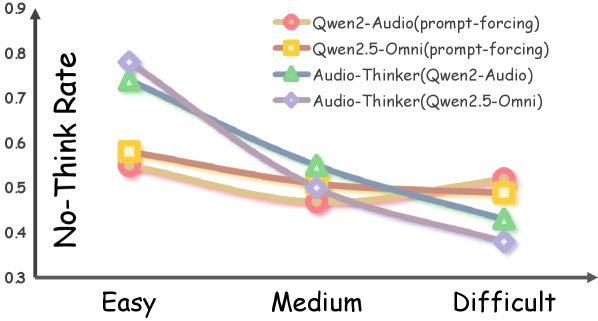
Analysis of 'no-thinking' rates across three complexity levels for prompt-forced models vs. Audio-Thinker.
Detailed breakdown of the Reinforcement Learning Training Framework and the specific reward components.
Main Takeaways
Prompting alone is insufficient for adaptive reasoning; without RL feedback, models do not adjust their 'thinking' rate based on problem complexity (Observation 2)
Audio-Thinker effectively learns difficulty-aware reasoning, increasing the 'no-thinking' rate for simple problems while engaging reasoning for complex ones (Qualitative result from Intro)
The use of soft penalty factors is necessary to prevent degenerate policies (always think or never think) during the early stages of RL training
📚 Prerequisite Knowledge
Prerequisites
Reinforcement Learning (PPO/GRPO)
Large Audio Language Models (LALMs)
Chain-of-Thought (CoT) prompting
Key Terms
LALM: Large Audio Language Model—a multimodal model capable of processing and reasoning about audio inputs
GRPO: Group Relative Policy Optimization—a reinforcement learning algorithm that optimizes policies based on the relative performance of a group of sampled outputs
CoT: Chain-of-Thought—a prompting technique where models generate intermediate reasoning steps before the final answer
ATAR: Adaptive Think Accuracy Reward—a proposed reward function that varies incentives based on whether the model chose to 'think' and whether the answer was correct
KL divergence: A statistical measure used in RL to ensure the trained model does not deviate too drastically from its initial reference behavior
Qwen2-Audio: A baseline Large Audio Language Model developed by Alibaba
PPO: Proximal Policy Optimization—a standard reinforcement learning algorithm used for fine-tuning language models