📝 Paper Summary
Cross-silo Federated Learning
Incentive Mechanisms
BARA uses Bayesian optimization to dynamically allocate a fixed reward budget across communication rounds in federated learning, balancing the number of participants per round against the total number of rounds to maximize final model accuracy.
Core Problem
Existing FL incentive mechanisms focus on allocating rewards among clients within a single round but overlook how to optimally distribute a limited total budget across multiple communication rounds.
Why it matters:
- Allocating too much budget per round exhausts resources early, preventing model convergence
- Allocating too little budget per round fails to recruit high-quality clients, leading to inefficient training
- The relationship between budget allocation strategies and final model accuracy is opaque and stochastic, making static strategies ineffective
Concrete Example:
If a PS spends its entire budget recruiting 100 clients for just 5 rounds, the model may not converge. Conversely, recruiting only 1 client for 500 rounds may result in poor updates. BARA dynamically finds the sweet spot (e.g., 20 clients for 100 rounds) to maximize accuracy.
Key Novelty
Online Bayesian Reward Allocation (BARA)
- Models the unknown relationship between the number of participating clients and final model accuracy using a Gaussian Process (GP)
- Synthesizes artificial training records using Newton’s polynomial interpolation to expand the historical data available for the GP
- Uses Bayesian optimization (Upper Confidence Bound) to dynamically select the number of clients for the next round, balancing exploration (trying new client counts) and exploitation (using the best count so far)
Architecture
Pseudocode flow of the BARA algorithm integrating GP updates and Reverse Auction.
Evaluation Highlights
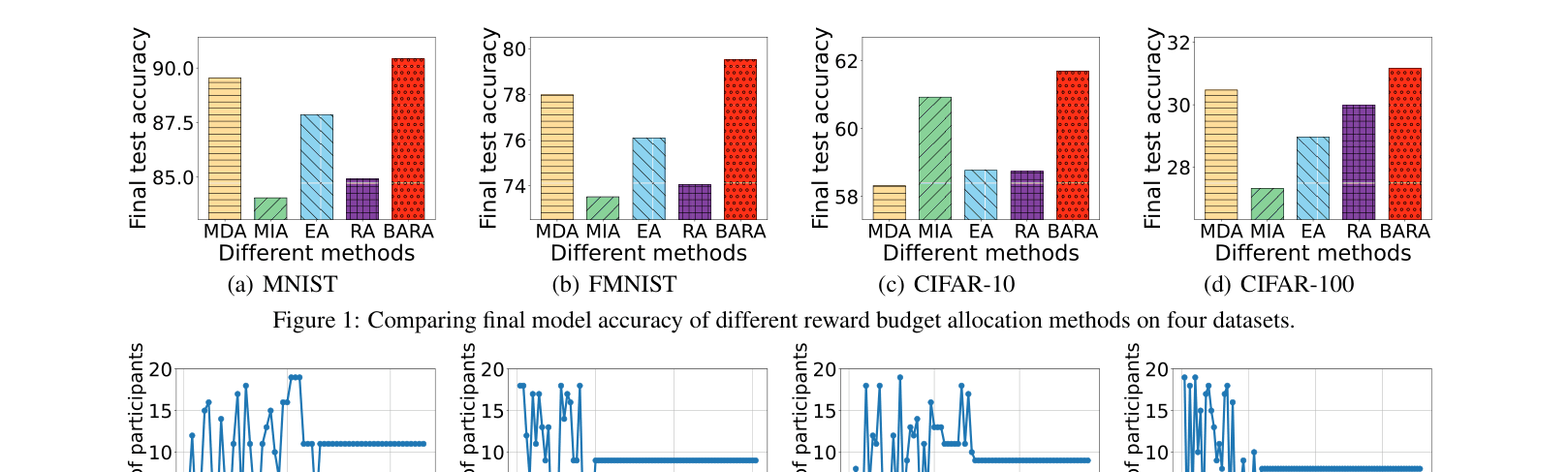
- Outperforms static allocation baselines by up to ~5% in test accuracy on MNIST (90.0% vs ~85.0% for MIA)
- Incorporating BARA into existing mechanisms like FAIR improves accuracy by +2.76% on MNIST (84.88% → 87.64%)
- Achieves fast convergence of regret, successfully identifying the optimal number of participating clients after ~40-50 rounds
Breakthrough Assessment
7/10
Novel formulation of the budget allocation problem across time (rounds) rather than just space (clients). Demonstrates significant gains over static heuristics, though the core technique (Bayesian Optimization) is standard.