📝 Paper Summary
Uncertainty Estimation
Medical Image Segmentation
Reinforcement Learning for Vision
FGRM fine-tunes segmentation models using reinforcement learning with a calibration-based reward and a Fisher Information-weighted parameter update scheme to explicitly align model confidence with prediction risk.
Core Problem
Existing uncertainty estimation methods rely on indirect task losses (like Cross-Entropy) rather than explicit uncertainty metrics during training, leading to miscalibrated confidence and unclear priors in safety-critical scenarios.
Why it matters:
- In safety-critical domains like robotic surgery, tolerance for prediction risk is extremely low, making reliable uncertainty estimation as crucial as accuracy
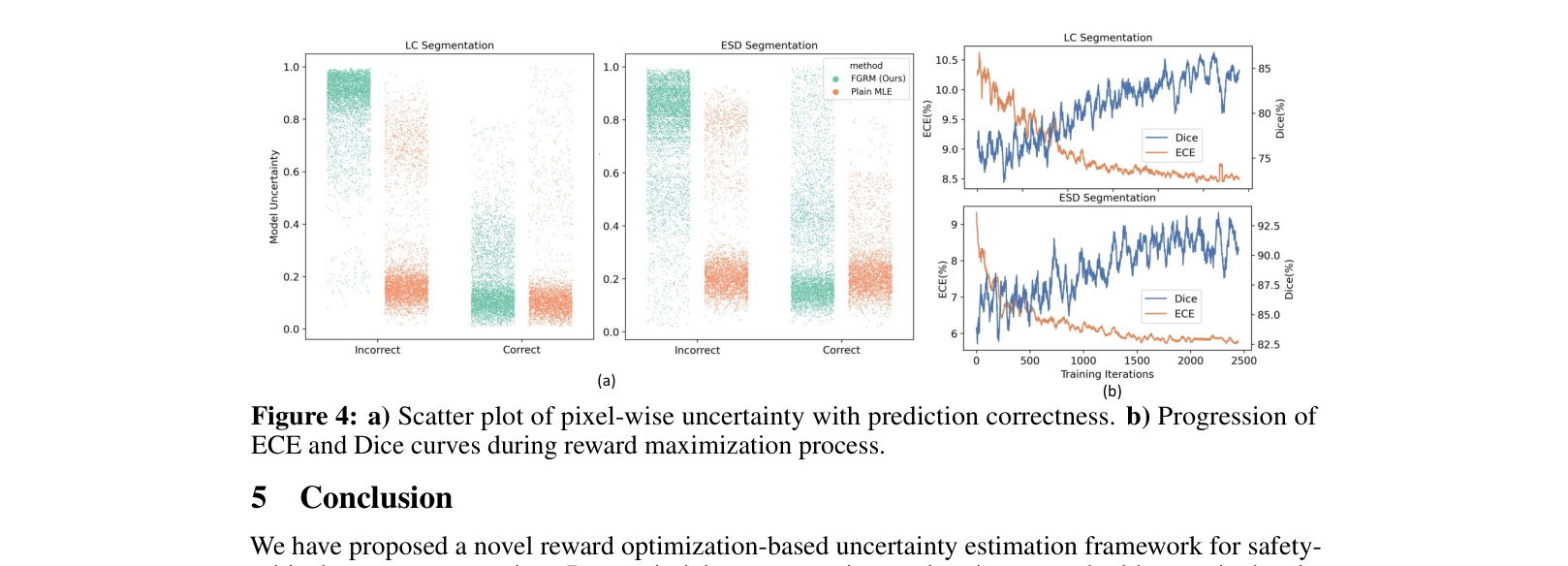
- Current approaches often lack explicit guidance for calibrating prediction risk, resulting in over-confidence on out-of-distribution data or ambiguous tissue boundaries
- Standard reinforcement learning updates are uniform across parameters, which is suboptimal for dense segmentation tasks where parameter importance varies significantly
Concrete Example:
In a laparoscopic surgery scene, a standard segmentation model might classify an ambiguous boundary between the liver and fat with high confidence (low uncertainty) because it was trained only on segmentation accuracy (Dice), potentially leading a surgical robot to make a dangerous cut.
Key Novelty
Fine-Grained Reward Maximization (FGRM)
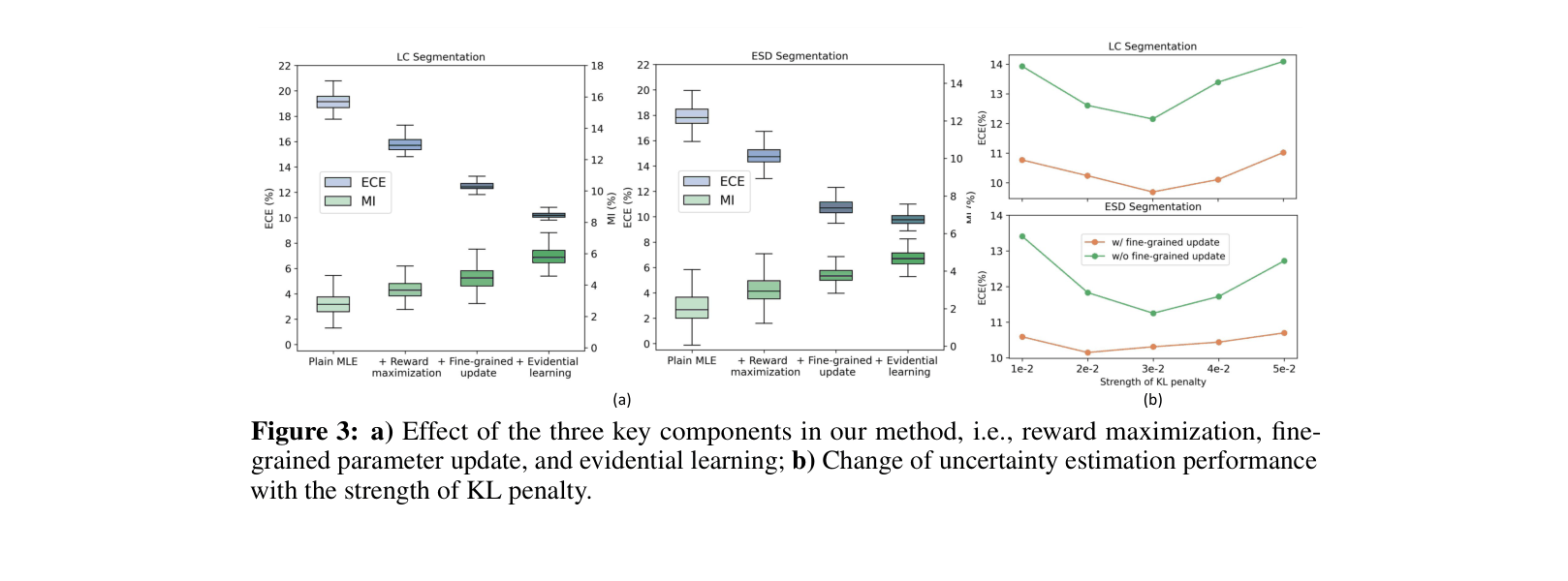
- Treats uncertainty estimation as a reward maximization problem where the reward is directly the calibration metric (e.g., negative Expected Calibration Error), rather than a proxy loss
- Uses the diagonal of the Fisher Information Matrix to weigh parameter updates, assigning larger updates to parameters that are more important for the model's output distribution
Architecture
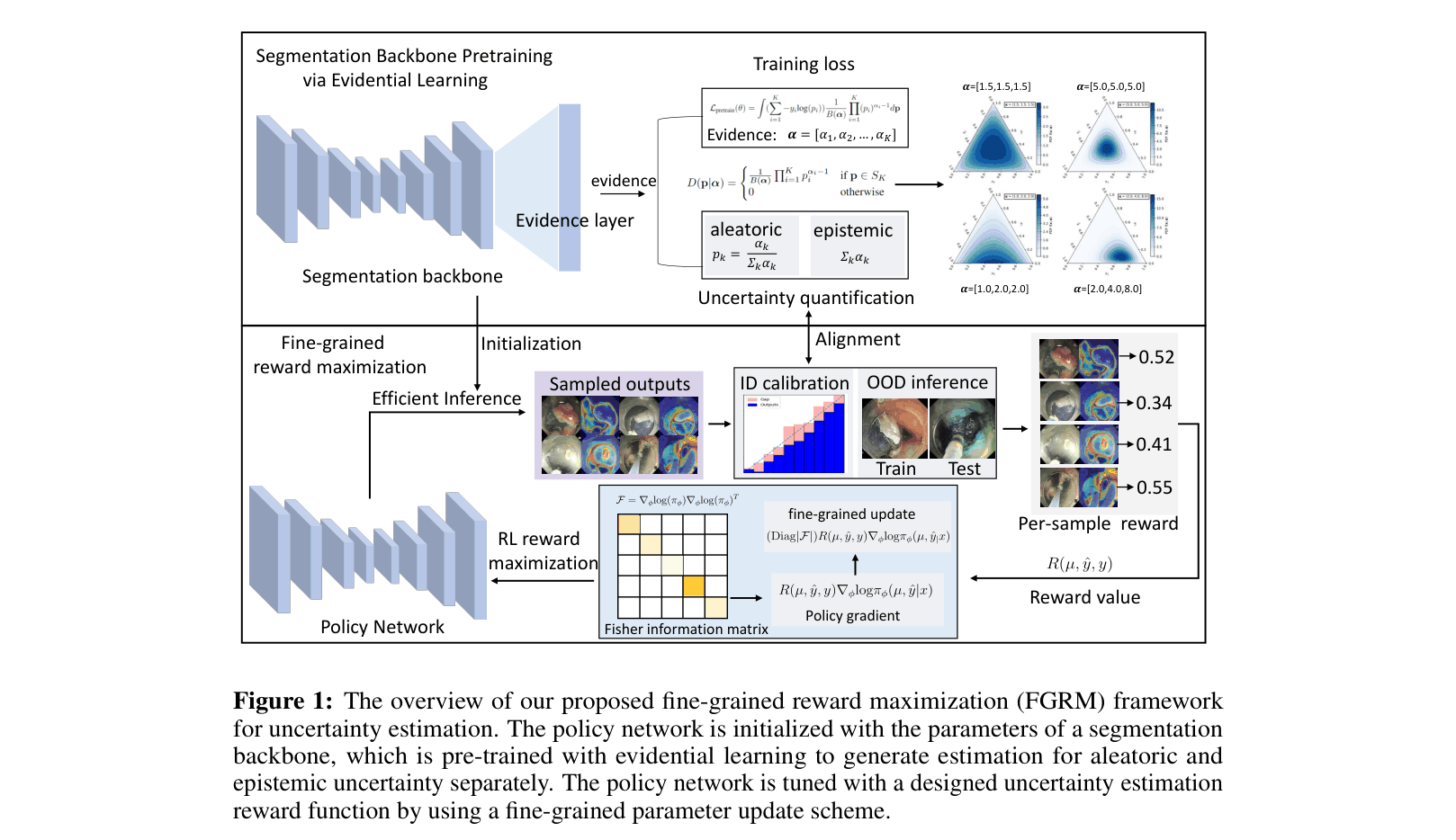
Overview of the FGRM framework, illustrating the pre-training and RL fine-tuning phases
Evaluation Highlights
- Reduces In-Distribution Expected Calibration Error (ECE) by ~2.1 points (11.74 -> 9.63) compared to state-of-the-art NatPN on the Laparoscopic Cholecystectomy dataset
- Improves Out-of-Distribution detection (Pixel Ratio) by +0.29 over NatPN and +0.93 over Deep Ensemble on the LC dataset
- Maintains real-time inference speed (0.052ms per image) while significantly outperforming ensemble methods (0.201ms) on calibration metrics
Breakthrough Assessment
8/10
Novel application of RL to fine-tune uncertainty calibration directly. The Fisher Information-based update scheme addresses the difficulty of applying RL to dense prediction tasks. Strong empirical results on medical datasets.